Inno Alessandro, Veccia Antonello, D'Argento Ettore, Morgillo Floriana, Pizzutilo Elio Gregory, Vitiello Fabiana, Pavan Alberto, Lombardo Fiorella, Russano Marco, Sforza Vincenzo, Colamartini Francesca, Genova Carlo, Chiari Rita, Cristofano Antonella, Delconte Alessandro, Vattemi Emanuela, Dessi Alessandra, Galanti Daniele, Busato Simona, Palazzolo Giovanni, Savastano Clementina, Bianco Antonio, Verderame Francesco, Mazzi Cristina, Marchetti Fabiana, Kinspergher Stefania, Occhipinti Denis, Corte Carminia Maria Della, Piscazzi Daniele, Gilli Marina, Bria Emilio, Caffo Orazio, Gori Stefania
Medical Oncology, IRCCS Sacro Cuore Don Calabria Hospital, Negrar Di Valpolicella, Verona, Italy.
Medical Oncology, Santa Chiara Hospital, Largo Medaglie D'Oro, 9, 38122, Trento, Italy.
Cancer Immunol Immunother. 2025 Jul 12;74(8):266. doi: 10.1007/s00262-025-04125-w.
This multi-center, observational cohort study aimed to evaluate the real-world effectiveness and safety of two first-line chemoimmunotherapy combinations-pembrolizumab plus chemotherapy and nivolumab/ipilimumab plus chemotherapy-in patients with metastatic non-small cell lung cancer (NSCLC) and programmed death ligand-1 (PD-L1) expression < 50%.
The primary objectives were progression-free survival (PFS) and overall survival (OS) in the overall population. Secondary objectives included the incidence of chemotherapy-related and immune-related adverse events (irAEs).
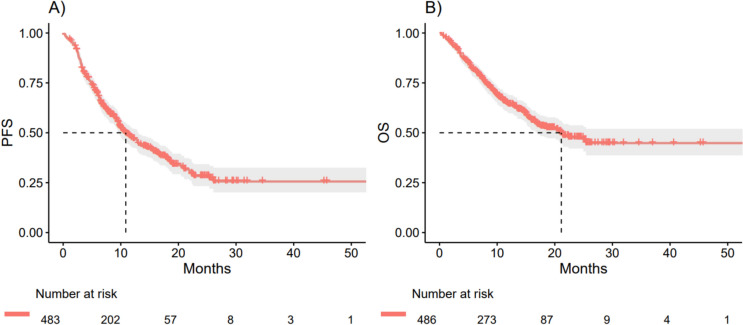
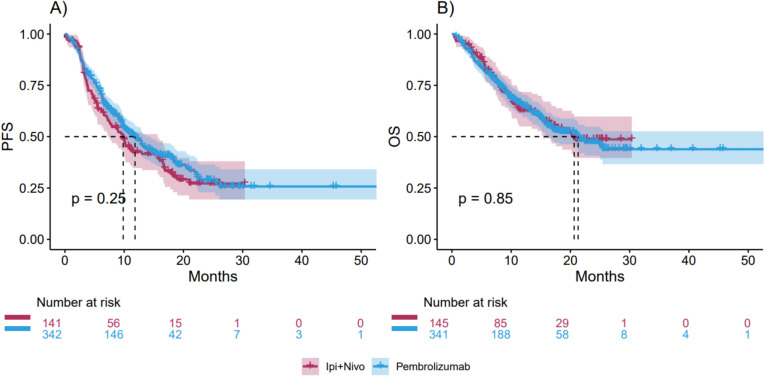
A total of 495 patients were enrolled, with 348 (70.3%) receiving pembrolizumab plus chemotherapy and 147 (29.7%) treated with nivolumab/ipilimumab plus chemotherapy. Overall, median follow-up was 11 (95% CI: 10.2 12.2) months. The median PFS was 10.9 months (95% CI: 9.6-13), and the median OS was 21.1 months (95% CI: 16.8-NR) in the overall population. In multivariable analysis, ECOG PS ≥ 2, PD-L1 expression < 1%, squamous histology, baseline steroid use, and the presence of CNS, bone, or liver metastases were significantly associated with shorter survival. No significant differences were observed between the pembrolizumab and nivolumab/ipilimumab cohorts in terms of PFS (11.83 vs. 9.83 months; HR 0.86, 95% CI: 0.67-1.11, p = 0.3) or OS (21.3 vs. 20.6 months; HR 1.03, 95% CI: 0.76-1.39, p = 0.9). Chemotherapy-related adverse events were more frequent in the pembrolizumab cohort, whereas irAEs were more common in the nivolumab/ipilimumab cohort.
In this real-world study, chemoimmunotherapy combinations demonstrated manageable toxicity profiles, with effectiveness comparable to that reported in pivotal phase 3 randomized trials. Pembrolizumab and nivolumab/ipilimumab showed similar real-world effectiveness but significantly different toxicity profiles.
这项多中心观察性队列研究旨在评估两种一线化疗免疫联合方案——帕博利珠单抗联合化疗以及纳武利尤单抗/伊匹木单抗联合化疗——在转移性非小细胞肺癌(NSCLC)且程序性死亡配体1(PD-L1)表达<50%患者中的真实世界有效性和安全性。
主要目标是总体人群中的无进展生存期(PFS)和总生存期(OS)。次要目标包括化疗相关和免疫相关不良事件(irAE)的发生率。
共纳入495例患者,其中348例(70.3%)接受帕博利珠单抗联合化疗,147例(29.7%)接受纳武利尤单抗/伊匹木单抗联合化疗。总体而言,中位随访时间为11(95%CI:10.2 - 12.2)个月。总体人群中,中位PFS为10.9个月(95%CI:9.6 - 13),中位OS为21.1个月(95%CI:16.8 - NR)。在多变量分析中,东部肿瘤协作组体能状态(ECOG PS)≥2、PD-L1表达<1%、鳞状组织学、基线使用类固醇以及存在中枢神经系统、骨骼或肝脏转移与较短生存期显著相关。帕博利珠单抗组和纳武利尤单抗/伊匹木单抗组在PFS(11.83对9.83个月;风险比[HR]0.86,95%CI:0.67 - 1.11,p = 0.3)或OS(21.3对20.6个月;HR 1.03,95%CI:0.76 - 1.39,p = 0.9)方面未观察到显著差异。化疗相关不良事件在帕博利珠单抗组更常见,而irAE在纳武利尤单抗/伊匹木单抗组更常见。
在这项真实世界研究中,化疗免疫联合方案显示出可管理的毒性特征,有效性与关键的3期随机试验报告的相当。帕博利珠单抗和纳武利尤单抗/伊匹木单抗显示出相似的真实世界有效性,但毒性特征显著不同。