Herrick Allison L, Kiser Jennifer N, White Stephen N, Neibergs Holly L
Department of Animal Sciences, Washington State University, Pullman, WA 99164, USA.
Washington Animal Disease Diagnostics Laboratory, Pullman, WA 99164, USA.
Genes (Basel). 2025 Jun 26;16(7):741. doi: 10.3390/genes16070741.
BACKGROUND/OBJECTIVES: Bovine respiratory disease (BRD) is a common disease impacting cattle throughout the US. BRD is a multifactorial disease as disease risk varies with the genetic profile of the host, environmental conditions, and pathogen exposure. Selection for enhanced BRD resistant cattle can aid in reducing BRD. The objectives of this study were to identify loci, gene sets, and genes associated and enriched for BRD in pre- and post-weaned Holstein cattle.
Cases consisted of 2147 and 5607 calves treated for BRD as pre-weaned (0-60 days old) and post-weaned (61-420 days old) calves, respectively. Controls consisted of calves untreated for BRD that remained in the herd for 61 ( = 14,219) days for pre-weaned or 421 ( = 12,242) days for post-weaned calves. A genome-wide association analysis (GWAA) identified loci and positional candidate genes associated with BRD (uncorrected < 1 × 10) for additive, dominant, and recessive inheritance models. A gene set enrichment analysis (GSEA-SNP) identified gene sets and leading-edge genes enriched (NES ≥ 3) for BRD.
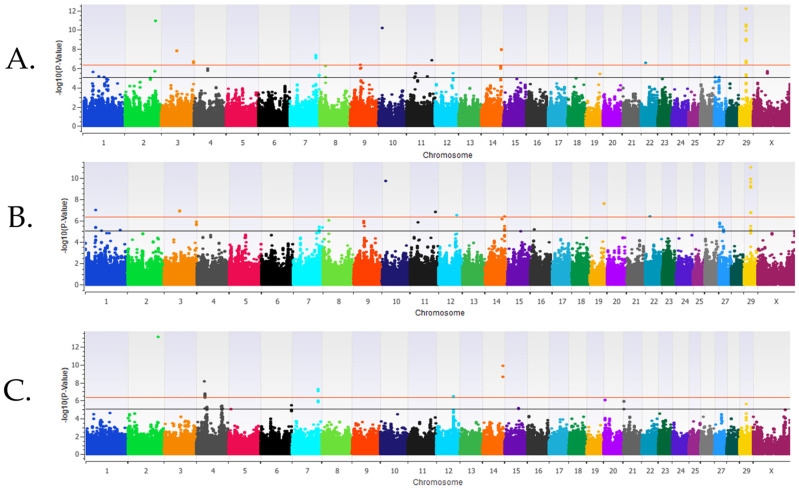
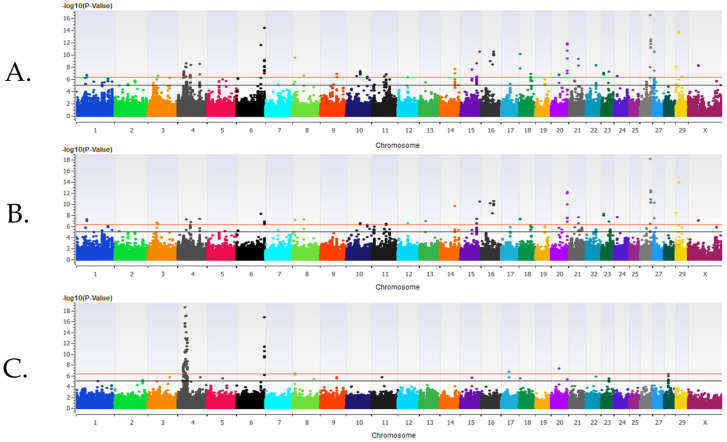
In pre-weaned calves, 62 loci and 123 positional candidate genes were associated ( < 1 × 10) in addition to the 12 gene sets and 126 leading-edge genes enriched (NES ≥ 3) for BRD. In post-weaned calves, 181 loci and 185 positional candidate genes were associated ( < 1 × 10), and 63 gene sets and 849 leading-edge genes were enriched (NES ≥ 3) for BRD.
These results provide further insight and validation of genomic regions that enhance selection for BRD resistance and for healthier cattle.
背景/目的:牛呼吸道疾病(BRD)是一种在美国影响牛群的常见疾病。BRD是一种多因素疾病,因为疾病风险会因宿主的基因概况、环境条件和病原体暴露情况而有所不同。选择增强抗BRD能力的牛有助于减少BRD的发生。本研究的目的是在断奶前和断奶后的荷斯坦犊牛中鉴定与BRD相关和富集的基因座、基因集和基因。
病例分别包括2147头和5607头接受BRD治疗的断奶前(0 - 60日龄)和断奶后(61 - 420日龄)犊牛。对照包括未接受BRD治疗且在牛群中分别停留61天(断奶前,n = 14219)或421天(断奶后,n = 12242)的犊牛。全基因组关联分析(GWAA)确定了与BRD相关的基因座和位置候选基因(未校正p < 1×10),适用于加性、显性和隐性遗传模型。基因集富集分析(GSEA - SNP)确定了BRD富集的基因集和前沿基因(NES≥3)。
在断奶前犊牛中,除了12个富集的基因集和126个前沿基因(NES≥3)与BRD相关外,还有62个基因座和123个位置候选基因(p < 1×10)。在断奶后犊牛中,有181个基因座和185个位置候选基因(p < 1×10)与BRD相关,并且有63个基因集和849个前沿基因(NES≥3)与BRD富集。
这些结果为增强抗BRD能力和培育更健康牛的基因组区域提供了进一步的见解和验证。