Ismail Fatima, Khawaja Sajid Gul, Khan Asad Mansoor, Shah Umer Hameed, Akram Muhammad Usman, Shaukat Arslan
College of Electrical and Mechanical Engineering, National University of Sciences and Technology, Islamabad, Pakistan.
Faculty of Engineering, Electrical, Computer and Biomedical Engineering Department, Abu Dhabi University, Abu Dhabi, United Arab Emirates.
Sci Rep. 2025 Jul 29;15(1):27604. doi: 10.1038/s41598-025-12277-z.
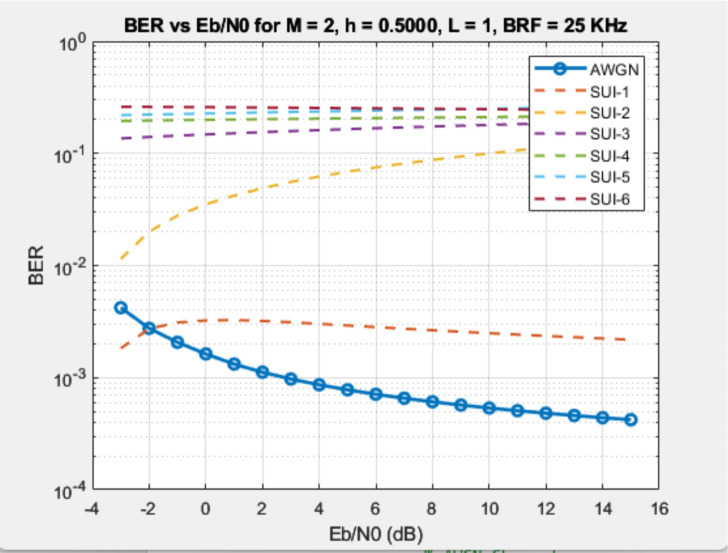
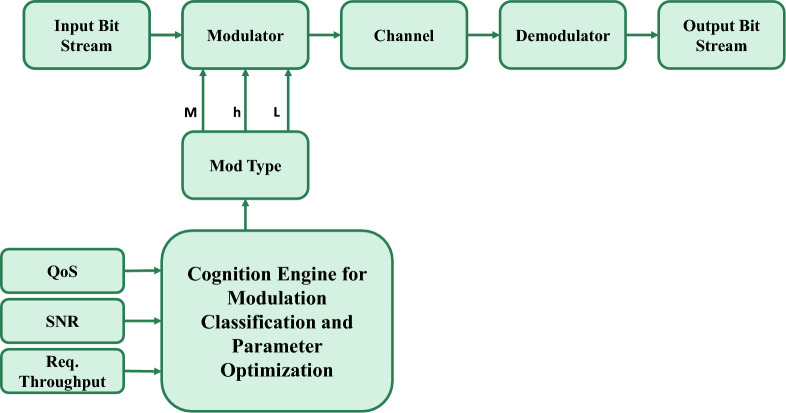
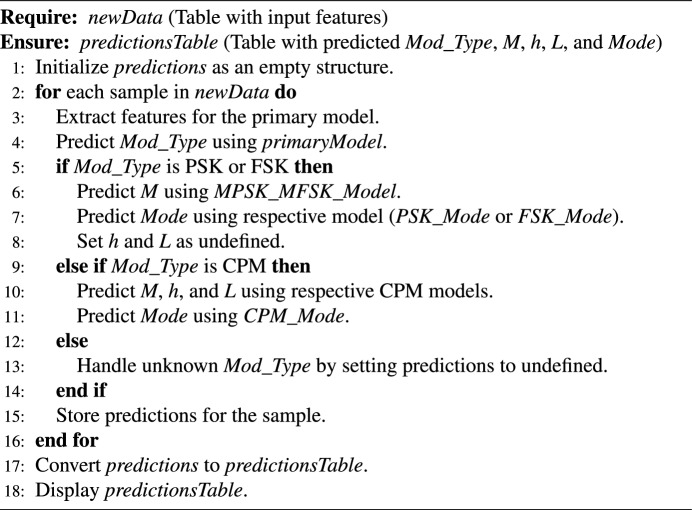
The demand for faster data transfer rates rises along with the number of mobile devices, such as smartphones and IoT gadgets, which makes the radio spectrum more crowded. The forthcoming 5G wireless communication technology seeks to significantly enhance data speeds and spectrum efficiency by dynamically adjusting to fluctuating channel conditions. This research presents a new approach in the form of a hierarchical machine learning system for automation of modulation classification and adaptive parameter selection that optimizes spectral efficiency for different communication channels. A hierarchical approach is adopted in place of traditional methods that classify modulation schemes as separate entities. This method first predicts the modulation type (e.g., PSK, FSK, CPM), and subsequently determines the optimal parameters (M, h, L) corresponding to the identified channel conditions. During experimentation, seven modulation schemes were tested (2-PSK, 4-PSK, 8-PSK, 2-FSK, 4-FSK, 8-FSK, and CPM) for different modulation orders ([Formula: see text]) and spectral efficiencies [Formula: see text] as well as for overlap factors [Formula: see text]. A detailed MATLAB simulation was built and signals were transmitted over different channels (AWGN and SUI Stanford University Interin) for evaluation over different frequency ranges. Performance of our proposed hierarchical framework was examined based on the Bit Error Rate (BER) and achievable data rate in different signal-to-noise ratio (SNR) situations. The accuracy achieved by our proposed hierarchical classifier was 98.57%, proving effectiveness in adaptive modulation selection. These achievements suggest plainly how cognitive radio systems and next generation wireless networks can benefit by the real-time spectrum adaptation and improvement in data reliability in transmission.
随着智能手机和物联网设备等移动设备数量的增加,对更快数据传输速率的需求也在上升,这使得无线电频谱变得更加拥挤。即将推出的5G无线通信技术旨在通过动态适应波动的信道条件来显著提高数据速度和频谱效率。本研究提出了一种新的方法,即采用分层机器学习系统实现调制分类自动化和自适应参数选择,以优化不同通信信道的频谱效率。采用分层方法取代了将调制方案作为单独实体进行分类的传统方法。该方法首先预测调制类型(例如,PSK、FSK、CPM),随后确定与所识别的信道条件相对应的最佳参数(M、h、L)。在实验过程中,针对不同的调制阶数([公式:见原文])、频谱效率[公式:见原文]以及重叠因子[公式:见原文],对七种调制方案(2-PSK、4-PSK、8-PSK、2-FSK、4-FSK、8-FSK和CPM)进行了测试。构建了详细的MATLAB仿真,并在不同信道(AWGN和SUI斯坦福大学Interin)上传输信号,以在不同频率范围内进行评估。基于误码率(BER)和不同信噪比(SNR)情况下可实现的数据速率,对我们提出的分层框架的性能进行了检验。我们提出的分层分类器所达到的准确率为98.57%,证明了其在自适应调制选择方面的有效性。这些成果清楚地表明了认知无线电系统和下一代无线网络如何能够从实时频谱自适应和传输中数据可靠性的提高中受益。