
植物发育阶段对硬粒小麦光合适应高浓度[CO]的影响
Impact of Plant Developmental Stage on Photosynthetic Acclimation to Elevated [CO] in Durum Wheat.
作者信息
Torralbo Fernando, Munné-Bosch Sergi, González-Murua Carmen, Aranjuelo Iker
机构信息
Department of Botany, Ecology and Plant Physiology, University of Cordoba, 14071 Córdoba, Spain.
Department of Evolutionary Biology, Ecology and Environmental Sciences, Faculty of Biology, University of Barcelona, 08028 Barcelona, Spain.
出版信息
Plants (Basel). 2025 Jul 18;14(14):2224. doi: 10.3390/plants14142224.
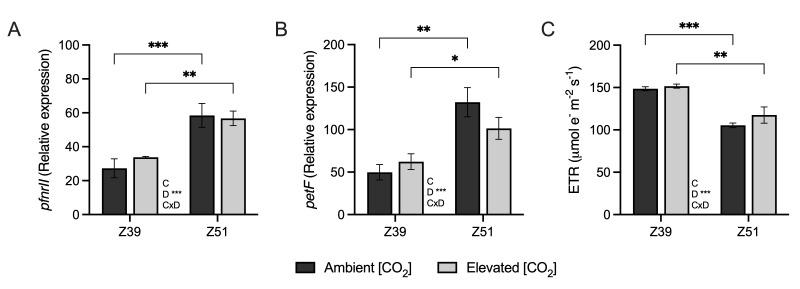
The response of plants to elevated atmospheric [CO] is highly dynamic and influenced by developmental stage, yet its role in photosynthetic acclimation remains underexplored. This study examines the physiological and molecular responses of wheat (, var. Amilcar) to elevated [CO] (700 ppm vs. 400 ppm) at two distinct developmental stages: the vegetative stage at the end of the elongation stage and the reproductive stage at the beginning of ear emergence (Z39 and Z51, respectively). Wheat plants at the developmental stage Z39, cultivated under elevated [CO], maintained photosynthetic rates despite a carbohydrate build-up. However, at Z51, photosynthetic acclimation became more evident as the decline in Rubisco carboxylation capacity (Vc) persisted, but also stomatal conductance and diffusion were decreased. This was accompanied by the up-regulation of the and genes, likely as a compensatory mechanism to maintain CO supply. Additionally, hormonal adjustments under elevated [CO], including increased auxin and bioactive cytokinins (zeatin and isopentenyl adenine), may have contributed to delayed senescence and nitrogen remobilization, sustaining carbon assimilation despite biochemical constraints. These findings highlight the developmental regulation of photosynthetic acclimation, emphasizing the need for the stage-specific assessments of crop responses to future atmospheric conditions.
植物对大气中[CO]浓度升高的响应具有高度动态性,且受发育阶段影响,但其在光合适应中的作用仍未得到充分研究。本研究考察了小麦(品种阿米尔卡)在两个不同发育阶段对[CO]浓度升高(700 ppm与400 ppm)的生理和分子响应:拔节末期的营养生长阶段和抽穗初期的生殖生长阶段(分别为Z39和Z51)。处于Z39发育阶段的小麦植株,在[CO]浓度升高的条件下栽培,尽管碳水化合物积累,但仍保持光合速率。然而,在Z51阶段,随着核酮糖-1,5-二磷酸羧化酶羧化能力(Vc)持续下降,光合适应变得更加明显,同时气孔导度和扩散也降低。这伴随着 和 基因的上调,可能是维持CO供应的一种补偿机制。此外,[CO]浓度升高条件下的激素调节,包括生长素和生物活性细胞分裂素(玉米素和异戊烯基腺嘌呤)增加,可能有助于延缓衰老和氮素再利用,尽管存在生化限制仍能维持碳同化。这些发现突出了光合适应的发育调控,强调了对作物对未来大气条件响应进行阶段特异性评估的必要性。




 Zotero 插件