
通过消费型智能手表测量的轻度至中度帕金森病患者每日平均步数的最小临床重要差异:横断面研究
Minimal Clinically Important Difference of Average Daily Steps Measured Through a Consumer Smartwatch in People With Mild-to-Moderate Parkinson Disease: Cross-Sectional Study.
作者信息
Bianchini Edoardo, Alborghetti Marika, Galli Silvia, Hansen Clint, Zampogna Alessandro, Suppa Antonio, Salvetti Marco, Pontieri Francesco Ernesto, Rinaldi Domiziana, Vuillerme Nicolas
机构信息
Department of Neuroscience, Mental Health and Sensory Organs (NESMOS), Sapienza University of Rome, Via di Grottarossa 1035, Rome, 00189, Italy, 39 0633775579.
AGEIS, Université Grenoble Alpes, Grenoble, France.
出版信息
JMIR Mhealth Uhealth. 2025 Jul 29;13:e64213. doi: 10.2196/64213.
BACKGROUND
Recent studies demonstrated the validity, reliability, and accuracy of consumer smartwatches for measuring daily steps in people with Parkinson disease (PD). However, no study to date has estimated the minimal clinically important difference (MCID) for average daily steps (avDS), measured through a consumer smartwatch in people with PD.
OBJECTIVE
This study aimed to calculate the MCID of avDS, measured through a commercial smartwatch (Garmin Vivosmart 4) in people with PD.
METHODS
People with PD with a disease stage <4, without cognitive impairment, and who were able to walk unaided, wore a Garmin Vivosmart 4 smartwatch for 5 consecutive days on the wrist least affected by the disease, allowing the computation of avDS. To define the 3 levels of MCID for avDS, we used an anchor-based method linked to: (1) scales capturing subtle changes in global mobility and motor functions, (2) clinical and health-related measures, and (3) disease-related patient-reported outcomes. Linear regressions, Student t test, and ANOVA were used to estimate the minimal change in avDS based on anchors relevant change. For each level, the overall MCID was calculated as the average of the variables included, and the range was reported.
RESULTS
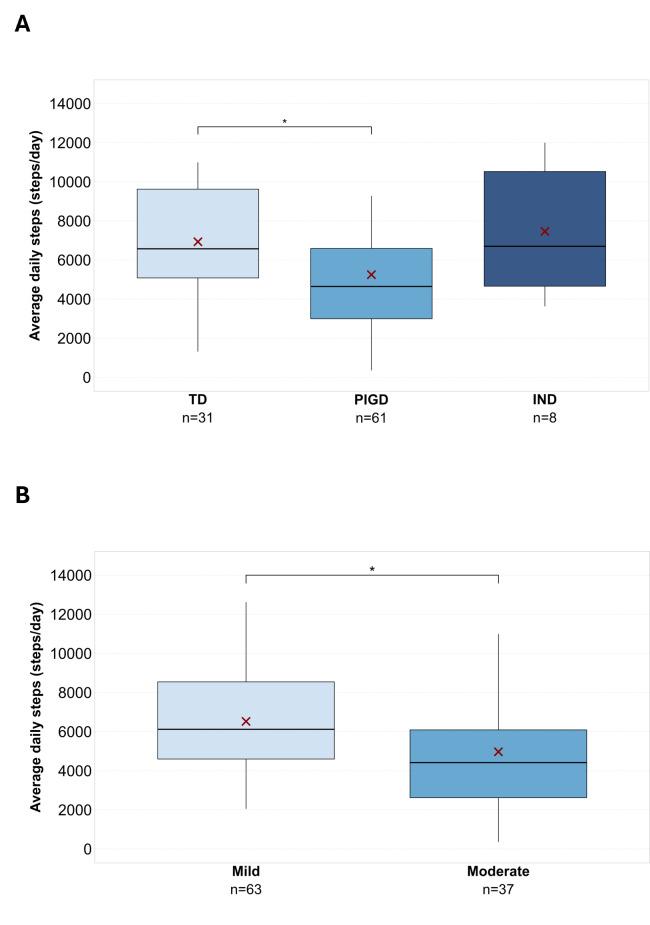
A total of 100 people with PD were enrolled. Participants took on average 5949 (SD 3034) daily steps, ranging from 357 to 12,620. The MCID of avDS anchored to standardized measures of motor symptoms and mobility was 581 steps/day (range 554-608) or around 10% of mean avDS in our population. The MCID of avDS anchored to clinical and health-related variables was 1200 steps/day (range 350-1683), or around 20% of mean avDS in our population. Finally, the MCID of avDS anchored to disease-related patient-reported outcomes was 1592 steps/day (range 594-2589), or around 27% of the mean avDS in our population.
CONCLUSIONS
These findings could be relevant for designing future clinical trials involving avDS as a digital mobility outcome in daily life for people with PD and evaluating the effectiveness of the intervention promoting free-living walking in this population.
背景
最近的研究证明了消费型智能手表在测量帕金森病(PD)患者每日步数方面的有效性、可靠性和准确性。然而,迄今为止,尚无研究估计通过消费型智能手表测量的PD患者平均每日步数(avDS)的最小临床重要差异(MCID)。
目的
本研究旨在计算通过商业智能手表(佳明Vivosmart 4)测量的PD患者avDS的MCID。
方法
疾病分期<4、无认知障碍且能够独立行走的PD患者,在受疾病影响最小的手腕上连续佩戴佳明Vivosmart 4智能手表5天,以计算avDS。为了定义avDS的3个MCID水平,我们使用了一种基于锚定的方法,该方法与以下方面相关:(1)捕捉整体运动能力和运动功能细微变化的量表,(2)临床和健康相关指标,以及(3)与疾病相关的患者报告结局。使用线性回归、学生t检验和方差分析,根据锚定相关变化估计avDS的最小变化。对于每个水平,计算总体MCID作为所包含变量的平均值,并报告范围。
结果
共招募了100名PD患者。参与者平均每天走5949步(标准差3034),范围为357步至12620步。以运动症状和运动能力的标准化测量为锚定的avDS的MCID为581步/天(范围554 - 608),约占我们研究人群平均avDS的10%。以临床和健康相关变量为锚定的avDS的MCID为1200步/天(范围350 - 1683),约占我们研究人群平均avDS的20%。最后,以与疾病相关的患者报告结局为锚定的avDS的MCID为1592步/天(范围594 - 2589),约占我们研究人群平均avDS的27%。
结论
这些发现可能与设计未来的临床试验相关,该试验将avDS作为PD患者日常生活中的数字运动结局,并评估促进该人群自由行走的干预措施的有效性。



 Zotero 插件