Xue Hui, Hooper Sarah M, Pierce Iain, Davies Rhodri H, Stairs John, Naegele Joseph, Campbell-Washburn Adrienne E, Manisty Charlotte, Moon James C, Treibel Thomas A, Kellman Peter, Hansen Michael S
Microsoft Research, Health Futures, Redmond, WA, USA.
National Heart, Lung and Blood Institute, National Institutes of Health, Bethesda, MD, USA.
ArXiv. 2025 Mar 23:arXiv:2503.18162v1.
To develop and evaluate a new deep learning MR denoising method that leverages quantitative noise distribution information from the reconstruction process to improve denoising performance and generalization.
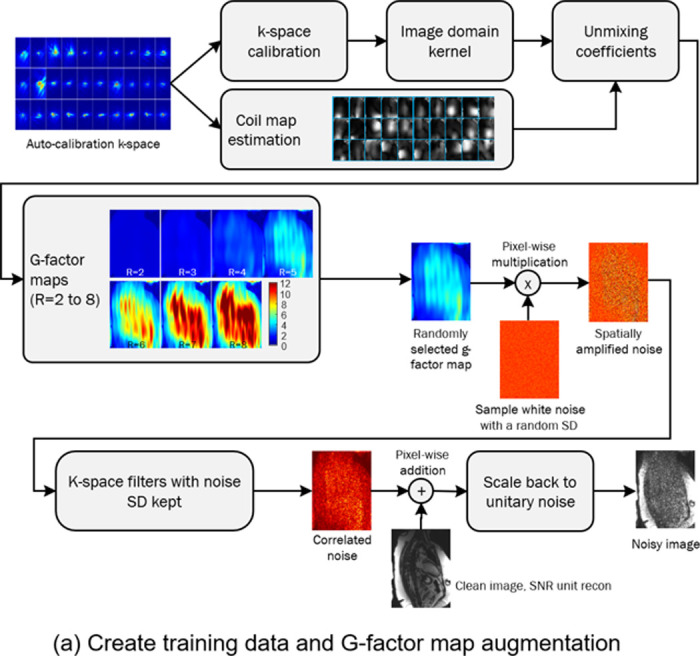
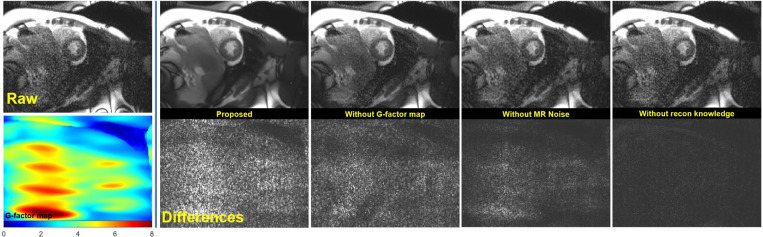
This retrospective study trained 14 different transformer and convolutional models with two backbone architectures on a large dataset of 2,885,236 images from 96,605 cardiac retro-gated cine complex series acquired at 3T. The proposed training scheme, termed SNRAware, leverages knowledge of the MRI reconstruction process to improve denoising performance by (1) simulating large, high quality, and diverse synthetic datasets, and (2) providing quantitative information about the noise distribution to the model. In-distribution testing was performed on a hold-out dataset of 3000 samples with performance measured using PSNR and SSIM, with ablation comparison without the noise augmentation. Out-of-distribution tests were conducted on cardiac real-time cine, first-pass cardiac perfusion, and neuro and spine MRI, all acquired at 1.5T, to test model generalization across imaging sequences, dynamically changing contrast, different anatomies, and field strengths.
The in-distribution tests showed that SNRAware training resulted in the best performance for all 14 models tested, better than those trained without the proposed synthetic data generation process or knowledge of the noise distribution. Models trained without any reconstruction knowledge were the most inferior. The improvement was architecture agnostic and shown for both convolution and transformer attention-based models; among them, the transformer models outperformed their convolutional counterparts and training with 3D input tensors improved performance over only using 2D images. The best model found in the in-distribution test generalized well to out-of-distribution samples, delivering 6.5× and 2.9× CNR improvement for real-time cine and perfusion imaging, respectively. Further, a model trained with 100% cardiac cine data generalized well to a T1 MPRAGE neuro 3D scan and T2 TSE spine MRI.
An SNRAware training scheme was proposed to leverage information from the MRI reconstruction process in deep learning denoising training, resulting in improved performance and good generalization properties.
开发并评估一种新的深度学习磁共振去噪方法,该方法利用重建过程中的定量噪声分布信息来提高去噪性能和泛化能力。
这项回顾性研究在一个包含来自96605个心脏回顾门控电影复杂序列的2885236张图像的大型数据集上,使用两种骨干架构训练了14种不同的变压器和卷积模型。所提出的训练方案称为SNRAware,它通过(1)模拟大型、高质量和多样化的合成数据集,以及(2)向模型提供有关噪声分布的定量信息,利用MRI重建过程的知识来提高去噪性能。在一个包含3000个样本的保留数据集上进行分布内测试,使用PSNR和SSIM测量性能,并与无噪声增强的消融比较。在心脏实时电影、首次通过心脏灌注以及神经和脊柱MRI(均在1.5T下采集)上进行分布外测试,以测试模型在不同成像序列、动态变化的对比度、不同解剖结构和场强下的泛化能力。
分布内测试表明,SNRAware训练使所有14个测试模型都取得了最佳性能,优于那些没有使用所提出的合成数据生成过程或噪声分布知识进行训练的模型。没有任何重建知识训练的模型表现最差。这种改进与架构无关,在基于卷积和变压器注意力的模型中均有体现;其中,变压器模型优于其对应的卷积模型,并且使用3D输入张量进行训练比仅使用2D图像能提高性能。在分布内测试中找到的最佳模型对分布外样本具有良好的泛化能力,分别使实时电影和灌注成像的CNR提高了6.5倍和2.9倍。此外,一个用100%心脏电影数据训练的模型对T1 MPRAGE神经3D扫描和T2 TSE脊柱MRI具有良好的泛化能力。
提出了一种SNRAware训练方案,以在深度学习去噪训练中利用MRI重建过程的信息,从而提高性能并具有良好的泛化特性。