From the Cardiovascular Branch, Division of Intramural Research, National Heart, Lung, and Blood Institute, National Institutes of Health, Bethesda, Md (A.E.C.W., R.R., M.C.R., I.B., B.B., D.A.H., M.S.H., T.R., W.P.B., D.R.M., C.M., M.Y.C., R.J.L.); Siemens Healthcare GmbH, Erlangen, Germany (D.G., R.S.); Siemens Medical Solutions Inc, Malvern Pa (W.M., H.B.); Systems Biology Center, Division of Intramural Research, National Heart, Lung, and Blood Institute, National Institutes of Health, 10 Center Dr, Building 10, Room 4C-1581, Bethesda, MD 20892-1458 (H.X., P.K., R.S.B.); Pulmonary Branch, Division of Intramural Research, National Heart, Lung, and Blood Institute, National Institutes of Health, Bethesda, MD (J.M.); Department of Radiology and Imaging Sciences, Clinical Center, National Institutes of Health, Bethesda, Md (A.A.M., E.C.J.); and Laboratory of Functional and Molecular Imaging, Division of Intramural Research, National Institute of Neurologic Disorders and Stroke, National Institutes of Health, Bethesda, Md (A.P.K.).
Radiology. 2019 Nov;293(2):384-393. doi: 10.1148/radiol.2019190452. Epub 2019 Oct 1.
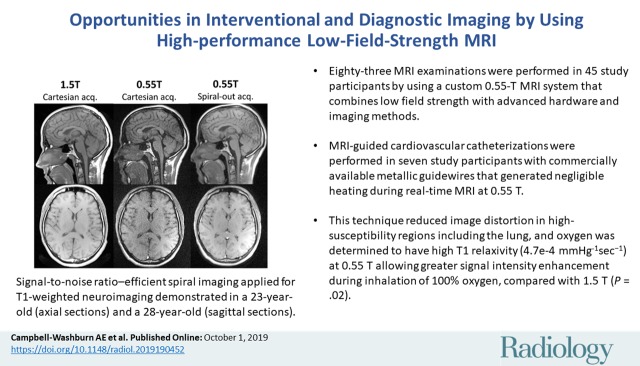
Background Commercial low-field-strength MRI systems are generally not equipped with state-of-the-art MRI hardware, and are not suitable for demanding imaging techniques. An MRI system was developed that combines low field strength (0.55 T) with high-performance imaging technology. Purpose To evaluate applications of a high-performance low-field-strength MRI system, specifically MRI-guided cardiovascular catheterizations with metallic devices, diagnostic imaging in high-susceptibility regions, and efficient image acquisition strategies. Materials and Methods A commercial 1.5-T MRI system was modified to operate at 0.55 T while maintaining high-performance hardware, shielded gradients (45 mT/m; 200 T/m/sec), and advanced imaging methods. MRI was performed between January 2018 and April 2019. T1, T2, and T2* were measured at 0.55 T; relaxivity of exogenous contrast agents was measured; and clinical applications advantageous at low field were evaluated. Results There were 83 0.55-T MRI examinations performed in study participants (45 women; mean age, 34 years ± 13). On average, T1 was 32% shorter, T2 was 26% longer, and T2* was 40% longer at 0.55 T compared with 1.5 T. Nine metallic interventional devices were found to be intrinsically safe at 0.55 T (<1°C heating) and MRI-guided right heart catheterization was performed in seven study participants with commercial metallic guidewires. Compared with 1.5 T, reduced image distortion was shown in lungs, upper airway, cranial sinuses, and intestines because of improved field homogeneity. Oxygen inhalation generated lung signal enhancement of 19% ± 11 (standard deviation) at 0.55 T compared with 7.6% ± 6.3 at 1.5 T ( = .02; five participants) because of the increased T1 relaxivity of oxygen (4.7e-4 mmHgsec). Efficient spiral image acquisitions were amenable to low field strength and generated increased signal-to-noise ratio compared with Cartesian acquisitions ( < .02). Representative imaging of the brain, spine, abdomen, and heart generated good image quality with this system. Conclusion This initial study suggests that high-performance low-field-strength MRI offers advantages for MRI-guided catheterizations with metal devices, MRI in high-susceptibility regions, and efficient imaging. © RSNA, 2019 See also the editorial by Grist in this issue.
背景 商业低场强 MRI 系统通常不配备最先进的 MRI 硬件,也不适合要求苛刻的成像技术。我们开发了一种将低场强(0.55 T)与高性能成像技术相结合的 MRI 系统。目的 评估高性能低场强 MRI 系统的应用,特别是带有金属器械的 MRI 引导心血管导管术、高磁敏感性区域的诊断成像以及高效的图像采集策略。材料与方法 将商业 1.5 T MRI 系统改装为 0.55 T 运行,同时保持高性能硬件、屏蔽梯度(45 mT/m;200 T/m/sec)和先进的成像方法。MRI 于 2018 年 1 月至 2019 年 4 月进行。在 0.55 T 下测量 T1、T2 和 T2*;测量外源性对比剂的弛豫率;评估在低场具有优势的临床应用。结果 在研究参与者中进行了 83 次 0.55-T MRI 检查(45 名女性;平均年龄 34 岁±13 岁)。与 1.5 T 相比,0.55 T 下 T1 缩短 32%,T2 延长 26%,T2*延长 40%。9 种金属介入器械在 0.55 T 下被证明是安全的(<1°C 加热),并对 7 名研究参与者使用商业金属导丝进行了 MRI 引导的右心导管术。与 1.5 T 相比,由于场均匀性的改善,肺部、上呼吸道、颅窦和肠道的图像失真减少。0.55 T 下吸入氧气使肺部信号增强 19%±11(标准差),而 1.5 T 下为 7.6%±6.3(=.02;5 名参与者),因为氧气的 T1 弛豫率(4.7e-4 mmHgsec)增加。与笛卡尔采集相比,高效螺旋图像采集适用于低场强,可产生更高的信噪比(<.02)。该系统生成的大脑、脊柱、腹部和心脏的代表性成像具有良好的图像质量。结论 这项初步研究表明,高性能低场强 MRI 为 MRI 引导的金属器械导管术、高磁敏感性区域的 MRI 和高效成像提供了优势。