Divyasakthi Mahalingam, Sarayu Yerasala Charu Lekha, Shanmugam Dilip Kumar, Karthigadevi Guruviah, Subbaiya Ramasamy, Karmegam Natchimuthu, Kaaviya J Jessica, Chung Woo Jin, Chang Soon Woong, Ravindran Balasubramani, Khoo Kuan Shiong
Department of Biotechnology, Sri Venkateswara College of Engineering, Pennalur Sriperumbudur (Tk), Kancheepuram District, Tamil Nadu 602117, India.
Department of Chemical Engineering, Indian Institute of Technology Madras, Chennai, India.
Food Technol Biotechnol. 2025 Jun;63(2):238-261. doi: 10.17113/ftb.63.02.25.8735.
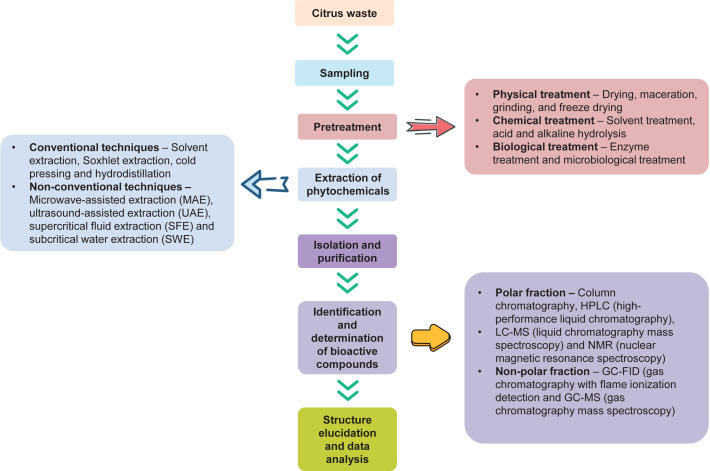
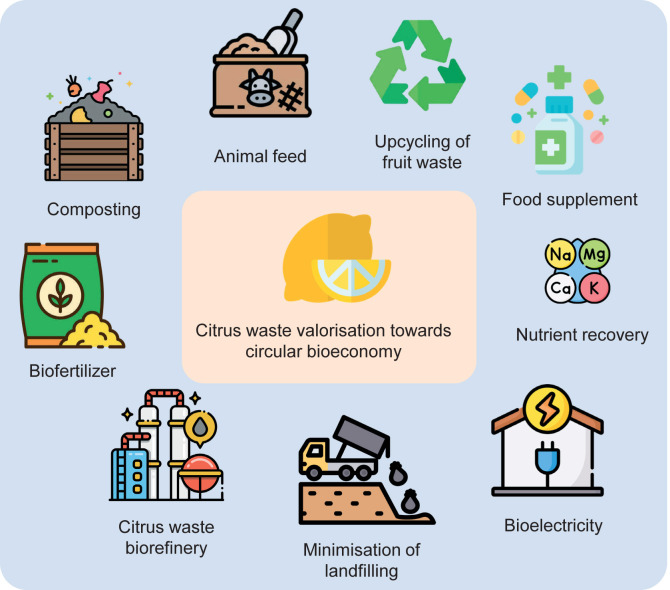
The cultivation of citrus fruits has increased significantly around the globe due to rising consumer demand. The citrus fruit processing industry produces approx. 110 to 120 million tonnes of citrus fruit waste worldwide every year. This in turn contributes to landfills and environmental pollution, and poses a risk to human health and the ecosystem. Proper recycling of citrus waste helps reduce pollution and also serves as a sustainable source for the production of different bio-based products. Abundant bioactive compounds in citrus waste offer immense economic value for the production of various useful products. Moreover, bioactive compounds found in citrus wastes have various biological properties, including antioxidant, anticancer, antimutagenic, antiplatelet, cardioprotective and antiviral activities. Instead of disposing of them directly, citrus wastes can be upcycled into various value-added products, including single-cell proteins, biopolymers, pectin, biofuel, biofertilizer and bioenergy. Citrus peels serve as a cost-effective reservoir of nutraceuticals and provide an affordable dietary option for the treatment of degenerative diseases. The citrus waste, which is used as a biofertilizer and is a rich source of phenolic compounds and carotenoids, helps to extend the shelf life of food. The aim is to maintain economic viability and sustainability with the help of recent innovations in the industry. This review discusses recent advances in the valorization of citrus fruit waste and presents innovative biotechnological approaches to extract valuable bioactive compounds such as limonene, flavonoids and pectin. These compounds are used in different sectors, from the food and pharmaceutical industries to bioenergy. Techniques such as microwave-assisted extraction (MAE) and ultrasound-assisted extraction (UAE) are characterized by high yields and energy efficiency. Techniques for sampling, pretreatment, extraction of phytochemicals, purification and identification of citrus fruit waste are also studied. Additionally, this review highlights the environmental benefits of waste valorization as part of a circular economy approach that contributes to both economic sustainability and pollution reduction.
由于消费者需求不断增加,全球柑橘类水果的种植量显著增长。柑橘类水果加工业每年在全球产生约1.1亿至1.2亿吨柑橘类水果废料。这反过来又导致了垃圾填埋和环境污染,并对人类健康和生态系统构成风险。对柑橘废料进行适当回收有助于减少污染,同时也可作为生产不同生物基产品的可持续来源。柑橘废料中丰富的生物活性化合物为生产各种有用产品提供了巨大的经济价值。此外,在柑橘废料中发现的生物活性化合物具有多种生物学特性,包括抗氧化、抗癌、抗诱变、抗血小板、心脏保护和抗病毒活性。柑橘废料无需直接丢弃,而是可以升级转化为各种增值产品,包括单细胞蛋白、生物聚合物、果胶、生物燃料、生物肥料和生物能源。柑橘皮是一种经济高效的营养保健品储存库,为治疗退行性疾病提供了一种经济实惠的饮食选择。用作生物肥料且富含酚类化合物和类胡萝卜素的柑橘废料有助于延长食品的保质期。其目的是借助该行业的最新创新来维持经济可行性和可持续性。本综述讨论了柑橘类水果废料增值利用的最新进展,并介绍了提取柠檬烯、黄酮类化合物和果胶等有价值生物活性化合物的创新生物技术方法。这些化合物被应用于从食品和制药行业到生物能源等不同领域。微波辅助萃取(MAE)和超声辅助萃取(UAE)等技术具有高产率和能源效率的特点。还研究了柑橘类水果废料的采样、预处理、植物化学物质提取、纯化和鉴定技术。此外,本综述强调了废料增值利用的环境效益,作为循环经济方法的一部分,这有助于实现经济可持续性和减少污染。