Du Ke-Jiang, Mo Bin-Yu, Hou Tao, Chen Long, Su Deng-Rong, Yin Shi-Hua
Department of Otorhinolaryngology Head and Neck Surgery, Second Affiliated Hospital of Guangxi Medical University, Nanning, Guangxi, China.
Department of Otorhinolaryngology Head and Neck Surgery, Liuzhou People's Hospital affiliated to Guangxi Medical University, Liuzhou, Guangxi, China.
PLoS One. 2025 Jul 30;20(7):e0327228. doi: 10.1371/journal.pone.0327228. eCollection 2025.
As an anti-aging protein, although studies increasingly suggest that the Klotho plays a role in the auditory system, the link between serum Klotho levels and tinnitus remains poorly characterized. The aim of this study was to investigate the associations between serum Klotho levels and tinnitus focusing on prevalence, duration and severity in middle-aged and older adults.
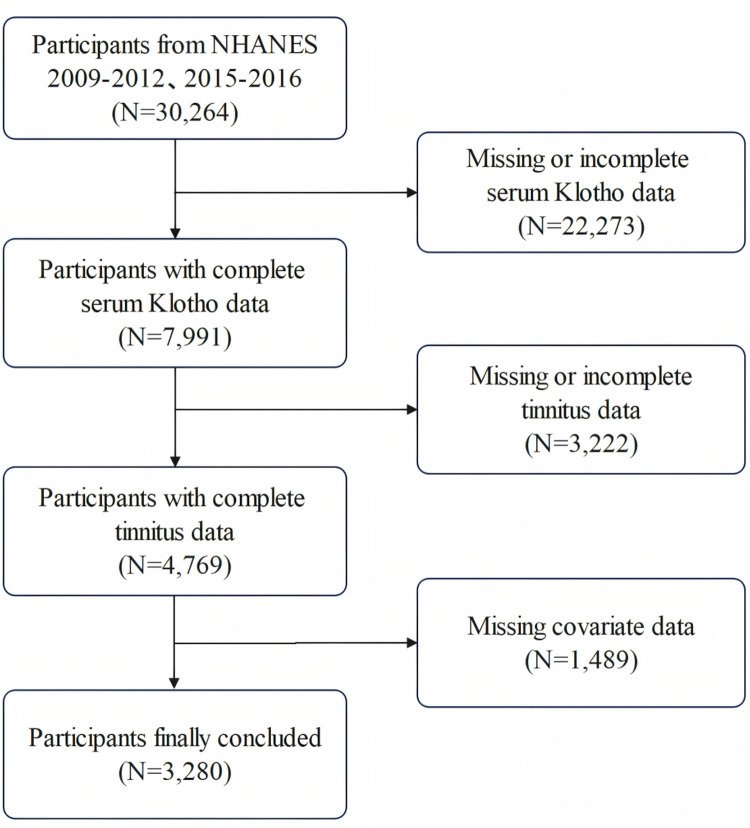
We performed a population-based cross-sectional study of individuals in the National Health and Nutrition Examination Survey (NHANES) 2009-2012 and 2015-2016. Univariable and multivariable logistic regression was used to evaluate the relationship between serum Klotho levels and tinnitus, with adjustment for potential confounders and further age-stratified analyses. Restricted cubic splines were applied to assess potential non-linearity in the dose-response relationship. Furthermore, Subgroup and interaction analyses were conducted to assess the consistency of this association.
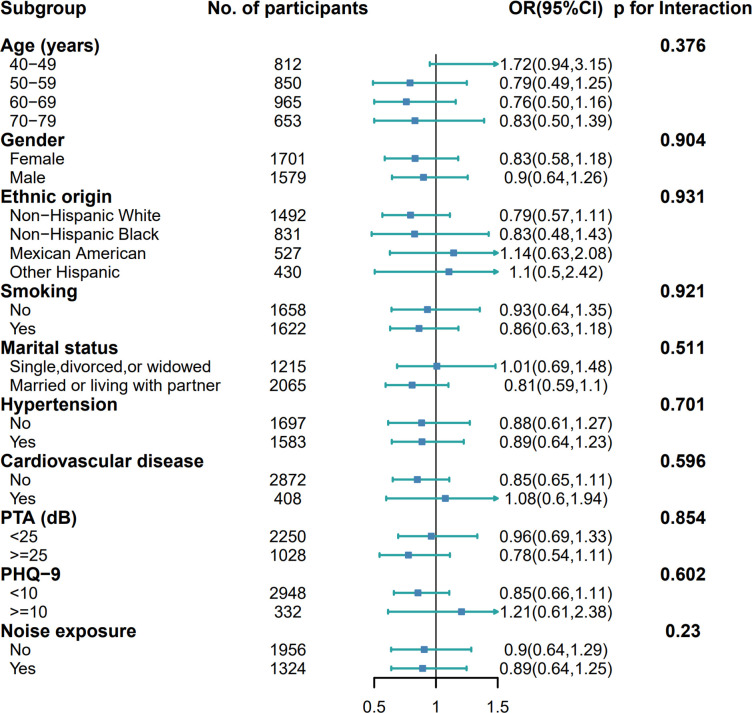
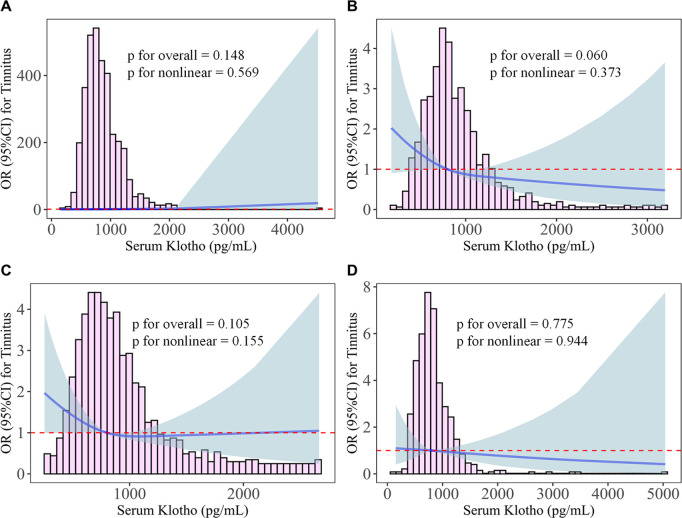
In this research of 3280 individuals aged 40-79 years with a median age of 55 (IQR: 48, 62) and 48% male participants, the median serum Klotho level was 779.80pg/mL. Multivariable logistic regression uncovered consistent inverse associations between serum Klotho levels and tinnitus incidence across progressively adjusted models (ORs: 0.68-0.70, p = 0.009-0.01). Age-based stratified analyses suggested the strongest effect was observed in individuals aged 50-59 years (full model ORs: 0.55, p = 0.046). A marginally significant protective effect was observed in the 60-69 age group (unadjusted OR=0.62, 95% CI: 0.39-1.00, p = 0.050). Serum Klotho levels showed no significant correlation with tinnitus severity, while a potential association with the duration of tinnitus was observed (p = 0.058). Additionally, restricted cubic spline analysis revealed a linear inverse association between Klotho and tinnitus risk stratified by age (all p for nonlinear >0.15). Finally, subgroup and interaction analyses revealed no significant effect modification (all p-interaction >0.1).
Serum Klotho concentrations showed a consistent inverse association with tinnitus prevalence in US adults, with the strongest effect observed in individuals aged 50-69 years.
作为一种抗衰老蛋白,尽管越来越多的研究表明α-klotho蛋白在听觉系统中发挥作用,但血清α-klotho水平与耳鸣之间的联系仍不清楚。本研究旨在探讨血清α-klotho水平与耳鸣之间的关联,重点关注中老年人群中的患病率、持续时间和严重程度。
我们对2009 - 2012年和2015 - 2016年美国国家健康与营养检查调查(NHANES)中的个体进行了一项基于人群的横断面研究。使用单变量和多变量逻辑回归来评估血清α-klotho水平与耳鸣之间的关系,并对潜在混杂因素进行调整以及进一步的年龄分层分析。应用受限立方样条来评估剂量反应关系中的潜在非线性。此外,进行亚组分析和交互分析以评估这种关联的一致性。
在这项对3280名年龄在40 - 79岁之间、中位年龄为55岁(四分位间距:48, 62)且男性参与者占48%的个体的研究中,血清α-klotho水平的中位数为779.80pg/mL。多变量逻辑回归发现在逐步调整的模型中,血清α-klotho水平与耳鸣发生率之间存在一致的负相关(比值比:0.68 - 0.70,p = 0.009 - 0.01)。基于年龄的分层分析表明,在50 - 59岁的个体中观察到最强的效应(全模型比值比:0.55,p = 0.046)。在60 - 69岁年龄组中观察到边缘显著的保护作用(未调整的比值比 = 0.62,95%置信区间:0.39 - 1.00,p = 0.050)。血清α-klotho水平与耳鸣严重程度无显著相关性,但观察到与耳鸣持续时间存在潜在关联(p = 0.058)。此外,受限立方样条分析显示按年龄分层的α-klotho与耳鸣风险之间存在线性负相关(所有非线性的p > 0.15)。最后,亚组分析和交互分析显示无显著的效应修饰(所有交互作用的p > 0.1)。
在美国成年人中,血清α-klotho浓度与耳鸣患病率呈一致的负相关,在50 - 69岁的个体中观察到最强的效应。