Loganathan Dineshkumar, OuYang Tung, Chen Chia-Yun, Chen Chia-Yuan
Department of Mechanical Engineering, National Cheng Kung University, Tainan 701, Taiwan.
Department of Materials Science and Engineering, National Cheng Kung University, Tainan 701, Taiwan.
Langmuir. 2025 Aug 19;41(32):21562-21575. doi: 10.1021/acs.langmuir.5c02350. Epub 2025 Jul 31.
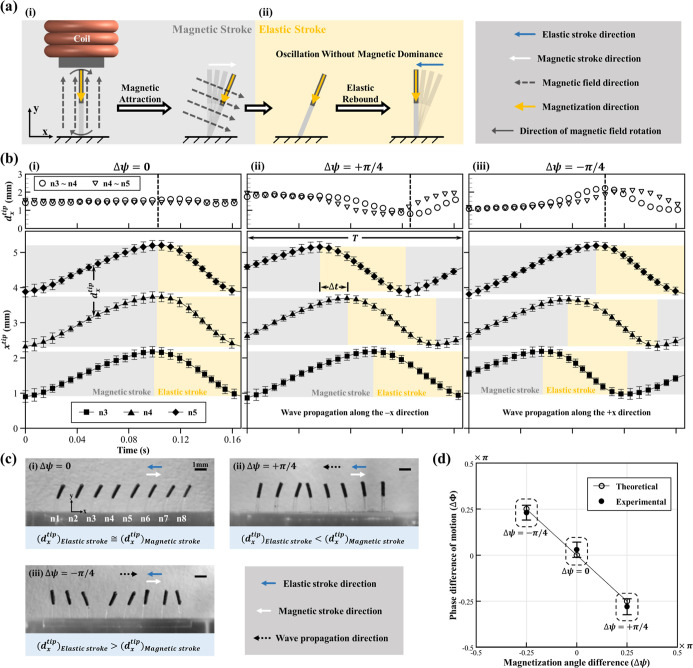
Artificial cilia are widely employed in microfluidic platforms, where their beating motion is harnessed to emulate the fluid transport capabilities of natural motile cilia. In particular, metachronal beating, characterized by phase-shifted motion among adjacent cilia, has proven to be effective for directional fluid transport. However, its potential for micromixing remains limited due to its inherently planar wave propagation, which offers room for improvement in generating strong vortices. To address this, three magnetically actuated artificial cilia carpets are fabricated with identical structural designs featuring spatially varied cilia orientations to embed controlled orientational asymmetry. To realize distinct motion patterns, each carpet is magnetized with a single, unique magnetization profile such that one carpet corresponds to one beating mode, including synchronous, symplectic metachronal, or antiplectic metachronal, and is actuated externally to generate its respective motion. For demonstration purposes, two different experiments are conducted, including micromixing and photocatalytic dye degradation. The results reveal that metachronal motion alone is insufficient to enhance micromixing, thereby highlighting the need for integration with orientational asymmetry. Compared to the aligned cilia carpet (control), superior mixing efficiency of 87% and a 3-fold enhancement in dye degradation are observed in the inclined cilia carpet actuated with antiplectic metachronal motion. This enhanced hydrodynamic activity is further substantiated through μPIV experiments. These findings define metachrony as a dual-function paradigm for both fluid propulsion and vortex-enabled microfluidic mixing.
人工纤毛在微流控平台中得到广泛应用,利用其摆动运动来模拟天然运动纤毛的流体输送能力。特别是,以相邻纤毛之间的相移运动为特征的顺次摆动,已被证明对定向流体输送有效。然而,由于其固有的平面波传播,其微混合潜力仍然有限,这为产生强涡旋方面的改进提供了空间。为了解决这个问题,制作了三种磁驱动人工纤毛地毯,它们具有相同的结构设计,纤毛方向在空间上变化,以嵌入可控的方向不对称性。为了实现不同的运动模式,每个地毯都用单一的、独特的磁化分布进行磁化,使得一个地毯对应一种摆动模式,包括同步、辛顺次或反辛顺次摆动,并通过外部驱动来产生各自的运动。为了进行演示,进行了两个不同的实验,包括微混合和光催化染料降解。结果表明,仅顺次运动不足以增强微混合,从而突出了与方向不对称性相结合的必要性。与对齐纤毛地毯(对照)相比,在以反辛顺次运动驱动的倾斜纤毛地毯中,观察到了87%的优异混合效率和染料降解提高了3倍。通过μPIV实验进一步证实了这种增强的流体动力学活性。这些发现将顺次摆动定义为流体推进和涡旋驱动微流控混合的双功能范式。