Qiao Rui, Guo Fanghao, Ding Haixia, Sun Di, Hu Qianhui, Li Yanquan, Zhang Meiling, Zhang Qing, Li Wen
Center for Reproductive Medicine & Fertility Preservation Program, International Peace Maternity and Child Health Hospital, School of Medicine, Shanghai Jiao Tong University, Shanghai, China.
Shanghai Key Laboratory of Embryo Original Diseases, Shanghai 200030, China.
Hum Reprod Open. 2025 Jul 12;2025(3):hoaf044. doi: 10.1093/hropen/hoaf044. eCollection 2025.
Do novel per- and poly-fluoroalkyl substances (Novel PFAS) have associations with premature ovarian insufficiency (POI)?
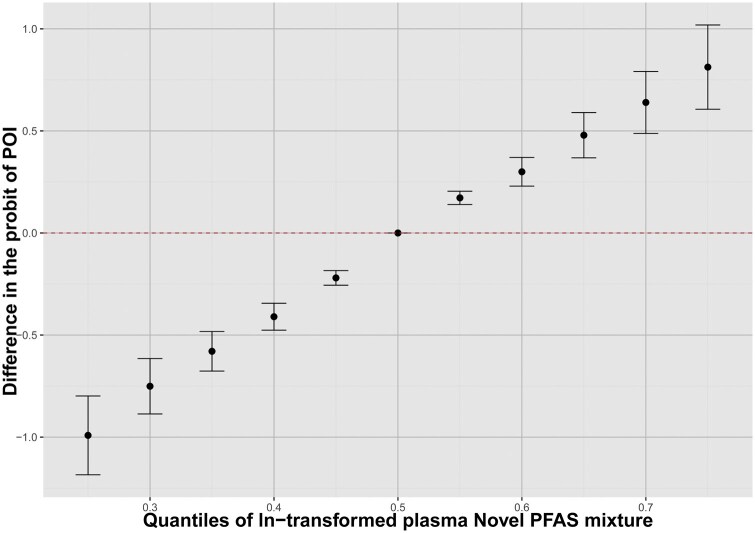
Hexafluoropropylene oxide dimer acid (HFPO-DA), perfluorobutanoic acid (PFBA), perfluoropentanoic acid (PFPeA), and perfluoropentanesulfonic acid (PFPeS) are associated with an increased risk of POI, and the effect is worse with exposure to mixtures.
As public health concerns following Novel PFAS exposure are rising globally, there is a need to understand the exact association between Novel PFAS and various diseases. Epidemiologic studies suggest traditional PFAS exposures adversely affect women's reproductive health, but the association between exposure to Novel PFAS and POI remains unclear.
A retrospective research study, including 371 women, with (case group, n = 151) and without POI (control group, n = 220), was conducted between June 2023 and May 2024.
PARTICIPANTS/MATERIALS SETTING METHODS: Thirteen types of Novel PFAS and basal concentrations of FSH, LH, estradiol (E2), and anti-Müllerian hormone (AMH) in plasma samples were measured in plasma samples collected during the early follicular phase (Days 2-5) of a natural menstrual cycle. In addition, characteristics of participants were collected. Both adjusted logistic regression and Bayesian kernel machine regression (BKMR) were used to evaluate associations between Novel PFAS (alone or as a mixture) and POI. Effect modification by age was also investigated.
The concentrations of HFPO-DA, PFBA, PFPeA, and PFPeS in the case group were significantly higher than in the reference group. The adjusted logistic regression models demonstrated positive associations between plasma concentrations of HFPO-DA, PFBA, PFPeA, and PFPeS with the risk of POI [OR = 2.89 (95% CI: 1.84-4.53), 1.54 (95% CI: 1.17-2.02), 3.12 (95% CI: 2.20-4.43), and 2.07 (95% CI: 1.31-3.27), respectively, per 2.7-fold increase in Novel PFAS concentrations]. High concentrations of Novel PFAS showed a negative correlation with AMH and antral follicle count (AFC), but a positive correlation with FSH. After controlling for other covariates, HFPO-DA, PFBA, PFBS, PFPeA, and PFPeS were the major contributors based on the BKMR models.
False positives cannot be ruled out. Therefore, experiments on PFBA, PFPeA, PFPeS, and HFPO-DA also need to be conducted in animal models.
Our study is the first to discover the impact of Novel PFAS on the incidence of POI, with an investigation of indicators such as AMH, FSH, and AFC. Considering increasingly severe environmental pollution, our research results provide a broader understanding of the impact of environmental endocrine disruptors on ovarian function, and suggest that women of reproductive age should reduce their exposure to Novel PFAS.
STUDY FUNDING/COMPETING INTERESTS: This work was supported by the National Key Research and Development Project of China (2022YFC2703002), National Natural Science Foundation of China (U24A20658, 82371726), Innovative Research Team of High-Level Local Universities in Shanghai (SHSMU-ZDCX20212200), Shanghai Hospital Development Center Foundation (SHDC22022303, SHDC22022201), and Key project of Medical and Industrial intersection of Shanghai Jiao Tong University (YG2023ZD27), as well as Reproductive Medicine Research Project of the Chinese Red Cross Foundation (HSZH2024GFYZQ) and Open Fund Project of Shanghai Key Laboratory of Embryogenic Diseases (shelab2023ZD02). The funders had no role in the study design, data collection and analysis, decision to publish, or preparation of the manuscript. The authors declare that they have no competing interests.
N/A.
新型全氟和多氟烷基物质(新型PFAS)与卵巢早衰(POI)是否有关联?
六氟环氧丙烷二聚酸(HFPO-DA)、全氟丁酸(PFBA)、全氟戊酸(PFPeA)和全氟戊烷磺酸(PFPeS)与POI风险增加有关,且暴露于混合物时影响更严重。
随着全球对新型PFAS暴露的公共卫生担忧不断增加,有必要了解新型PFAS与各种疾病的确切关联。流行病学研究表明,传统PFAS暴露会对女性生殖健康产生不利影响,但新型PFAS暴露与POI之间的关联仍不明确。
研究设计、规模、持续时间:一项回顾性研究,纳入了371名女性,其中患有POI的为病例组(n = 151),未患POI的为对照组(n = 220),研究于2023年6月至2024年5月进行。
参与者/材料、设置、方法:在自然月经周期的卵泡早期(第2 - 5天)采集的血浆样本中,测量了13种新型PFAS以及血浆中促卵泡生成素(FSH)、促黄体生成素(LH)、雌二醇(E2)和抗苗勒管激素(AMH)的基础浓度。此外,还收集了参与者的特征。采用调整后的逻辑回归和贝叶斯核机器回归(BKMR)来评估新型PFAS(单独或作为混合物)与POI之间的关联。还研究了年龄的效应修正。
病例组中HFPO-DA、PFBA、PFPeA和PFPeS的浓度显著高于对照组。调整后的逻辑回归模型显示,HFPO-DA、PFBA,、PFPeA和PFPeS的血浆浓度与POI风险呈正相关[每新型PFAS浓度增加2.7倍,OR分别为2.89(95%CI:1.84 - 4.53)、1.54(95%CI:1.17 - 2.02)、3.12(95%CI:2.20 - 4.43)和2.07(95%CI:1.31 - 3.27)]。高浓度的新型PFAS与AMH和窦卵泡计数(AFC)呈负相关,但与FSH呈正相关。在控制其他协变量后,基于BKMR模型,HFPO-DA、PFBA、PFBS、PFPeA和PFPeS是主要贡献因素。
局限性、谨慎的原因:不能排除假阳性。因此,还需要在动物模型中对PFBA、PFPeA、PFPeS和HFPO-DA进行实验。
我们的研究首次发现了新型PFAS对POI发病率的影响,并对AMH、FSH和AFC等指标进行了研究。考虑到环境污染日益严重,我们的研究结果为环境内分泌干扰物对卵巢功能的影响提供了更广泛的认识,并建议育龄女性应减少对新型PFAS的暴露。
研究资金/利益冲突:本研究得到了中国国家重点研发计划(2022YFC2703002)、国家自然科学基金(U24A20658、82371726)、上海市高水平地方高校创新研究团队(SHSMU-ZDCX20212200)、上海申康医院发展中心基金(SHDC22022303、SHDC22-022201)、上海交通大学医工交叉重点项目(YG2023ZD27)以及中国红十字基金会生殖医学研究项目(HSZH2024GFYZQ)和上海市胚胎源性疾病重点实验室开放基金项目(shelab2023ZD02)的支持。资助者在研究设计、数据收集和分析、出版决策或稿件准备过程中没有参与。作者声明他们没有利益冲突。
无。