Veronig Astrid M, Dissauer Karin, Kliem Bernhard, Downs Cooper, Hudson Hugh S, Jin Meng, Osten Rachel, Podladchikova Tatiana, Prasad Avijeet, Qiu Jiong, Thompson Barbara, Tian Hui, Vourlidas Angelos
Institute of Physics, University of Graz, Universitätsplatz 5, 8010 Graz, Austria.
Kanzelhöhe Observatory for Solar and Environmental Research, University of Graz, Kanzelhöhe 19, 9521 Treffen, Austria.
Living Rev Sol Phys. 2025;22(1):2. doi: 10.1007/s41116-025-00041-4. Epub 2025 Jul 28.
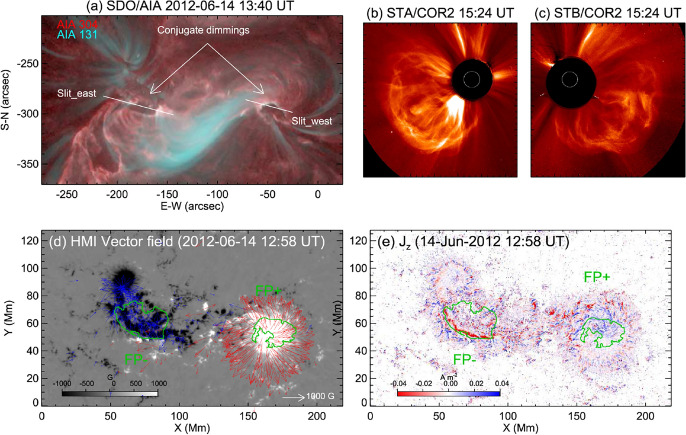
Coronal dimmings associated with coronal mass ejections (CMEs) from the Sun have gained much attention since the late 1990s when they were first observed in high-cadence imagery of the SOHO/EIT and Yohkoh/SXT instruments. They appear as localized sudden decreases of the coronal emission at extreme ultraviolet (EUV) and soft X-ray (SXR) wavelengths, that evolve impulsively during the lift-off and early expansion phase of a CME. Coronal dimmings have been interpreted as "footprints" of the erupting flux rope and also as indicators of the coronal mass loss by CMEs. However, these are only some aspects of coronal dimmings and how they relate to the overall CME/flare process. The goal of this review is to summarize our current understanding and observational findings on coronal dimmings, how they relate to CME simulations, and to discuss how they can be used to provide us with a deeper insight and diagnostics of the triggering of CMEs, the magnetic connectivities and coronal reconfigurations due to the CME as well as the replenishment of the corona after an eruption. In addition, we go beyond a pure review by introducing a new, physics-driven categorization of coronal dimmings based on the magnetic flux systems involved in the eruption process. Finally, we discuss the recent progress in studying coronal dimmings on solar-like and late-type stars, and how to use them as a diagnostics for stellar coronal mass ejections and their properties.
The online version contains supplementary material available at 10.1007/s41116-025-00041-4.
自20世纪90年代末日冕物质抛射(CME)相关的日冕暗化首次在SOHO/EIT和Yohkoh/SXT仪器的高时间分辨率图像中被观测到以来,它们就备受关注。它们表现为极紫外(EUV)和软X射线(SXR)波长处日冕辐射的局部突然下降,在CME的升空和早期膨胀阶段呈脉冲式演化。日冕暗化被解释为喷发磁通绳的“足迹”,也被视为CME导致日冕物质损失的指标。然而,这些只是日冕暗化的一些方面以及它们与整体CME/耀斑过程的关系。本综述的目的是总结我们目前对日冕暗化的理解和观测结果,它们与CME模拟的关系,并讨论如何利用它们为我们提供对CME触发、CME导致的磁连接和日冕重构以及喷发后日冕补充的更深入见解和诊断。此外,我们通过基于喷发过程中涉及的磁通系统引入一种新的、由物理驱动的日冕暗化分类,超越了单纯的综述。最后我们讨论了在类太阳恒星和晚型恒星上研究日冕暗化的最新进展,以及如何将它们用作恒星日冕物质抛射及其性质的诊断方法。
在线版本包含可在10.1007/s41116-025-00041-4获取的补充材料。