
儿童中重度二尖瓣反流二尖瓣成形术的中期结果及术后病情恶化的相关危险因素
Midterm Outcomes of Pediatric Mitral Valvuloplasty for Moderate to Severe Mitral Valve Regurgitation and Associated Risk Factors for Postoperative Deterioration.
作者信息
Fu Hongyuan, Liu Aijun, Yang Ming, Liu Zeyu, Su Junwu
机构信息
Pediatric Cardiovascular Center, Capital Medical University Affiliated Anzhen Hospital, Beijing, China.
出版信息
Tex Heart Inst J. 2025 Jul 30;52(2):e248523. doi: 10.14503/THIJ-24-8523. eCollection 2025 Jul-Dec.
BACKGROUND
Mitral valvuloplasty is considered the best treatment for pediatric mitral valve regurgitation. The objective of this analysis was to identify risk factors for postoperative mitral valve regurgitation progression and evaluate valvuloplasty effectiveness.
METHODS
This retrospective, single-center study investigated the clinical efficacy of mitral valvuloplasty and identified factors that affect prognosis. Pediatric patients with moderate or severe mitral valve regurgitation who had undergone mitral valvuloplasty between September 2016 and August 2023 were included. Kaplan-Meier survival analysis was used to assess freedom from both mitral valve deterioration and cardiovascular death. Univariate and multivariate Cox regression analyses were performed to identify potential risk factors.
RESULTS
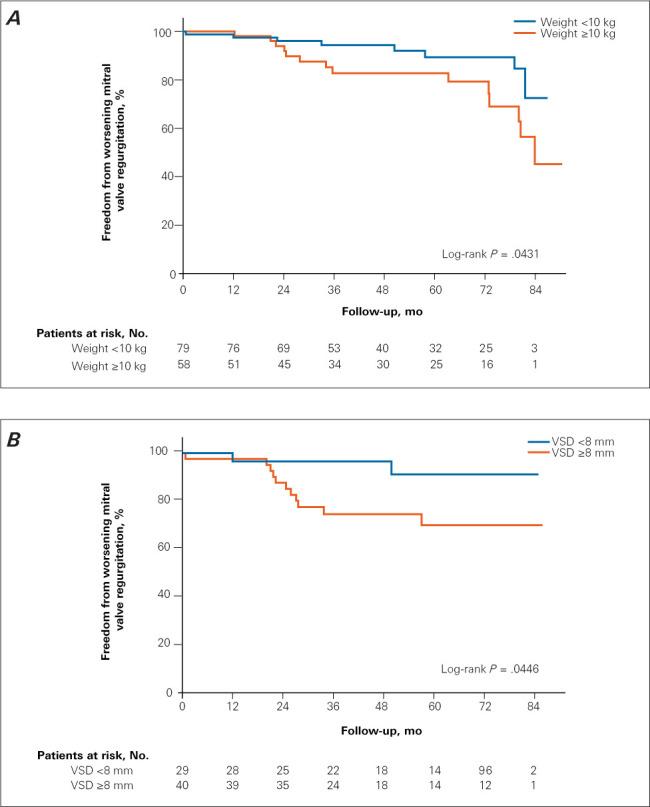
The study comprised 137 pediatric patients (mean age, 37.5 months [range, 2.4-167.6 months]) who had moderate (64/137 [46.7%]) or severe (73.137 [53.3%]) mitral valve regurgitation. At midterm follow-up (median, 55.3 months), mitral valve regurgitation had statistically significantly decreased compared with preoperative levels ( < .001, Wilcoxon signed-rank test); freedom from cardiovascular death was 97.5%, and freedom from worsening mitral valve regurgitation was 89.4%. Cox regression analysis identified body weight ( = .02), left ventricular end-diastolic diameter ( = .005), and left ventricular ejection fraction ( = .01) at 1 month and cardiopulmonary bypass time ( = .007) as independent risk factors for deterioration. Patients weighing 10 kg or more ( = .04) or with a ventricular septal defect 8 mm or larger ( = .04) had worse outcomes.
CONCLUSION
Mitral valvuloplasty resulted in low mortality and positive long-term results in pediatric patients with mitral valve regurgitation. Early aggressive therapy is recommended to avoid late postoperative mitral valve deterioration.
背景
二尖瓣成形术被认为是小儿二尖瓣反流的最佳治疗方法。本分析的目的是确定术后二尖瓣反流进展的危险因素,并评估二尖瓣成形术的有效性。
方法
这项回顾性单中心研究调查了二尖瓣成形术的临床疗效,并确定了影响预后的因素。纳入了2016年9月至2023年8月期间接受二尖瓣成形术的中度或重度二尖瓣反流患儿。采用Kaplan-Meier生存分析评估二尖瓣恶化和心血管死亡的无事件生存率。进行单因素和多因素Cox回归分析以确定潜在危险因素。
结果
该研究包括137例患有中度(64/137 [46.7%])或重度(73/137 [53.3%])二尖瓣反流的小儿患者(平均年龄37.5个月[范围2.4 - 167.6个月])。在中期随访(中位数55.3个月)时,二尖瓣反流与术前水平相比有统计学显著降低(<0.001,Wilcoxon符号秩检验);心血管死亡的无事件生存率为97.5%,二尖瓣反流恶化的无事件生存率为89.4%。Cox回归分析确定1个月时的体重(P = 0.02)、左心室舒张末期直径(P = 0.005)、左心室射血分数(P = 0.01)以及体外循环时间(P = 0.007)为恶化的独立危险因素。体重10 kg或以上(P = 0.04)或室间隔缺损8 mm或更大(P = 0.04)的患者预后较差。
结论
二尖瓣成形术在小儿二尖瓣反流患者中导致低死亡率和良好的长期结果。建议早期积极治疗以避免术后晚期二尖瓣恶化。

 Zotero 插件