
内脏脂肪指数与子宫内膜异位症之间的关联:一项基于人群的研究。
Association between visceral adiposity index and endometriosis: a population-based study.
作者信息
Zhang Jiajia, Zhang Qian, Chu Tianyu, Chen Xian, Zhou Hui, Xu Dewu, Dong Chunlin, Wu Yibo
机构信息
Obstetrics, Gynecology and Reproduction Research Center, Affiliated Hospital of Jiangnan University, Wuxi, China.
Department of Medical Education, Affiliated Hospital of Jiangnan University, Wuxi, China.
出版信息
Front Nutr. 2025 Jul 21;12:1602288. doi: 10.3389/fnut.2025.1602288. eCollection 2025.
OBJECTIVES
Obesity and endometriosis are intricately linked. The body mass index (BMI) is commonly used as an indicator of obesity, but it has limitations. The visceral adiposity index (VAI) is a novel, low-cost composite index that reflects visceral adiposity accumulation and metabolic health status. The objective of our research was to investigate the association between VAI and endometriosis.
METHODS
This is a cross-sectional study. The investigation utilized information from the NHANES (1999-2006), focusing on participants aged ≥20 years. We evaluated the association between VAI and endometriosis through five complementary approaches: multivariable-adjusted weighted logistic regression, trend tests, sensitivity analyses, subgroup analyses, and restricted cubic spline (RCS) curve.
RESULTS
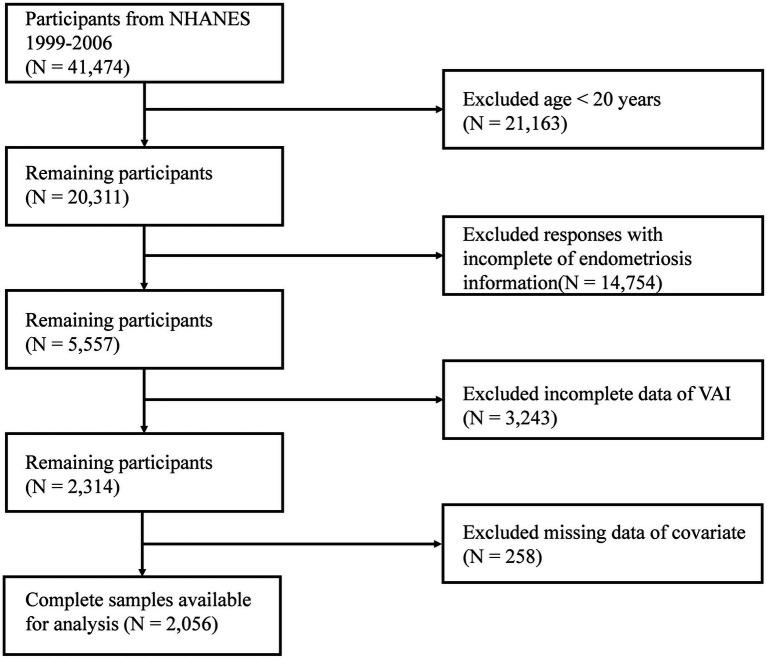
After screening, our analysis included 2,056 eligible subjects, among whom 163 cases of endometriosis were identified. The final adjusted logistic regression model demonstrated a significant positive association between VAI and endometriosis (OR = 1.08, 95% CI: 1.04-1.12, < 0.001). Results of restricted cubic spline fitting revealed a linear positive correlation between VAI and endometriosis ( for overall < 0.001; for non-linear = 0.539). The results of subgroup analyses showed that some specific demographic, lifestyle, and reproductive characteristics were not statistically significant in influencing the correlation between VAI and endometriosis ( > 0.05 for all interactions).
CONCLUSION
Our study observed a statistically significant association between VAI and endometriosis. More prospective cohort investigations with large samples are required to further validate these findings because the etiology of endometriosis remains unclear.
目的
肥胖与子宫内膜异位症有着复杂的联系。体重指数(BMI)通常被用作肥胖的指标,但它有局限性。内脏脂肪指数(VAI)是一种新型的低成本综合指数,反映内脏脂肪堆积和代谢健康状况。我们研究的目的是调查VAI与子宫内膜异位症之间的关联。
方法
这是一项横断面研究。该调查利用了美国国家健康与营养检查调查(NHANES,1999 - 2006年)的信息,重点关注年龄≥20岁的参与者。我们通过五种互补方法评估VAI与子宫内膜异位症之间的关联:多变量调整加权逻辑回归、趋势检验、敏感性分析、亚组分析和受限立方样条(RCS)曲线。
结果
经过筛选,我们的分析纳入了2056名符合条件的受试者,其中确诊为子宫内膜异位症的有163例。最终调整后的逻辑回归模型显示VAI与子宫内膜异位症之间存在显著正相关(OR = 1.08,95%CI:1.04 - 1.12,P < 0.001)。受限立方样条拟合结果显示VAI与子宫内膜异位症之间呈线性正相关(总体P < 0.001;非线性P = 0.539)。亚组分析结果表明,一些特定的人口统计学、生活方式和生殖特征在影响VAI与子宫内膜异位症之间的相关性方面无统计学意义(所有交互作用的P > 0.05)。
结论
我们的研究观察到VAI与子宫内膜异位症之间存在统计学显著关联。由于子宫内膜异位症的病因仍不清楚,需要更多大样本的前瞻性队列研究来进一步验证这些发现。

 Zotero 插件