Kalina Matus, Nouri Babak, Almdal Kristoffer
Department of Chemistry, Technical University of Denmark Kgs. Lyngby Denmark
RSC Adv. 2025 Aug 4;15(34):27700-27722. doi: 10.1039/d5ra03730a. eCollection 2025 Aug 1.
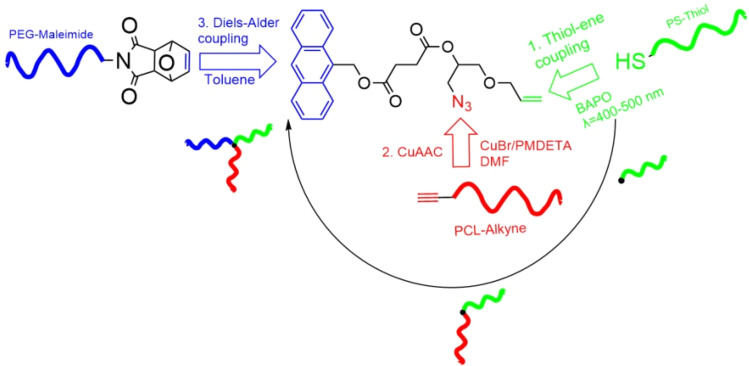
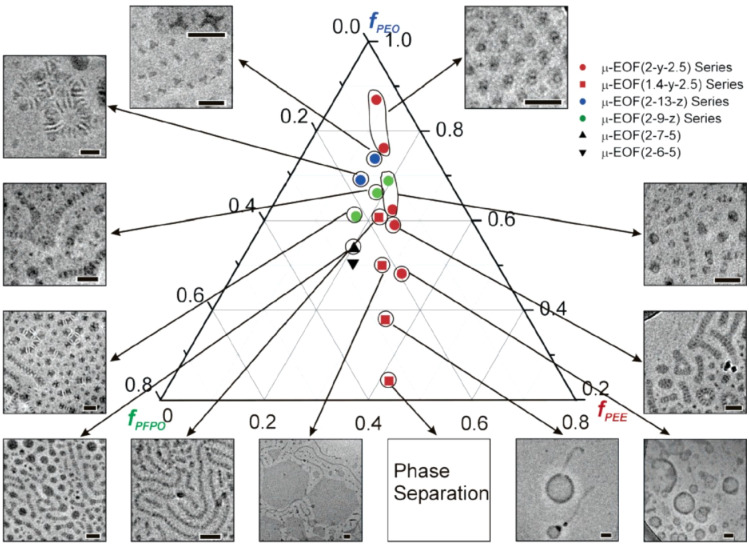
ABC star polymers, consisting of three chemically distinct polymeric chains bound to a common point, have emerged over the last 35 years as versatile materials with tunable morphologies and potential applications in nanofabrication, drug delivery, or solid-state electrolytes. Despite decades of progress, well-defined synthesis and design remain a challenge due to their high synthetic complexity. This review surveys key developments in synthetic strategies, ranging from early anionic routes to modern reversible-deactivation radical polymerizations and click-driven methods, highlighting the trade-offs between architectural precision, functional compatibility, and scalability. Particular emphasis is placed on the resulting morphologies in bulk, thin-film, and solution states, where the star topology enables unique structural motifs not accessible to linear triblocks. These include complex tilings, hierarchical phases, and multicompartment micelles. Emerging computational and data-driven approaches are discussed in the context of inverse design, offering new directions for bridging idealized model systems with scalable, application-ready materials.
ABC 星形聚合物由三条化学性质不同的聚合物链连接到一个共同点组成,在过去35年中已成为具有可调形态的多功能材料,并在纳米制造、药物递送或固态电解质等领域具有潜在应用。尽管经过了几十年的发展,但由于其合成复杂性高,明确的合成和设计仍然是一个挑战。本综述概述了合成策略的关键进展,从早期的阴离子路线到现代的可逆失活自由基聚合和点击驱动方法,强调了结构精度、功能兼容性和可扩展性之间的权衡。特别强调了在本体、薄膜和溶液状态下产生的形态,其中星形拓扑结构能够形成线性三嵌段无法获得的独特结构图案。这些包括复杂的平铺、分级相和多隔室胶束。在逆设计的背景下讨论了新兴的计算和数据驱动方法,为将理想化模型系统与可扩展的、可用于实际应用的材料联系起来提供了新方向。