Alhmoud Eman, Barazi Raja, Zakaria Almunzer, Andraous Lubna, El Enany Rasha, Thomas Binny, Abdulrouf Palli Valapila, Pathan Sameer A, Nazar Hamde, Ibrahim Mohamed Izham Mohamed, Hadi Muhammad Abdul
QU Health Sector, Qatar University, Doha, Qatar.
Pharmacy Department, Hamad Medical Corporation, Doha, Qatar.
BMJ Open. 2025 Aug 5;15(8):e106073. doi: 10.1136/bmjopen-2025-106073.
Transitions from the emergency department (ED) to home are high-risk periods for medication-related harm. Pharmacist-led interventions during this period may improve medication safety and care continuity, yet co-design approaches to develop such interventions remain underused. The aim of this study is to co-design a pharmacist-led transition of care programme for patients discharged from the ED.
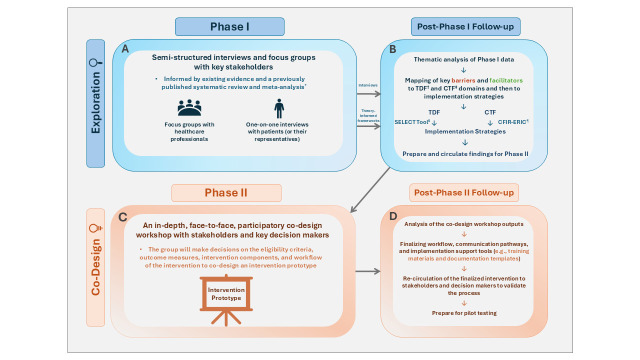
This study will be conducted at a 371-bed secondary-care teaching hospital in Qatar and will follow two sequential phases using qualitative and participatory methods. Phase I will involve focus groups and semistructured interviews with key stakeholders (clinical pharmacists, physicians, nurses and patients or patient representatives). Phase II will consist of an intervention co-design workshop with decision makers (leaders, policymakers and representatives from Phase I). Participants will be recruited using purposive and snowball sampling. Interviews will be audio recorded and transcribed verbatim. Data will be analysed using an inductive-deductive approach, guided by the Theoretical Domains Framework, the Care Transitions Framework and the APEASE (Affordability, Practicability, Effectiveness/cost-effectiveness, Acceptability, Side-effects/safety, Equity) criteria for evaluation of intervention feasibility.The anticipated outcome is a prototype intervention detailing target recipients, core components, workflow, implementation strategies and supporting tools. This prototype will be pilot-tested to assess feasibility and inform further refinement.
The study was approved by the Medical Research Centre of Hamad Medical Corporation-Qatar (MRC-01-24-699) and Qatar University Institutional Review Board (QU-IRB 009/2025-EM). Written informed consent will be obtained from all study participants prior to participation. Research findings will be disseminated through institutional stakeholder briefings, presentations at national and international scientific conferences and publication in peer-reviewed journals. Patient representatives will contribute throughout the intervention development process.
从急诊科(ED)过渡到家庭是药物相关伤害的高风险时期。在此期间,由药剂师主导的干预措施可能会提高用药安全性和护理连续性,但采用共同设计方法来制定此类干预措施的情况仍未得到充分利用。本研究的目的是共同设计一项由药剂师主导的针对从急诊科出院患者的护理过渡计划。
本研究将在卡塔尔一家拥有371张床位的二级护理教学医院进行,并将采用定性和参与式方法分两个连续阶段进行。第一阶段将包括与关键利益相关者(临床药剂师、医生、护士以及患者或患者代表)进行焦点小组讨论和半结构化访谈。第二阶段将由一个与决策者(第一阶段的领导、政策制定者和代表)共同设计干预措施的研讨会组成。将采用目的抽样和滚雪球抽样的方法招募参与者。访谈将进行录音并逐字转录。将使用归纳-演绎方法进行数据分析,以理论领域框架、护理过渡框架以及用于评估干预可行性的APEASE(可承受性、实用性、有效性/成本效益、可接受性、副作用/安全性、公平性)标准为指导。预期结果是一个详细说明目标受众、核心组成部分、工作流程、实施策略和支持工具的干预措施原型。该原型将进行试点测试,以评估可行性并为进一步完善提供依据。
该研究已获得卡塔尔哈马德医疗公司医学研究中心(MRC-01-24-699)和卡塔尔大学机构审查委员会(QU-IRB 009/2025-EM)的批准。在参与之前,将从所有研究参与者处获得书面知情同意书。研究结果将通过机构利益相关者简报、在国内和国际科学会议上的演讲以及在同行评审期刊上发表来进行传播。患者代表将在整个干预措施开发过程中发挥作用。