Gajewska Ewa, Moczko Jerzy, Sobieska Magdalena
Department of Physiotherapy, Institute of Health Sciences, University of Zielona Gora, Zielona Góra, Poland.
Department of Computer Science and Statistics, Poznan University of Medical Sciences, Poznań, Poland.
Front Hum Neurosci. 2025 Jul 22;19:1586228. doi: 10.3389/fnhum.2025.1586228. eCollection 2025.
This study aims to determine the correlations between axial and distal motor features observed at 3 months of age on later motor elements at 4-5 and 7-8 months.
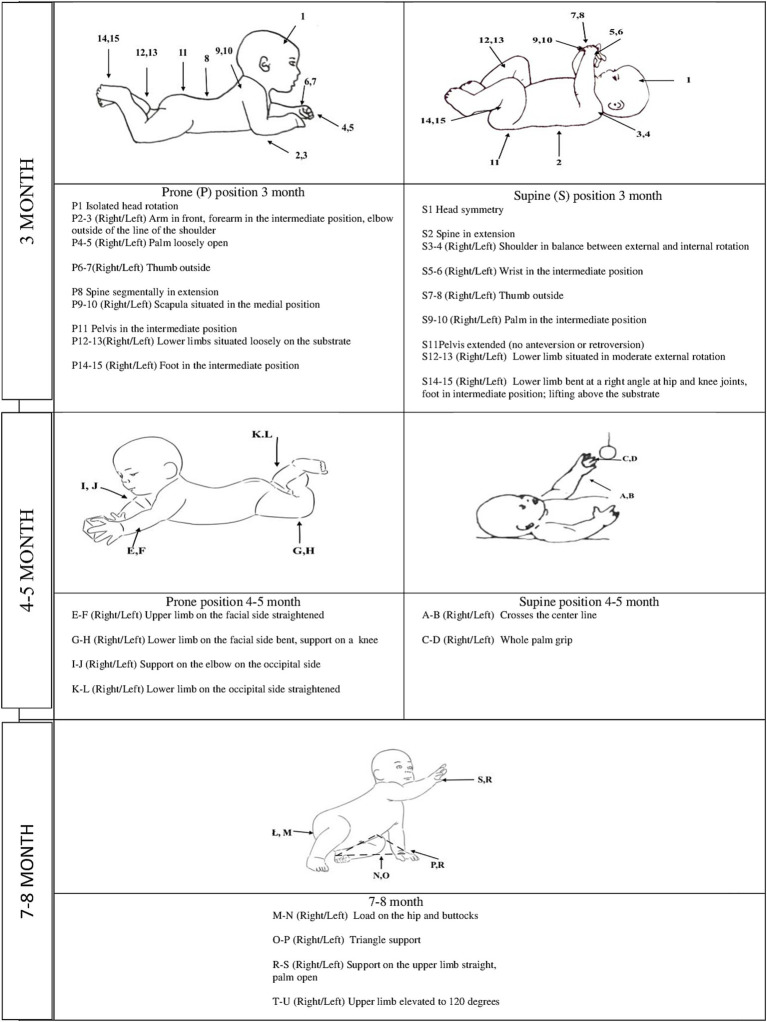
We analyzed 93 children (50 boys); 24 were born prematurely. All children underwent a prospective qualitative evaluation of motor development, performed by the physiotherapist, at 3, 4-5, and 7-8 months of age. We analyzed infants' motor development in the third month using the validated Quantitative and Qualitative Assessment of Motor Development Worksheet. The qualitative assessment determined for 4-5 and 7-8 months was based on the Vojta development concept.
Studies showed that axial features observed in the third month significantly and relatively strongly correlated (Cramer's V = 0.4-0.6) with proper asymmetric elbow support. In the supine position, crossing the body's midline and grasping correlated relatively strongly with the correct positioning of the pelvis and lower limbs observed in the third month. The axial and distal elements from the third month remain necessary to achieve a qualitatively correct oblique sitting position at 7-8 months. The relatively high values of Cramer's V were also confirmed by the relatively high values of the Tau test. At 7-8 months, this relationship was quite strong sometimes (high Cramer's V) but applied to a minor part of the variability (low Tau).
Axial elements observed at 3 months of age correlate relatively strongly with axial elements at 4-5 months. The relationships between the elements at 3 months of age and those studied at 7-8 months were moderate but related to axial and distal features. Without proper spine functioning, the development of the shoulders and pelvis will not occur properly. Findings support the early use of axial motor features as developmental indicators for motor progression, with implications for early intervention programs.
本研究旨在确定3个月大时观察到的轴向和远端运动特征与4 - 5个月及7 - 8个月时后期运动要素之间的相关性。
我们分析了93名儿童(50名男孩);其中24名早产。所有儿童在3个月、4 - 5个月和7 - 8个月时均由物理治疗师进行了运动发育的前瞻性定性评估。我们使用经过验证的《运动发育定量与定性评估工作表》分析了婴儿在第三个月的运动发育情况。4 - 5个月和7 - 8个月的定性评估基于沃伊塔发育概念。
研究表明,第三个月观察到的轴向特征与正确的不对称肘部支撑显著且相关性较强(克莱姆相关系数V = 0.4 - 0.6)。在仰卧位时,身体中线交叉和抓握与第三个月观察到的骨盆和下肢的正确定位相关性较强。第三个月的轴向和远端要素对于在7 - 8个月时获得定性正确的斜坐位仍然是必要的。克莱姆相关系数V的较高值也通过陶氏检验的较高值得到了证实。在7 - 8个月时,这种关系有时相当强(克莱姆相关系数V较高),但适用于变异性的一小部分(陶氏检验值较低)。
3个月大时观察到的轴向要素与4 - 5个月时的轴向要素相关性较强。3个月大时的要素与7 - 8个月时研究的要素之间的关系中等,但与轴向和远端特征有关。如果没有正常的脊柱功能,肩部和骨盆的发育就不会正常进行。研究结果支持早期将轴向运动特征用作运动进展的发育指标,这对早期干预计划具有启示意义。