Deng Zi Wei, Fu Wei, Chen Feng, Wang Hong Qiang, Deng Yin Hua, Yan Yan
Department of Clinical Pharmacy, Hunan University of Medicine General Hospital, Huaihua, Hunan, People's Republic of China.
Evidence-Based Medicine and Clinical Center, Hunan University of Medicine General Hospital, Huaihua, Hunan, People's Republic of China.
Infect Drug Resist. 2025 Aug 1;18:3847-3857. doi: 10.2147/IDR.S514088. eCollection 2025.
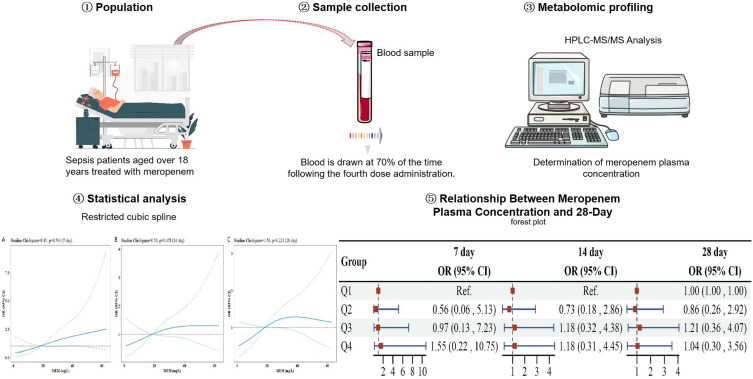
Meropenem is a first-line antibiotic for sepsis in settings with high prevalence of multidrug-resistant organisms due to its broad-spectrum activity. However, the relationship between meropenem plasma concentration and prognosis of sepsis is unclear. This study aims to investigate whether optimizing meropenem plasma levels improves 28-day outcomes in sepsis patients, while also exploring the potential impact of continuous versus intermittent infusion methods.
This real-world retrospective study included 202 sepsis patients treated with meropenem at Hunan University of Medicine General Hospital from January 2022 to December 2023. Patients received either prolonged intravenous infusion or intermittent intravenous infusion of meropenem, as determined by the attending physician. Prolonged infusion involved a 3-hour duration with an infusion pump, while intermittent infusion lasted 30 minutes to 1 hour. Patients were grouped by the quartiles of meropenem plasma concentration (Q1, Q2, Q3, and Q4) to facilitate analysis of dose-response relationships and control for variability in plasma concentration distributions. Mortality rates at 7, 14, and 28 days, as well as the detection rates of resistant bacteria and ICU length of stay, were compared among groups.
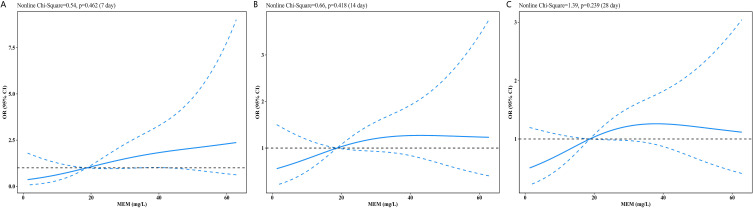
Prolonged intravenous infusion yielded higher meropenem plasma concentrations compared to intermittent infusion (=0.024), aligning with expected therapeutic targets for optimal antimicrobial efficacy. However, no significant differences were observed in mortality rates at 7, 14, and 28 days between infusion methods or across plasma concentration quartiles. Multivariable logistic regression confirmed these findings after adjusting for confounding factors. Additionally, no significant differences were found in resistant bacteria detection rates or ICU length of stay across quartiles.
While prolonged infusion increases plasma meropenem concentration, it does not impact 28-day mortality risk, ICU stay, or resistant bacteria detection in sepsis patients. These findings suggest that prolonged infusion may not offer significant clinical advantages over intermittent infusion and highlight the importance of balancing antibiotic use with stewardship principles (Graphical abstract).
美罗培南因其广谱活性,是多重耐药菌高流行地区脓毒症的一线抗生素。然而,美罗培南血浆浓度与脓毒症预后之间的关系尚不清楚。本研究旨在调查优化美罗培南血浆水平是否能改善脓毒症患者的28天预后,同时探讨持续输注与间歇输注方法的潜在影响。
这项真实世界的回顾性研究纳入了2022年1月至2023年12月在湖南医药学院附属医院接受美罗培南治疗的202例脓毒症患者。由主治医师决定,患者接受美罗培南的延长静脉输注或间歇静脉输注。延长输注使用输液泵持续3小时,而间歇输注持续30分钟至1小时。根据美罗培南血浆浓度四分位数(Q1、Q2、Q3和Q4)对患者进行分组,以便于分析剂量反应关系并控制血浆浓度分布的变异性。比较各组7天、14天和28天的死亡率,以及耐药菌检出率和ICU住院时间。
与间歇输注相比,延长静脉输注产生的美罗培南血浆浓度更高(=0.024),符合最佳抗菌疗效的预期治疗目标。然而,在输注方法之间或血浆浓度四分位数之间,7天、14天和28天的死亡率没有观察到显著差异。在调整混杂因素后,多变量逻辑回归证实了这些发现。此外,各四分位数之间的耐药菌检出率或ICU住院时间没有发现显著差异。
虽然延长输注会增加美罗培南血浆浓度,但它不会影响脓毒症患者的28天死亡风险、ICU住院时间或耐药菌检出率。这些发现表明,延长输注可能不会比间歇输注提供显著的临床优势,并强调了在抗生素使用与管理原则之间取得平衡的重要性(图摘要)。