Yu Abigail L, DeNardo Laura A
Department of Physiology, University of California Los Angeles, Los Angeles, California, USA.
Neuroscience Interdepartmental Program, University of California Los Angeles, Los Angeles, California, USA.
Hippocampus. 2025 Sep;35(5):e70032. doi: 10.1002/hipo.70032.
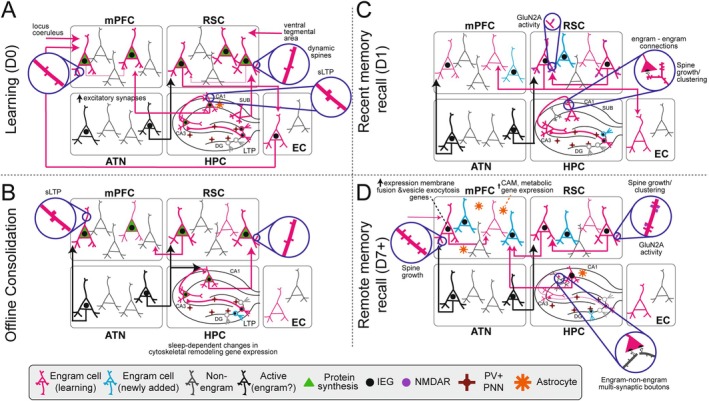
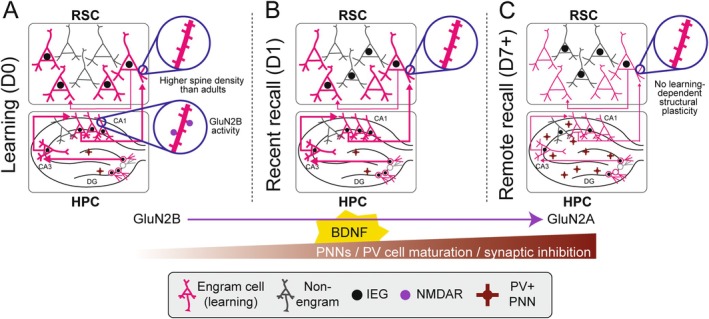
Memories formed in adulthood can last a lifetime, whereas those formed early in life are rapidly forgotten through a process known as infantile amnesia. In recent years, tremendous progress has been made in understanding the memory engram-the physical trace of a memory in the brain-and how it transforms as memories evolve from recent to remote. This review focuses on engram cells and examines their roles in memory encoding, consolidation, retrieval, and forgetting from development to adulthood. We concentrate on four key brain regions: the hippocampus, the retrosplenial cortex, the medial prefrontal cortex, and the anterior thalamic nuclei. We first focus on the adult brain, highlighting recent studies that reveal the distinct contributions of engram cells in each brain region, with particular emphasis on synaptic plasticity and memory consolidation. We then explore how coordinated activity across these regions supports long-term memory. In the second section, we review emerging knowledge of engram cells in the developing brain, examining how developmental differences in their functions contribute to infant memory generalization and infantile amnesia. Compared to adults, much less is known about how, or to what extent, early-life memories undergo consolidation. In the final section, we synthesize current knowledge of memory consolidation and retrieval in the adult brain with what is known about the development of the four brain regions we discuss. We then propose key directions for future research. In sum, this review brings together recent findings that deepen our understanding of the dynamic changes in memory engrams that underlie consolidation and long-term storage and explores how developmental differences may shape the maturation of memory processes.
成年期形成的记忆可以持续一生,而生命早期形成的记忆则会通过一种称为婴儿期遗忘的过程迅速被遗忘。近年来,在理解记忆印迹(大脑中记忆的物理痕迹)以及它如何随着记忆从近期到远期的演变而变化方面取得了巨大进展。这篇综述聚焦于印迹细胞,并研究它们在从发育到成年的记忆编码、巩固、提取和遗忘过程中的作用。我们关注四个关键脑区:海马体、 retrosplenial 皮质、内侧前额叶皮质和前丘脑核。我们首先关注成年大脑,强调近期研究揭示了每个脑区印迹细胞的独特贡献,特别强调突触可塑性和记忆巩固。然后我们探讨这些区域之间的协同活动如何支持长期记忆。在第二部分,我们回顾了发育中大脑印迹细胞的新知识,研究它们功能上的发育差异如何导致婴儿记忆泛化和婴儿期遗忘。与成年人相比,关于早期记忆如何或在多大程度上经历巩固的了解要少得多。在最后一部分,我们将成年大脑中记忆巩固和提取的现有知识与我们所讨论的四个脑区的发育知识结合起来。然后我们提出未来研究的关键方向。总之,这篇综述汇集了近期的研究结果,这些结果加深了我们对巩固和长期存储基础的记忆印迹动态变化的理解,并探讨了发育差异如何塑造记忆过程的成熟。