Chen Xichun, Tian Yu, Li Ming, Lv Bin, Zhang Shuo, Qu Zixian, Wu Jianqing, Cheng Shiya
School of Traffic and Transportation, Lanzhou Jiaotong University, Lanzhou, Gansu, China.
Department of Freight Transportation, Jinan Bureau Group Corporation, Jinan, Shandong, China.
PLoS One. 2025 Aug 6;20(8):e0329303. doi: 10.1371/journal.pone.0329303. eCollection 2025.
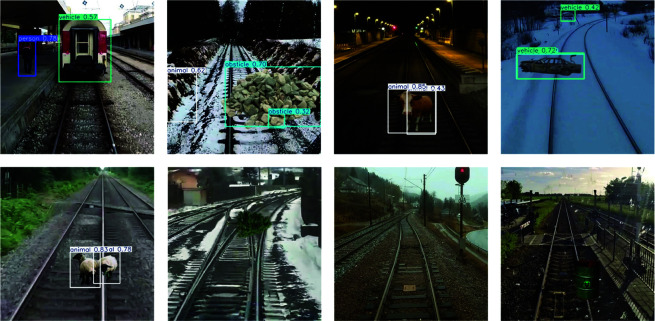
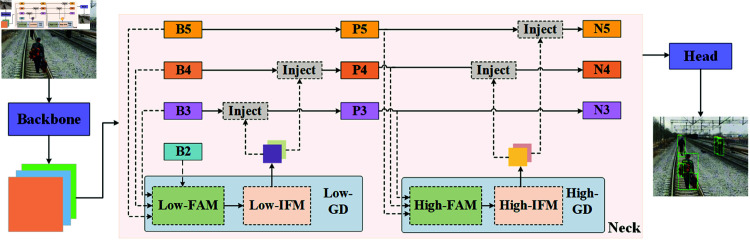
Ensuring high accuracy and efficiency in foreign object intrusion detection along railway lines is critical for guaranteeing railway operational safety under limited resource conditions. However, current visual detection methods generally exhibit limitations in effectively handling diverse object shapes, scales, and varying environmental conditions, while typically incurring substantial computational overhead. To overcome these limitations, this study proposes a multi-level feature aggregation and context enhancement network (MACE-Net). The network architecture integrates the GOLD-YOLO module, an advanced object detection approach, alongside the updated deformable convolutional networks (DCNv3). The incorporation of DCNv3 allows the model to dynamically adapt its sampling positions according to actual object shapes, significantly enhancing feature extraction accuracy, especially for irregularly shaped intrusions. Additionally, the convolutional block attention module (CBAM) is employed to refine spatial and channel-wise feature representation, enabling the model to emphasize crucial object characteristics without substantially increasing computational complexity. Meanwhile, to improve localization robustness, the generalized intersection over union (GIoU) loss function is implemented, offering more reliable detection across various object sizes and shapes. Furthermore, to address the shortage of domain-specific datasets, we created a railway intrusion dataset comprising 7,200 images. Experimental results demonstrate that MACE-Net achieves superior detection performance, improving mAP@0.5 from 78.9% (baseline YOLOv8) to 83.8%-a notable increase of 4.9%. Meanwhile, the F1-score also rises by 5.2%. Importantly, despite significant accuracy gains, MACE-Net maintains computational efficiency similar to that of the baseline, affirming its suitability for real-time railway foreign object detection tasks under constrained energy and computational environments.
在资源有限的条件下,确保铁路沿线异物入侵检测的高精度和高效率对于保障铁路运营安全至关重要。然而,当前的视觉检测方法在有效处理各种物体形状、尺度和变化的环境条件方面普遍存在局限性,同时通常会产生大量的计算开销。为了克服这些局限性,本研究提出了一种多级特征聚合和上下文增强网络(MACE-Net)。该网络架构集成了先进的目标检测方法GOLD-YOLO模块以及更新后的可变形卷积网络(DCNv3)。DCNv3的加入使模型能够根据实际物体形状动态调整采样位置,显著提高特征提取精度,特别是对于形状不规则的入侵物体。此外,采用卷积块注意力模块(CBAM)来细化空间和通道维度的特征表示,使模型能够在不显著增加计算复杂度的情况下强调关键物体特征。同时,为了提高定位鲁棒性,实现了广义交并比(GIoU)损失函数,在各种物体尺寸和形状上提供更可靠的检测。此外,为了解决特定领域数据集不足的问题,我们创建了一个包含7200张图像的铁路入侵数据集。实验结果表明,MACE-Net实现了卓越的检测性能,将mAP@0.5从78.9%(基线YOLOv8)提高到83.8%,显著提高了4.9%。同时,F1分数也提高了5.2%。重要的是,尽管精度有显著提高,但MACE-Net保持了与基线相似的计算效率,证实了其适用于能量和计算环境受限的实时铁路异物检测任务。