Januário Priscila de Oliveira, de Souza Ingred Merllin Batista, Cruz Ariela Torres, Antunes Mateus Dias, Pinheiro Mara Maria Lisboa Santana, Pássaro Anice de Campos, Galhardo Deizyane Dos Reis, Neto João Simão de Mello, Callegari Bianca, Marques Amélia Pasqual
Department of Physiotherapy, Speech Therapy and Occupational Therapy, Faculdade de Medicina da Universidade de São Paulo (FMUSP), São Paulo, SP, Brazil; Department of Physiotherapy, Centro Universitário Barra Mansa (UBM), Barra Mansa, RJ, Brazil.
Department of Physiotherapy, Speech Therapy and Occupational Therapy, Faculdade de Medicina da Universidade de São Paulo (FMUSP), São Paulo, SP, Brazil.
Clinics (Sao Paulo). 2025 Aug 5;80:100747. doi: 10.1016/j.clinsp.2025.100747.
This Cross-sectional study with 516 elderly individuals aimed to measure the prevalence of Low Back Pain (LBP) at different periods and identify associated factors in the elderly population from Barra Mansa, Rio de Janeiro.
A questionnaire on the prevalence of LBP was applied, covering three periods: at the time of the interview, in the last year, and at some point in life, with sociodemographic, clinical, behavioral, and occupational variables in addition, the Numerical Pain Scale and the Roland Morris questionnaire. The significance level established was 5 %.
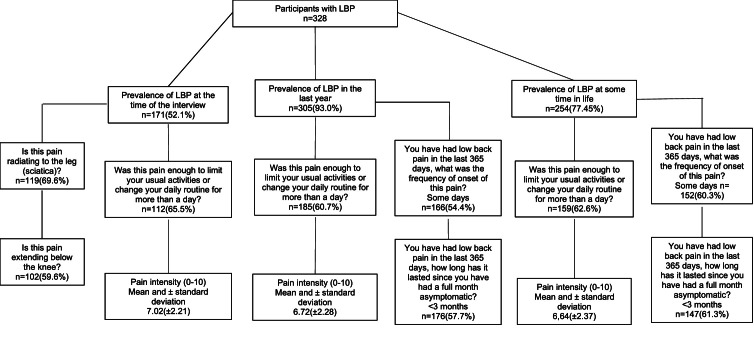
The prevalence of LBP was high at the time of the interview, 52.1 % (95 % CI 0.467‒0.575), 93 % in the last year (95 % CI 0.899‒0.954), and 77.4 % at some point in life (95 % CI 0.710‒0.800). The intensity of pain and functional incapacity were considered moderate. The LBP was associated with lower body mass index, female sex, high blood pressure, greater functional disability and perception of regular health. More active elderly people had less LBP, while the white race had a higher prevalence, and emotional problems had impacted severely at the time of the interview. Diabetes mellitus and being widowed were associated with a greater prevalence of LBP at some point in life. Greater functional disability worsened LBP at the time of the interview, while lower disability increased the prevalence of LBP at some point in life. Greater pain intensity was associated to higher LBP in the last year.
The findings indicate a high prevalence of LBP in different periods associated with sociodemographic, clinical and behavioral factors.
这项横断面研究对516名老年人进行,旨在测量不同时期下背痛(LBP)的患病率,并确定里约热内卢巴拉曼萨老年人群中的相关因素。
应用了一份关于LBP患病率的问卷,涵盖三个时期:访谈时、过去一年以及一生中的某个时间点,此外还包括社会人口统计学、临床、行为和职业变量、数字疼痛量表和罗兰·莫里斯问卷。设定的显著性水平为5%。
访谈时LBP的患病率很高,为52.1%(95%CI 0.467‒0.575),过去一年为93%(95%CI 0.899‒0.954),一生中某个时间点为77.4%(95%CI 0.710‒0.800)。疼痛强度和功能障碍被认为是中度的。LBP与较低的体重指数、女性、高血压、更大的功能残疾以及对健康状况一般的认知有关。活动较多的老年人LBP较少,而白人患病率较高,并且在访谈时情绪问题影响严重。糖尿病和丧偶与一生中某个时间点LBP的较高患病率相关。在访谈时,更大的功能残疾会使LBP恶化,而较低的残疾程度会增加一生中某个时间点LBP的患病率。去年,更高的疼痛强度与更高的LBP相关。
研究结果表明,不同时期LBP的患病率较高,且与社会人口统计学、临床和行为因素有关。