Hu Jun, Li Sanzhong, Wang Shui-Jiong, Peckmann Jörn, Guan Hongxiang, Jiang Shao-Yong, Chen Wei, Cui Huan, Qin Zheng, Liu Peng, Suo Yanhui, Jiang Zhaoxia, Li Dongyong, Wang Nan, Li Xiaohui, Zhong Yuan, Li Ruru, Yang Xi-Ming, Konhauser Kurt O
Frontiers Science Center for Deep Ocean Multispheres and Earth System, Key Lab of Submarine Geosciences and Prospecting Techniques, MOE and College of Marine Geosciences, Ocean University of China, Qingdao, China.
Laoshan Laboratory, Laboratory for Marine Mineral Resources, Qingdao Marine Science and Technology Center, Qingdao, China.
Nat Commun. 2025 Aug 6;16(1):7249. doi: 10.1038/s41467-025-62622-z.
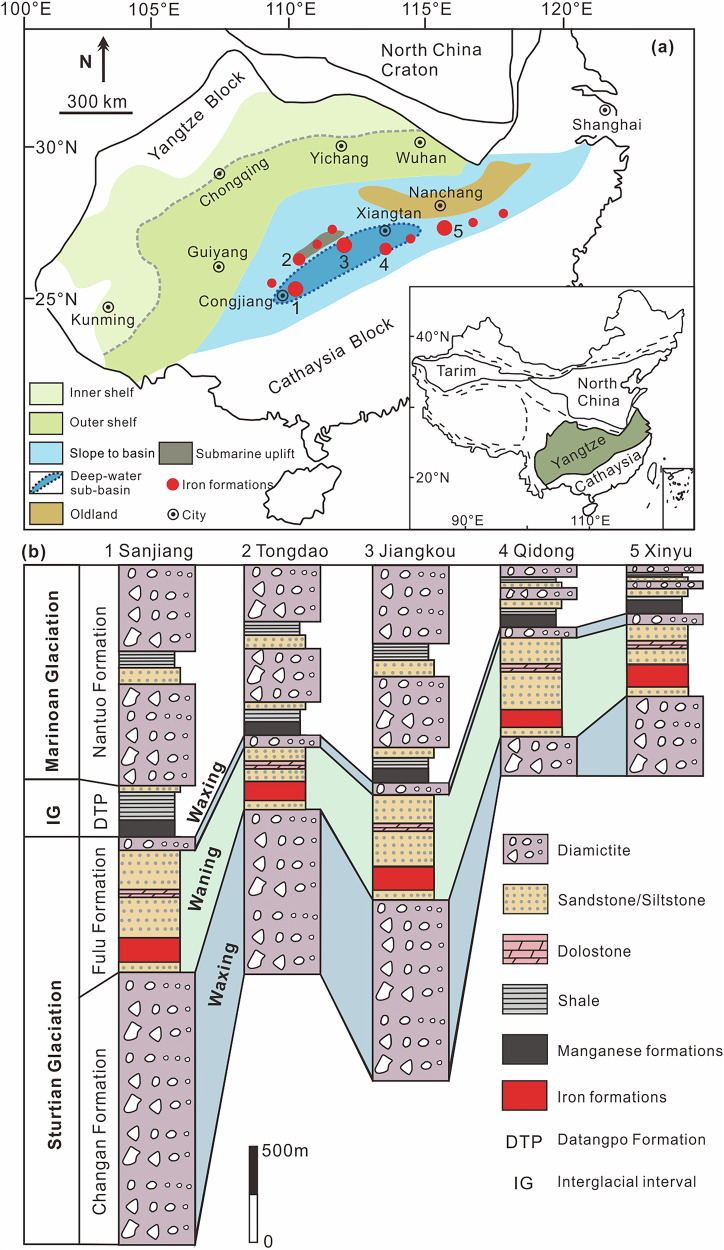
The Sturtian and Marinoan glaciations shaped Neoproterozoic palaeoenvironmental evolution. While methane emission likely intensified the Marinoan greenhouse effect, its role during the Sturtian glaciation-coinciding with widespread iron formations (IFs)-remains poorly understood. Here, we analysed bio-essential metals (Ni, Co, Zn), rare earth elements and yttrium (REY), Fe (δFe) and Ni (δNi) isotopes in hematite and magnetite, alongside bulk-rock and in-situ C isotopes of Mn-rich carbonates from five well-preserved Sturtian-aged IFs in South China. Our findings provide geochemical evidence for a methane-related biogeochemical pathway driving Fe-bearing mineral transformation via methanogenesis and metal-driven anaerobic methane oxidation (AOM), mediated by methanogens and anaerobic methane-oxidizing archaea (ANME) in ferruginous settings. Additionally, the Sturtian deglaciation facilitated atmospheric-oceanic O exchange, increased nutrient influx from weathering, and methane release under slow AOM oxidation kinetics, potentially aiding ice sheet melting or prolonging glacial waning.
斯图尔蒂亚冰期和马里诺冰期塑造了新元古代的古环境演化。虽然甲烷排放可能加剧了马里诺冰期的温室效应,但其在斯图尔蒂亚冰期(与广泛分布的铁建造(IFs)同时出现)中的作用仍知之甚少。在此,我们分析了中国南方五个保存完好的斯图尔蒂亚纪铁建造中赤铁矿和磁铁矿中的生物必需金属(镍、钴、锌)、稀土元素和钇(REY)、铁(δFe)和镍(δNi)同位素,以及块状岩石和富锰碳酸盐岩的原位碳同位素。我们的研究结果提供了地球化学证据,证明存在一条与甲烷相关的生物地球化学途径,该途径通过产甲烷作用和金属驱动的厌氧甲烷氧化(AOM)推动含铁矿物转化,这一过程由产甲烷菌和铁环境中的厌氧甲烷氧化古菌(ANME)介导。此外,斯图尔蒂亚冰期的冰消作用促进了大气 - 海洋间的氧交换,增加了风化作用带来的营养物质流入,并在缓慢的AOM氧化动力学条件下导致甲烷释放,这可能有助于冰盖融化或延长冰川消退期。