Čelakovská Jarmila, Čermáková Eva, Boudková Petra, Krejsek Jan
Department of Dermatology and Venereology Faculty Hospital and Medical Faculty of Charles University, Hradec Králové, Czechia.
Department of Medical Biophysics, Medical Faculty of Charles University, Hradec Králové, Czechia.
Front Immunol. 2025 Jul 23;16:1604883. doi: 10.3389/fimmu.2025.1604883. eCollection 2025.
Interleukins IL-4, Il-5, IL-10, IL-13 and IL-33 play an important role in atopic dermatitis patients. The aim of our study is to address several knowledge gaps in the understanding of interleukin dynamics in atopic dermatitis patients and the effects of dupilumab treatment.
We conducted an assessment of plasma levels of interleukins IL-4, IL-5, IL-10, IL-13 and IL-33 in 89 AD patients and in 44 healthy individuals as a control group. The group of AD patients consisted of 27 patients treated with dupilumab (15 men, 12 women) at a mean age of 44.8 years and 62 patients without dupilumab treatment (35 women and 27 men) at a mean age of 46.3 years. The control group consisted of 44 healthy subjects (22 men, 22 women), at a mean age of 43.3 years. Patients were treated with a standard dose of dupilumab, 300 mg s.c. every two weeks. For screening analysis of plasma levels of selected cytokines, the performance assay Human cytokine Luminex was used. Blood samples were unstimulated and stimulated with phorbol myristate acetate and ionomycin. This stimulation provides non-specific stimulation of innate and adaptive immunity cells and increases their cytokine production. The level of interleukins IL-4, IL-5, IL-10, IL-13 and IL-33 were compared in AD patients with the results in control group. Nonparametric Kruskal-Wallis analysis of variance with Dunn's test with Bonferroni modification of significance level was used.
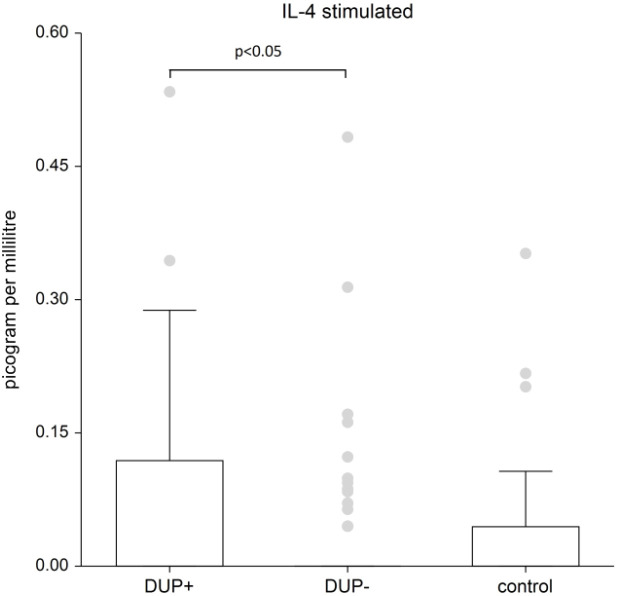
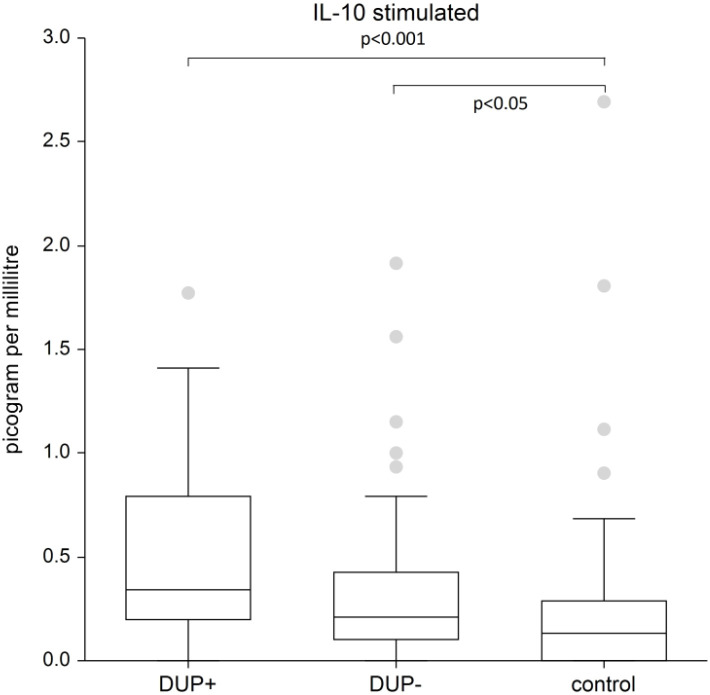
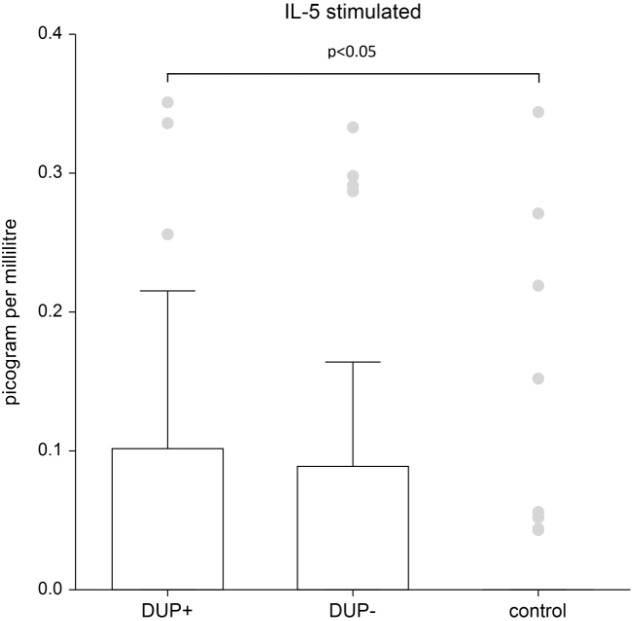
The significantly higher plasma level of stimulated IL-5 was confirmed in AD patients treated with dupilumab and significantly higher plasma IL-10 levels were confirmed in both dupilumab and non-dupilumab treated patients compared to control group. Stimulated IL-4 levels are significantly higher in patients treated with dupilumab compared to patients without dupilumab. The significant difference in IL-13 and IL-33 in AD patients compared to control group was not confirmed.
By identifying significant differences in IL-5 and IL-10 plasma levels, our study highlights potential markers that could improve AD diagnosis and treatment monitoring. Our results contribute to a deeper understanding of how dupilumab alters immune signaling and may inform the development of additional biomarkers and targeted therapies for AD.
白细胞介素IL-4、IL-5、IL-10、IL-13和IL-33在特应性皮炎患者中起重要作用。我们研究的目的是填补在理解特应性皮炎患者白细胞介素动态变化及度普利尤单抗治疗效果方面的几个知识空白。
我们对89例特应性皮炎患者和44例健康个体(作为对照组)的血浆中白细胞介素IL-4、IL-5、IL-10、IL-13和IL-33水平进行了评估。特应性皮炎患者组包括27例接受度普利尤单抗治疗的患者(15名男性,12名女性),平均年龄44.8岁,以及62例未接受度普利尤单抗治疗的患者(35名女性和27名男性),平均年龄46.3岁。对照组由44名健康受试者(22名男性,22名女性)组成,平均年龄43.3岁。患者接受标准剂量的度普利尤单抗治疗,皮下注射300mg,每两周一次。对于选定细胞因子血浆水平的筛查分析,使用人细胞因子Luminex性能测定法。血液样本未受刺激,并分别用佛波酯肉豆蔻酸酯和离子霉素进行刺激。这种刺激可对先天性和适应性免疫细胞进行非特异性刺激,并增加其细胞因子的产生。将特应性皮炎患者中白细胞介素IL-4、IL-5、IL-10、IL-13和IL-33的水平与对照组的结果进行比较。采用非参数Kruskal-Wallis方差分析及经Bonferroni显著性水平修正的Dunn检验。
接受度普利尤单抗治疗的特应性皮炎患者中,刺激后的IL-5血浆水平显著更高;与对照组相比,接受度普利尤单抗治疗和未接受度普利尤单抗治疗的患者中,血浆IL-10水平均显著更高。与未接受度普利尤单抗治疗的患者相比,接受度普利尤单抗治疗的患者中刺激后的IL-4水平显著更高。未证实特应性皮炎患者与对照组相比,IL-13和IL-33存在显著差异。
通过识别IL-5和IL-10血浆水平的显著差异,我们的研究突出了可能改善特应性皮炎诊断和治疗监测的潜在标志物。我们的结果有助于更深入地理解度普利尤单抗如何改变免疫信号,并可能为特应性皮炎的其他生物标志物和靶向治疗的开发提供信息。