Ficarra Giuseppe, Pramanik Ashim, Barbata Ludovico G, Cannas Marco, Ettlinger Romy L, Morris Russel E, Buscarino Gianpiero, Messina Fabrizio, Sciortino Alice
Physics and Chemistry Department - Emilio Segrè, University of Palermo, Via Archirafi 36, 90123 Palermo, Italy.
INST Consortium for Materials Science and Technology, Via Giusti 9, 50125 Firenze, Italy.
ACS Appl Nano Mater. 2025 Jul 18;8(30):15165-15175. doi: 10.1021/acsanm.5c02396. eCollection 2025 Aug 1.
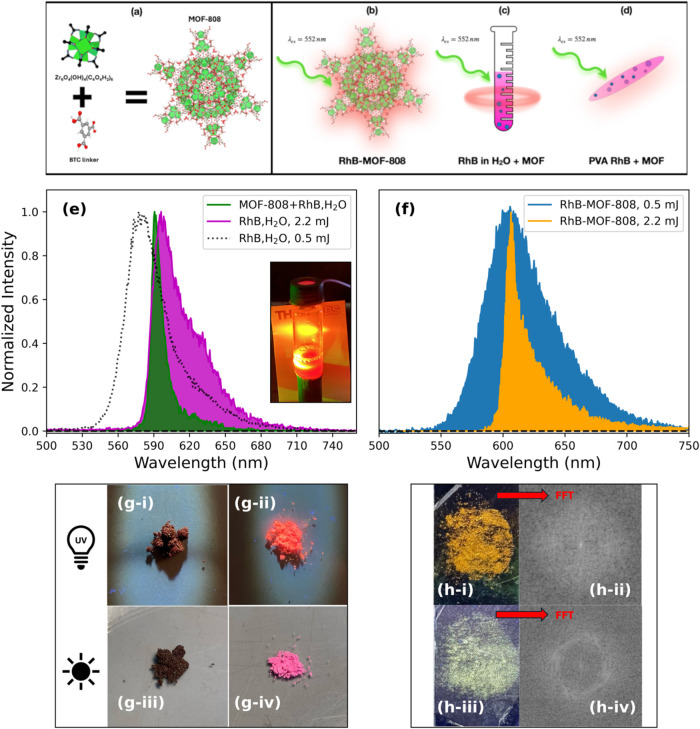
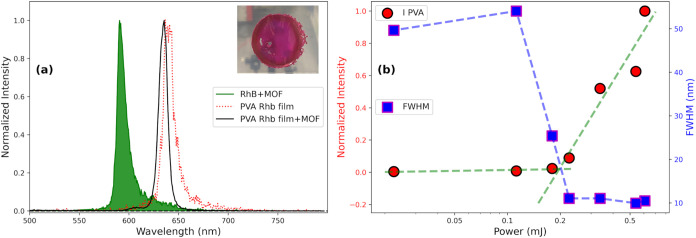
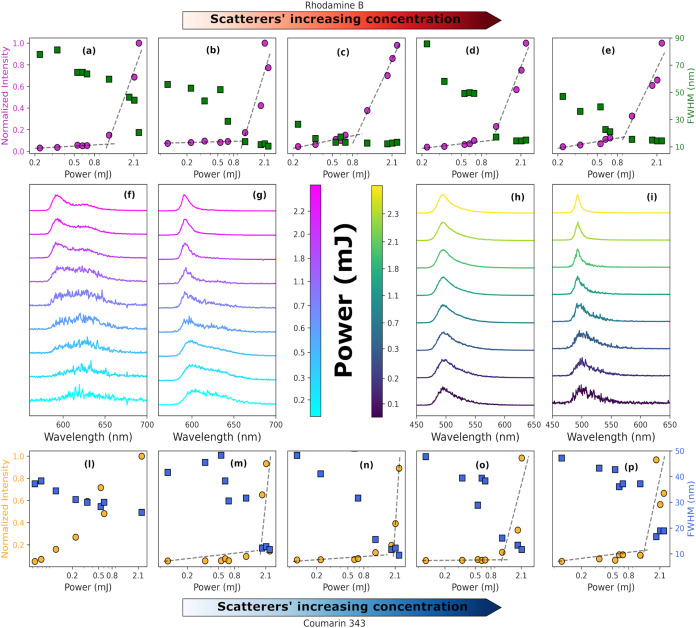
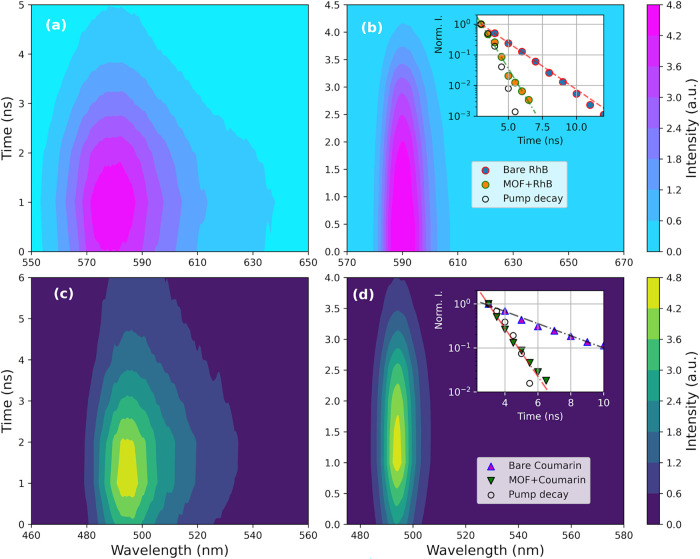
Fluorescent organic dyes have a broad range of applications across various fields. However, their use is threatened by stability issues such as photobleaching and aggregation-caused quenching that prevent them from showing solid-state luminescence and being used in high-power photonics applications for a long period. One possibility to overcome these problems is to embed dye molecules within a hosting platform. Metal-organic frameworks (MOFs) are among the best candidates to overcome these problems due to their porous nature, which provides excellent sorption capacities while ensuring stability for potential guest molecules, even in extreme environments. In this work, we investigate the optical performance of rhodamine B and coumarin 343 when interacting with Zr-based MOF-808. On one hand, we demonstrate that inclusion of dye molecules in MOF-808 cavities prevents aggregation-induced quenching, enabling the use of dyes in powdered form and enhancing their emission in solid-state applications, such as fingerprint detection. On the other hand, the dye-MOF interaction in solution reveals that MOF-808 nanoparticles act as efficient scatterers, significantly enhancing random lasing emission by narrowing the emission spectra and reducing the lasing threshold. The lasing performance is shown to be dependent on the MOF concentration and excitation intensity, with an optimal concentration minimizing the threshold and bandwidth. Finally, we demonstrate the feasibility of combining MOF-808 nanoparticles and dyes into polymeric thin films, where the MOFs contribute to halving the lasing threshold, making the system suitable for portable lasing applications.
荧光有机染料在各个领域都有广泛的应用。然而,它们的使用受到诸如光漂白和聚集诱导猝灭等稳定性问题的威胁,这些问题阻碍了它们呈现固态发光并长期用于高功率光子学应用。克服这些问题的一种可能性是将染料分子嵌入宿主平台中。金属有机框架(MOF)由于其多孔性质是克服这些问题的最佳候选材料之一,这种多孔性质提供了出色的吸附能力,同时确保潜在客体分子的稳定性,即使在极端环境中也是如此。在这项工作中,我们研究了罗丹明B和香豆素343与基于Zr的MOF-808相互作用时的光学性能。一方面,我们证明将染料分子包含在MOF-808的空腔中可防止聚集诱导猝灭,使得能够使用粉末形式的染料并增强它们在固态应用(如指纹检测)中的发射。另一方面,溶液中的染料-MOF相互作用表明,MOF-808纳米颗粒充当高效散射体,通过使发射光谱变窄和降低激光阈值来显著增强随机激光发射。激光性能显示取决于MOF浓度和激发强度,存在一个最佳浓度可使阈值和带宽最小化。最后,我们证明了将MOF-808纳米颗粒和染料组合成聚合物薄膜的可行性,其中MOF有助于将激光阈值减半,使该系统适用于便携式激光应用。