Setsu Selena, Morimoto Satoru, Nakamura Shiho, Ozawa Fumiko, Okano Hideyuki
Keio University Regenerative Medicine Research Center, Kanagawa 210-0821, Japan; Laboratory of RNA Function, Institute for Quantitative Biosciences, The University of Tokyo, Tokyo 113-0032, Japan; Department of Computational Biology and Medical Sciences, Graduate School of Frontier Sciences, The University of Tokyo, Tokyo 277-0822, Japan.
Keio University Regenerative Medicine Research Center, Kanagawa 210-0821, Japan; Division of Neurodegenerative Disease Research, Tokyo Metropolitan Institute for Geriatrics and Gerontology, Tokyo 173-0015, Japan.
STAR Protoc. 2025 Aug 5;6(3):104016. doi: 10.1016/j.xpro.2025.104016.
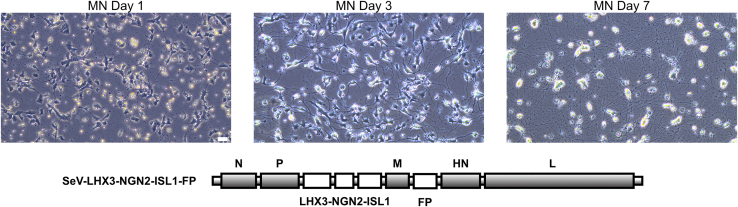
Here, we present a protocol for inducing spinal lower motor neurons (LMNs) from human induced pluripotent stem cells (iPSCs). We describe steps for preparation of a chemically induced transitional state (CTraS), transduction with Sendai virus, and LMN differentiation and maintenance. We then detail procedures for live imaging for single-cell-based survival analysis and neurite length of LMNs using BioStation and immunocytochemistry for induction efficiency check. This protocol is optimized for amyotrophic lateral sclerosis (ALS) research and large-scale screening. For complete details on the use and execution of this protocol, please refer to Setsu et al..
在此,我们展示了一种从人诱导多能干细胞(iPSC)诱导生成脊髓下运动神经元(LMN)的方案。我们描述了化学诱导过渡状态(CTraS)的制备步骤、仙台病毒转导以及LMN的分化和维持。然后,我们详细说明了使用BioStation进行基于单细胞的存活分析和LMN神经突长度的实时成像程序,以及用于诱导效率检查的免疫细胞化学方法。该方案针对肌萎缩侧索硬化症(ALS)研究和大规模筛选进行了优化。有关此方案的使用和执行的完整详细信息,请参考Setsu等人的研究。