Li Shujun, Huang Nanqu, Wang Mei, Huang Wendi, Shi Jingshan, Luo Yong, Huang Juan
Key Laboratory of Basic Pharmacology and Joint International Research Laboratory of Ethnomedicine of Ministry of Education, Zunyi Medical University, Zunyi, Guizhou, China.
Department of Geriatrics, National Drug Clinical Trial Institution, Third Affiliated Hospital of Zunyi Medical University (The First People's Hospital of Zunyi), Zunyi, Guizhou, China.
Front Aging Neurosci. 2025 Jul 24;17:1601602. doi: 10.3389/fnagi.2025.1601602. eCollection 2025.
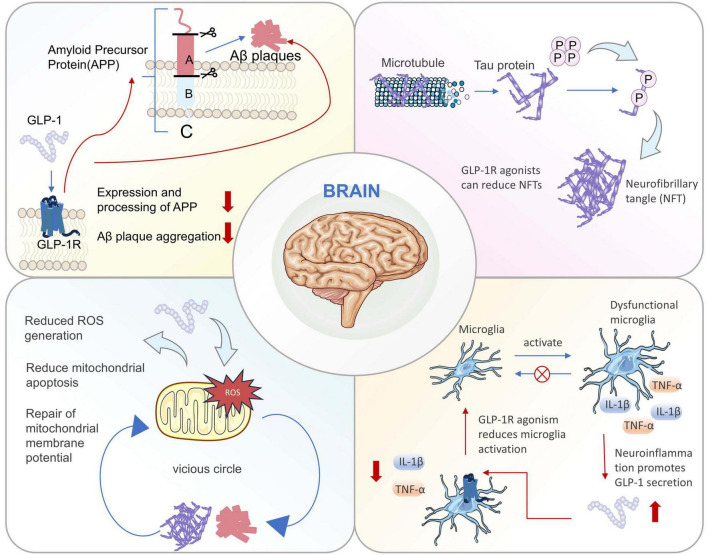
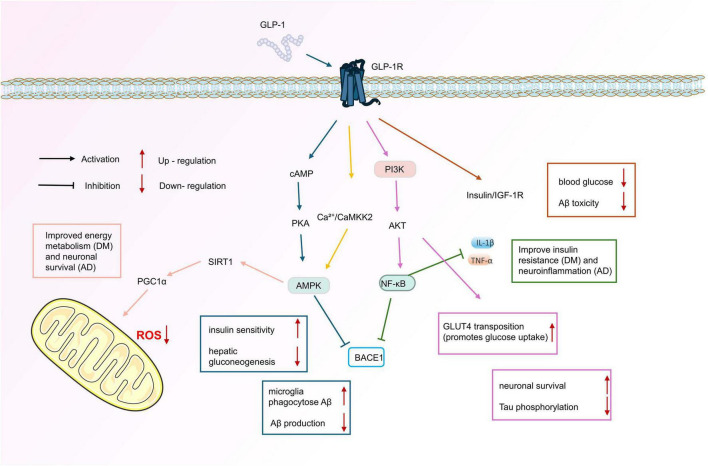
There is growing interest in the relationship between Alzheimer's disease (AD) and diabetes mellitus (DM), and the glucagon-like peptide-1 receptor (GLP-1R) may be an important link between these two diseases. The role of GLP-1R in DM is principally to regulate glycemic control by stimulating insulin secretion, inhibiting glucagon secretion, and improving insulin signaling, thereby reducing blood glucose levels. In AD, GLP-1R attenuates the pathological features of AD through mechanisms such as anti-inflammatory effects, the reduction in amyloid-beta (Aβ) deposition, the promotion of Aβ clearance, and improvements in insulin signaling. Notably, AD and DM share numerous pathophysiological mechanisms, most notably the disruption of insulin signaling pathways in the brain. These findings further underscore the notion that GLP-1R plays pivotal roles in both diseases. Taken together, these findings lead us to conclude that GLP-1R not only plays an important role in the treatment of DM and AD but also may serve as a bridge between these two diseases. Future research should focus on elucidating the detailed molecular mechanisms underlying the actions of GLP-1R in both diseases and exploring the development of GLP-1R agonists with dual therapeutic benefits for AD and DM. This could pave the way for innovative integrated treatment strategies to improve outcomes for patients affected by these intertwined conditions.
阿尔茨海默病(AD)与糖尿病(DM)之间的关系正受到越来越多的关注,胰高血糖素样肽-1受体(GLP-1R)可能是这两种疾病之间的重要联系。GLP-1R在糖尿病中的作用主要是通过刺激胰岛素分泌、抑制胰高血糖素分泌和改善胰岛素信号传导来调节血糖控制,从而降低血糖水平。在阿尔茨海默病中,GLP-1R通过抗炎作用、减少β淀粉样蛋白(Aβ)沉积、促进Aβ清除以及改善胰岛素信号传导等机制减轻阿尔茨海默病的病理特征。值得注意的是,阿尔茨海默病和糖尿病有许多共同的病理生理机制,最显著的是大脑中胰岛素信号通路的破坏。这些发现进一步强调了GLP-1R在这两种疾病中都起着关键作用的观点。综上所述,这些发现使我们得出结论,GLP-1R不仅在糖尿病和阿尔茨海默病的治疗中发挥重要作用,而且可能是这两种疾病之间的桥梁。未来的研究应侧重于阐明GLP-1R在这两种疾病中作用的详细分子机制,并探索开发对阿尔茨海默病和糖尿病具有双重治疗益处的GLP-1R激动剂。这可能为创新的综合治疗策略铺平道路,以改善受这些相互交织病症影响患者的治疗效果。