Chee Cassandra Sheau Mei, Tan Shirley Siang Ning, Voon Pei Jye, Augustin Yolanda, Krishna Sanjeev, Mat Ali Nafeesa, Wan Maharuddin Izzati Binti, Tiong Xun Ting, Abdul Rahim Nur Khairiyah Binti, Ismail Adam Malik, Sim Edmund Ui-Hang, Divis Paul Cs, Jinam Timothy Adrian, Lim Melissa Siaw Han
Faculty of Medicine and Health Sciences, Universiti Malaysia Sarawak (UNIMAS), Kota Samarahan, Sarawak, Malaysia.
Clinical Research Centre, Institute for Clinical Research, Sarawak General Hospital, Ministry of Health, National Institutes of Health, Kuching, Sarawak, Malaysia.
BMC Infect Dis. 2025 Aug 10;25(1):1010. doi: 10.1186/s12879-025-11441-0.
Human papillomavirus (HPV) is a key etiological factor in cervical cancer in both Malaysia and globally. It continues to pose a significant public health challenge. This systematic review aims to delineate the distribution of HPV genotypes across different demographics in Malaysia to inform targeted prevention strategies.
We conducted a systematic review following PRISMA guidelines, analyzing observational studies published from 2000 onward that reported HPV genotypes in cervicovaginal samples from Malaysian women. The review utilized PubMed, SCOPUS, The Cochrane Library, APA PsycNet, and Google Scholar for literature searches, focusing on studies that employed molecular methods for HPV genotyping. Two reviewers independently screened the articles, extracted data, and assessed study quality using the Newcastle-Ottawa Scale (NOS). A descriptive analysis was performed, and findings were synthesized by genotype, region, and ethnicity.
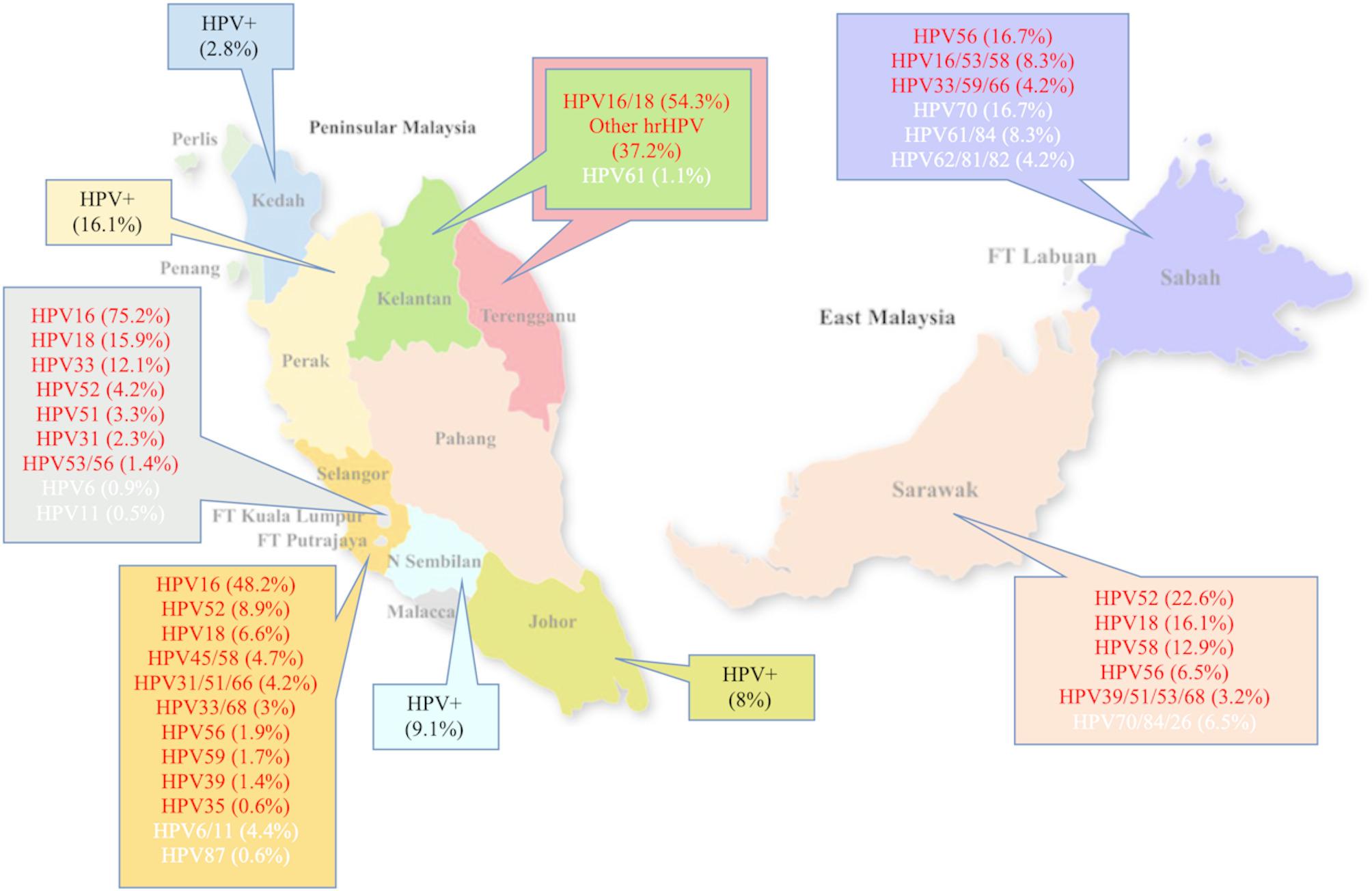
The review included 22 studies from an initial pool of 2,547 articles, encompassing 44,251 women. These studies reported a HPV prevalence of up to 100% in confirmed cervical cancer cases and in general screenings from 4.5 to 47.7%. A total of 28 different HPV genotypes (high- and low-risk) were identified, with HPV16, HPV18, HPV58, HPV52, and HPV33 being the most prevalent high-risk genotypes. Genotype distributions showed significant variation across different states and ethnic groups within Malaysia, highlighting the diverse nature of HPV-related risks.
This review provides a detailed snapshot of the HPV genotype distribution in Malaysia, underscoring the necessity for tailored public health interventions that address the regional and ethnic diversity in HPV prevalence. The findings support the need for targeted vaccination programs and enhanced screening measures to effectively combat the high rates of HPV-related (99%) cervical cancer in Malaysia.
人乳头瘤病毒(HPV)是马来西亚乃至全球宫颈癌的关键病因。它仍然是一项重大的公共卫生挑战。本系统评价旨在描绘马来西亚不同人群中HPV基因型的分布情况,为针对性预防策略提供依据。
我们按照PRISMA指南进行系统评价,分析2000年以后发表的观察性研究,这些研究报告了马来西亚女性宫颈阴道样本中的HPV基因型。该评价利用PubMed、SCOPUS、考克兰图书馆、APA心理学网络数据库和谷歌学术进行文献检索,重点关注采用分子方法进行HPV基因分型的研究。两名评价者独立筛选文章、提取数据,并使用纽卡斯尔-渥太华量表(NOS)评估研究质量。进行了描述性分析,并按基因型、地区和种族对结果进行了综合。
该评价纳入了从最初的2547篇文章中筛选出的22项研究,涉及44251名女性。这些研究报告,在确诊的宫颈癌病例中HPV感染率高达100%,在一般筛查中为4.5%至47.7%。共鉴定出28种不同的HPV基因型(高危和低危),其中HPV16、HPV18、HPV58、HPV52和HPV33是最常见的高危基因型。基因型分布在马来西亚不同州和种族之间存在显著差异,凸显了HPV相关风险的多样性。
本评价提供了马来西亚HPV基因型分布的详细概况,强调了针对HPV感染率的地区和种族差异制定公共卫生干预措施的必要性。研究结果支持开展针对性疫苗接种计划和加强筛查措施,以有效应对马来西亚与HPV相关(99%)的宫颈癌高发病率。