Padi Anil Reddy, Patel Rutvij, Dumpala Maheshwar, Anjum Ayesha, Ahmed Israr, Dronadula Venkata Sai Krishna Reddy, Saeed Zain Bin, Mirza Muhammad Sohail S, Jonnala Ramya Reddy
Internal Medicine, Osmania Medical College, Hyderabad, IND.
Internal Medicine, Creighton University, Omaha, USA.
Cureus. 2025 Jul 10;17(7):e87666. doi: 10.7759/cureus.87666. eCollection 2025 Jul.
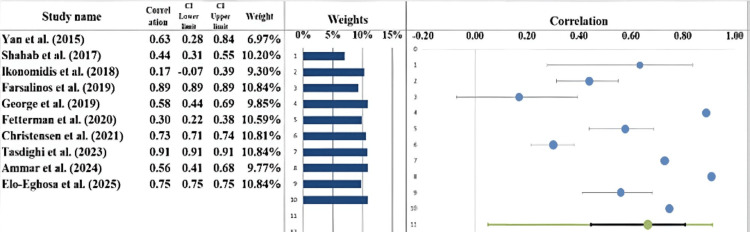
E-cigarette (EC) use has been associated with several chronic cardiovascular effects. These include arterial stiffness, endothelial dysfunction, and increased oxidative stress. Despite the fact that the use of ECs has been welcomed as potentially less dangerous than alternatives compared to the smoking of conventional cigarettes, the impact that the utilization of ECs has on cardiovascular condition is an issue that is open to a controversial debate. The purpose of this systematic review and meta-analysis was to ascertain the cardiovascular risk of EC smoking as related to that of nonsmoking and conventional smoking. The exhaustive search was conducted on a variety of databases (Scopus, PubMed, Web of Science, and Google Scholar) for identifying cross-sectional studies, randomized controlled trials, and observational cohort studies that were published between 2015 and 2025. Pooled analysis was performed on the data, and the correlation coefficient was estimated through a model of random effects. The heterogeneity was assessed through the publication bias, and the I² statistic was tackled through funnel plots and Egger's test. The overall analysis demonstrated that EC smoking was related to higher vascular stiffness and oxidative stress, although to a lesser degree compared to conventional cigarette smoking. The total effect size indicated a positive but moderate relationship (r = 0.60, 95% CI: 0.45-0.81) between EC smoking and cardiovascular risks. Although the results were encouraging, there was substantial heterogeneity (I² = 99.99%), showing variation in findings. This implies that future research is obligatory to explicate appropriate long-term cardiovascular consequences of EC consumption, especially among dual users.
使用电子烟(EC)已与多种慢性心血管效应相关联。这些效应包括动脉僵硬度增加、内皮功能障碍和氧化应激增加。尽管与吸传统香烟相比,使用电子烟被认为潜在危险性较低而受到欢迎,但电子烟的使用对心血管状况的影响仍是一个存在争议的问题。本系统评价和荟萃分析的目的是确定吸电子烟与不吸烟及吸传统香烟相比的心血管风险。我们在多个数据库(Scopus、PubMed、Web of Science和谷歌学术)中进行了详尽搜索,以识别2015年至2025年期间发表的横断面研究、随机对照试验和观察性队列研究。对数据进行了汇总分析,并通过随机效应模型估计了相关系数。通过发表偏倚评估异质性,并通过漏斗图和埃格检验处理I²统计量。总体分析表明,吸电子烟与更高的血管僵硬度和氧化应激有关,尽管与吸传统香烟相比程度较轻。总效应量表明吸电子烟与心血管风险之间存在正相关但中等程度的关系(r = 0.60,95% CI:0.45 - 0.81)。尽管结果令人鼓舞,但存在显著异质性(I² = 99.99%),研究结果存在差异。这意味着未来有必要进行研究,以阐明吸电子烟尤其是在双重使用者中适当的长期心血管后果。