
双侧全膝关节置换术后出现大量出血性水疱:一例报告
Massive Hemorrhagic Blisters following Bilateral Total Knee Replacement: A Case Report.
作者信息
Latha Dhinesh Nadarajan, Janakiraman Buvanesh
机构信息
Department of Orthopaedic Surgery, Bhaarath Medical College and Hospital, Chennai, Tamil Nadu, India.
出版信息
J Orthop Case Rep. 2025 Aug;15(8):154-157. doi: 10.13107/jocr.2025.v15.i08.5922.
INTRODUCTION
Skin blisters occur due to increased shear forces at the dermo-epidermal junction. They are classified as clear and hemorrhagic blisters. Blisters occur due to trauma, compartment syndrome, and vascular deficits. We present a case report of hemorrhagic blister formation following bilateral total knee replacement.
CASE REPORT
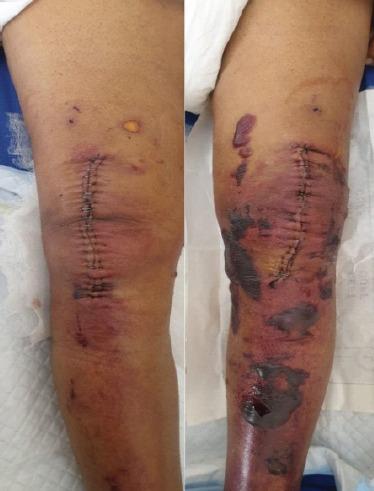
A 64-year-old male with bilateral advanced osteoarthritis of the knees underwent bilateral total knee replacement in the same sitting. Surgery was done under strict aseptic precautions and tourniquet control. The procedure went uneventfully. Postoperatively, on the 2nd day, the patient developed massive hemorrhagic blisters around the operated site in both legs. Doppler scans showed no evidence of deep vein thrombosis. The blisters were managed by intravenous antibiotic coverage and soft, non-adherent collagen dressings. The blisters healed and reepithelialized by 3 weeks. A range of motion exercise was initiated on the 2nd post-operative day, as tolerated. At the final follow-up of 1 year, the patient had satisfactory Oxford Knee Scores.
CONCLUSION
Non-adhesive dressings, prophylactic intravenous antibiotics, and effective rehabilitation are the keystones in the management of patients with hemorrhagic blisters following total knee replacement.
引言
皮肤水泡是由于真皮 - 表皮交界处的剪切力增加而出现的。它们分为清亮水泡和出血性水泡。水泡可因创伤、骨筋膜室综合征和血管缺陷而发生。我们报告一例双侧全膝关节置换术后出血性水泡形成的病例。
病例报告
一名64岁男性,双膝患有双侧晚期骨关节炎,在同一次手术中接受了双侧全膝关节置换术。手术在严格的无菌预防措施和止血带控制下进行。手术过程顺利。术后第2天,患者双下肢手术部位周围出现大量出血性水泡。多普勒扫描显示无深静脉血栓形成迹象。水泡通过静脉使用抗生素及柔软、不粘连的胶原敷料进行处理。水泡在3周内愈合并重新上皮化。术后第2天开始进行可耐受的关节活动度锻炼。在1年的最终随访中,患者的牛津膝关节评分令人满意。
结论
非粘性敷料、预防性静脉使用抗生素和有效的康复治疗是全膝关节置换术后出血性水泡患者管理的关键。



 Zotero 插件