Ashraf Tariq, Sultana Rafat, Karim Musa, Aamir Kanwal Fatima, Mujtaba Mustajab, Memon Shoukat, Gajju Deedar Hussain, Bhutto Abdul Qadir, Arif Umair, Bajwa Hassan Irshad, Shehzad Naveed, Mehmood Haji Maqsood, Hassan Ijaz Ul, Hassan Syed Gulzar Ul, Ashraf Waheed, Saleem Muhammad, Tariq Naeem, Khan Muhammad Niaz, Khan Khalid Naseem, Khawaja Muhammad Farooq Saeed, Hussain Naveed, Memon Shahid Hussain, Kazmi Imran Ahmed, Azeem Muhamamd Shahzad, Asi Muhammad Akram, Malik Khalid Razaq, Aslam Shahzad, Sohail Muhammad Amir, Shah Arshad Ali, Yaqub Maha Zainab Zia, Khubaib Syed, Imam Hasan, Fareed Ghulam, Riaz Rehan
Karachi Institute of Heart Disease (KIHD), Karachi, Pakistan.
National Institute of Cardiovascular Disease (NICVD), Karachi, Pakistan.
PLoS One. 2025 Aug 11;20(8):e0328447. doi: 10.1371/journal.pone.0328447. eCollection 2025.
Hypertension (HTN) affects over a billion people worldwide, with most cases in low- and middle-income countries (LMICs) where awareness and control remain low. In Pakistan, general practitioners (GPs) are usually the initial contact for hypertensive patients. Through the Train the Trainer (TTT) initiative, a group of consultant cardiologists were trained as master trainers to conduct training for GPs across Pakistan. This study aimed to assess the effectiveness of the TTT initiative regarding knowledge of GPs about the diagnosis and management of HTN.
This study included 540 GPs from all over Pakistan. Participants attended HTN training workshops run by Master Trainers under the TTT model and completed a structured online questionnaire in relation to knowledge of HTN before and 1-3 months after training. Knowledge scores were derived from correct responses for 19 items.
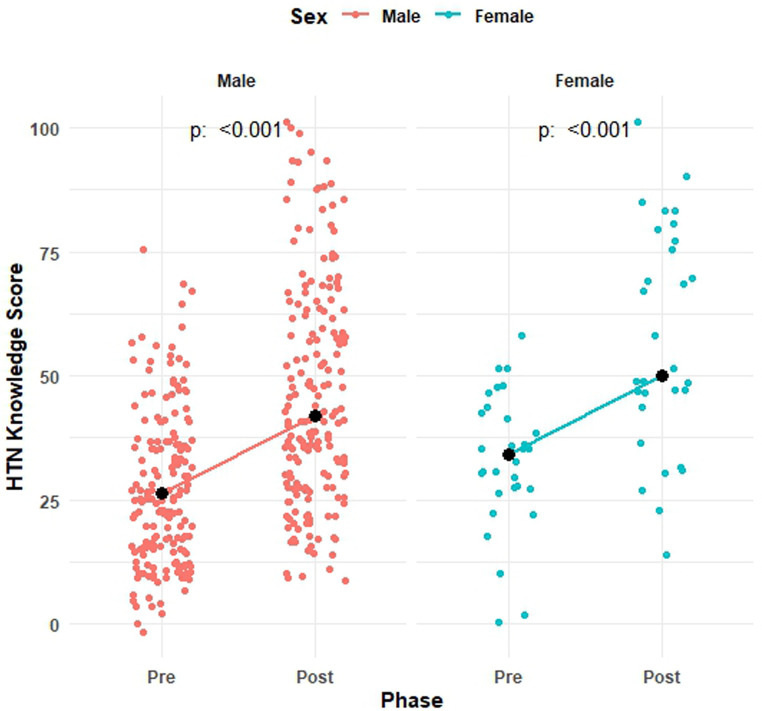
Pre-training GPs demonstrated low HTN knowledge scores with a median of 26.3 [IQR: 15.8-36.8] and 92% scoring less than 50. In contrast, post-training medians increased significantly to 42.1 [IQR: 31.6-63.2], with 38.5% of GPs achieving moderate or high knowledge scores ≥50 (p < 0.001). Overall, gains were observed across all demographic groups; significant improvement was observed among female and younger GPs.
The TTT initiative effectively improved knowledge in both the diagnosis and management of hypertension among GPs, thus standing to potentially improve the current gaps in HTN care in many LMICs through similar models. Further studies are warranted to document the long-term clinical impact of this kind of training on patient outcomes and hypertension control.
高血压影响着全球超过10亿人,大多数病例发生在低收入和中等收入国家(LMICs),这些国家的知晓率和控制率仍然很低。在巴基斯坦,全科医生(GPs)通常是高血压患者的首诊医生。通过“培训培训师”(TTT)倡议,一组顾问心脏病专家被培训为主培训师,为巴基斯坦各地的全科医生开展培训。本研究旨在评估TTT倡议在提高全科医生对高血压诊断和管理知识方面的有效性。
本研究纳入了来自巴基斯坦各地的540名全科医生。参与者参加了由主培训师根据TTT模式举办的高血压培训研讨会,并在培训前和培训后1至3个月完成了一份关于高血压知识的结构化在线问卷。知识得分来自19个项目的正确回答。
培训前,全科医生的高血压知识得分较低,中位数为26.3[四分位间距:15.8 - 36.8],92%的人得分低于50分。相比之下,培训后的中位数显著提高到42.1[四分位间距:31.6 - 63.2],38.5%的全科医生获得了中度或高度知识得分≥50(p < 0.001)。总体而言,所有人口群体都有进步;女性和年轻全科医生有显著改善。
TTT倡议有效地提高了全科医生在高血压诊断和管理方面的知识,因此有可能通过类似模式改善许多低收入和中等收入国家目前在高血压护理方面的差距。有必要进一步研究记录这种培训对患者结局和高血压控制的长期临床影响。