Sharma Rishikesh, Rallapalli Srinivas, Magner Joe
Department of Civil Engineering, Birla Institute of Technology and Science, Pilani, Pilani Campus, Vidya Vihar, Pilani, 333031, Rajasthan, India.
Department of Bioproducts and Biosystems Engineering, University of Minnesota, Twin cities, Minneapolis, USA.
Sci Rep. 2025 Aug 11;15(1):29382. doi: 10.1038/s41598-025-15426-6.
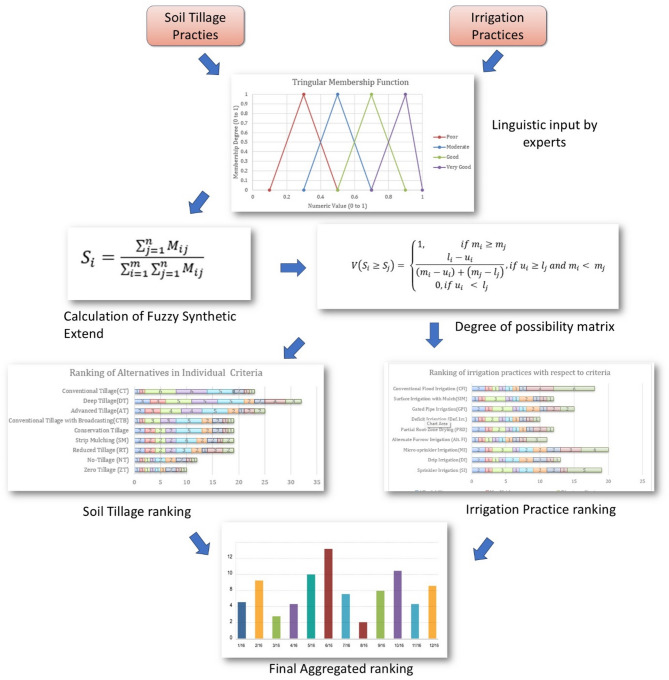
Sustainable agriculture demands the integration of optimized irrigation and soil tillage practices. Poor selection or mismatched combinations of these practices can lead to inefficient resource use, declining soil health, and reduced crop productivity. Despite extensive research on individual tillage and irrigation methods, limited studies explored their combined effects on multiple agricultural sustainability parameters. This gap underscores the need for a comprehensive assessment framework that can guide farmers and stakeholders in identifying optimal combinations for diverse agricultural objectives. This study employs a compounded fuzzy extent analysis to evaluate the cumulative impact of various soil tillage and irrigation methods on key agricultural parameters, including affordability, maximum yield, climate resilience, water usage, soil disruption, disease resistance, ease of operation, nutrient utilization, and crop diversification. The analysis compares individual practices and their combinations using comparative matrices to identify the most suitable options across all parameters. The fuzzy logic approach addresses data uncertainty by converting linguistic variables into triangular fuzzy numbers, enabling more accurate decision-making. The results indicate that Zero Tillage is the most effective tillage practice (score of 0.176), while Deficit Irrigation emerges as the most efficient irrigation method, scoring 0.144. The research suggests that integrating Zero-Tillage (ZT) with Deficit Irrigation (DI) is the most cost-effective agricultural practice. Additionally, combining No-Tillage (NT) with Surface Irrigation and Mulching (SIM) results in higher yields and improved water use efficiency. Furthermore, the synergy of No-Tillage (NT) and Drip Irrigation (DI) enhances crop resilience to climate change. These findings provide valuable insights for developing sustainable agricultural strategies that balance productivity, resource conservation, and environmental protection.
可持续农业需要整合优化的灌溉和土壤耕作实践。这些实践的选择不当或组合不匹配可能导致资源利用效率低下、土壤健康状况下降以及作物产量降低。尽管对单独的耕作和灌溉方法进行了广泛研究,但探索它们对多个农业可持续性参数综合影响的研究有限。这一差距凸显了需要一个全面的评估框架,以指导农民和利益相关者确定实现不同农业目标的最佳组合。本研究采用复合模糊层次分析法,评估各种土壤耕作和灌溉方法对关键农业参数的累积影响,这些参数包括可承受性、最大产量、气候适应能力、水资源利用、土壤扰动、抗病性、操作简便性、养分利用和作物多样性。该分析使用比较矩阵比较单独的实践及其组合,以确定所有参数中最合适的选项。模糊逻辑方法通过将语言变量转换为三角模糊数来解决数据不确定性问题,从而实现更准确的决策。结果表明,免耕是最有效的耕作实践(得分0.176),而亏缺灌溉是最有效的灌溉方法,得分为0.144。研究表明,免耕(ZT)与亏缺灌溉(DI)相结合是最具成本效益的农业实践。此外,免耕(NT)与地面灌溉和覆盖(SIM)相结合可提高产量并改善水资源利用效率。此外,免耕(NT)和滴灌(DI)的协同作用增强了作物对气候变化的适应能力。这些发现为制定平衡生产力、资源保护和环境保护的可持续农业战略提供了宝贵的见解。