Department of Plant and Soil Science, Texas Tech University, Lubbock, TX, 79409, USA.
Department of Plant and Environmental Sciences, New Mexico State University, Las Cruces, NM, 88003, USA.
Sci Rep. 2021 Nov 11;11(1):22095. doi: 10.1038/s41598-021-01433-w.
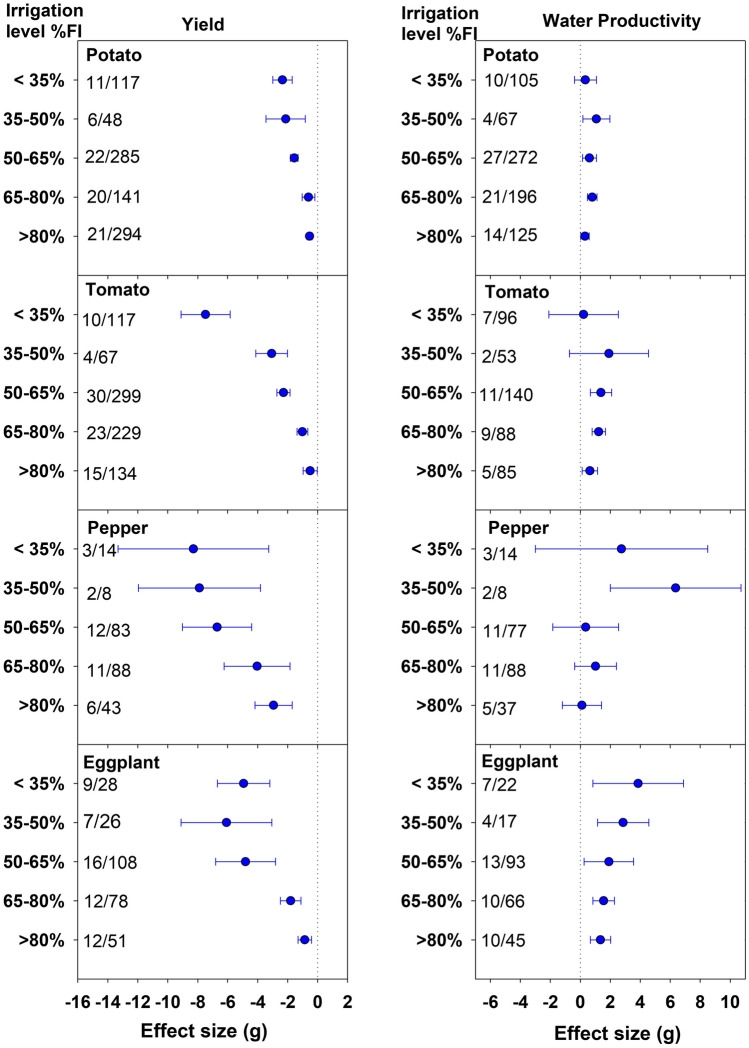
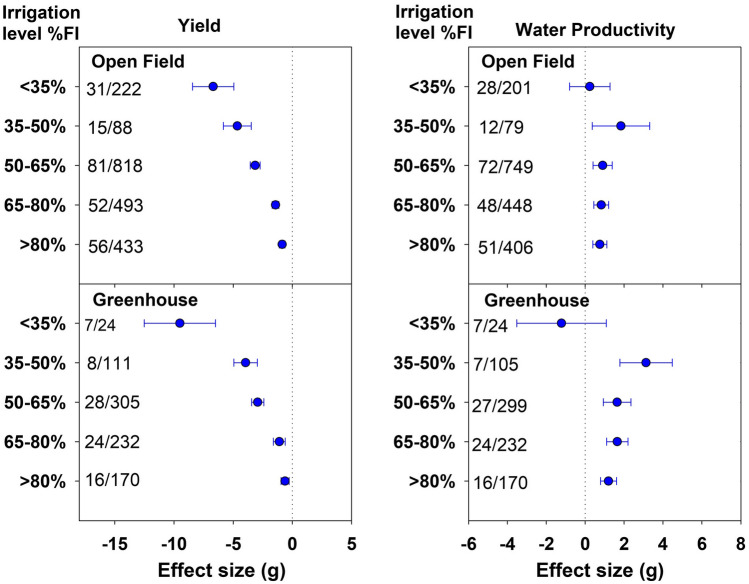
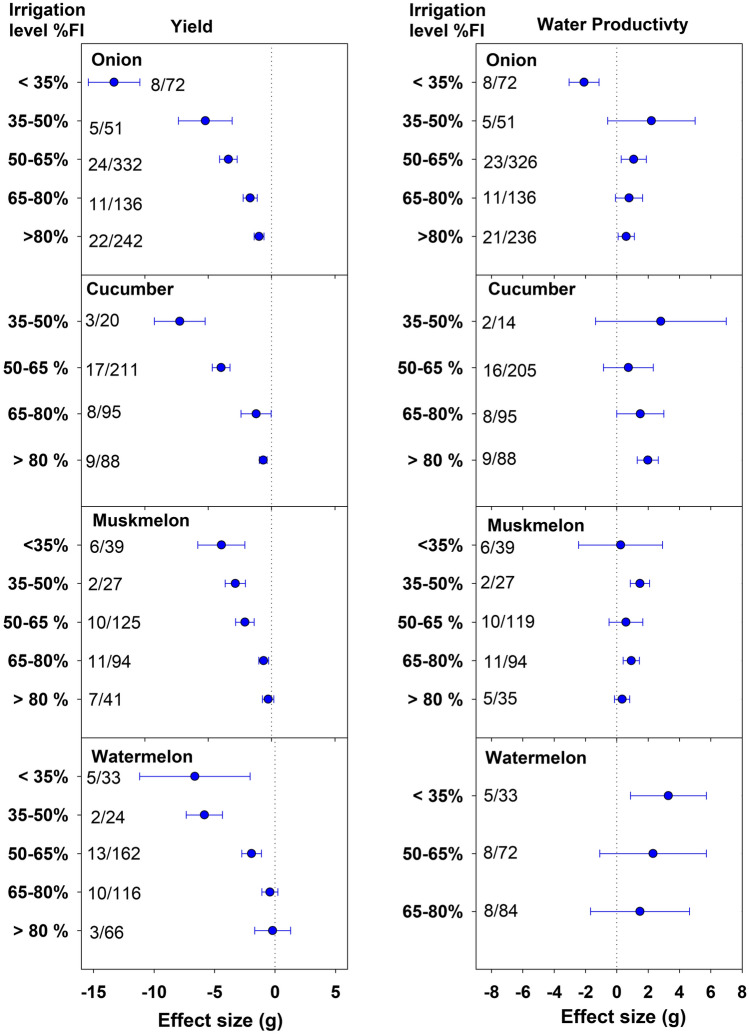
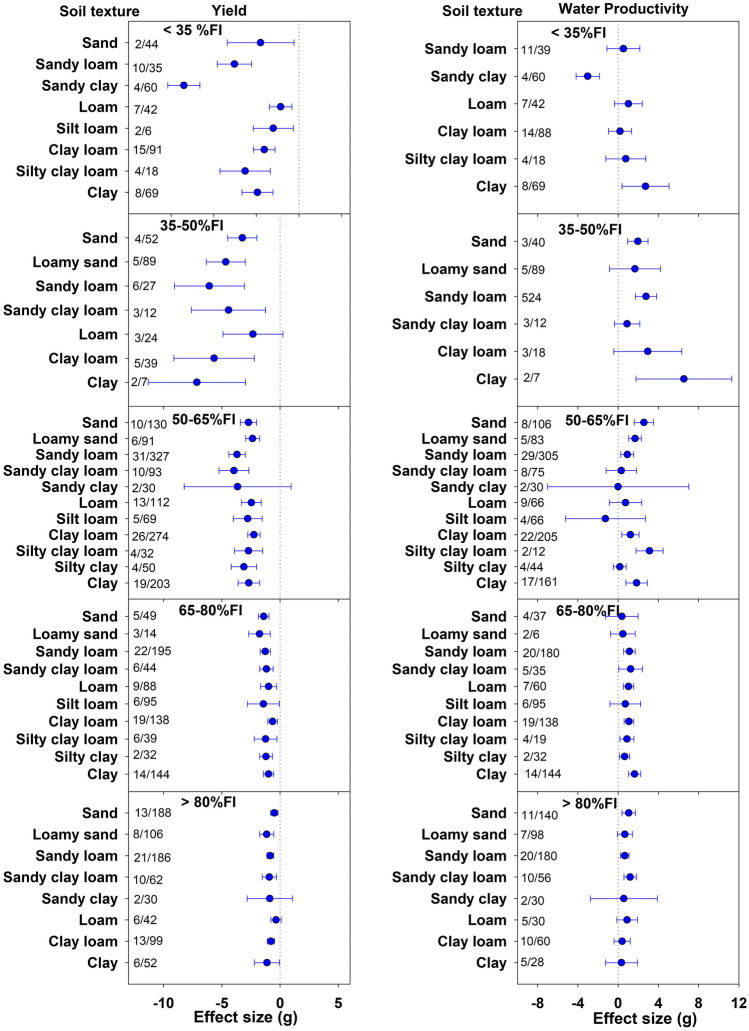
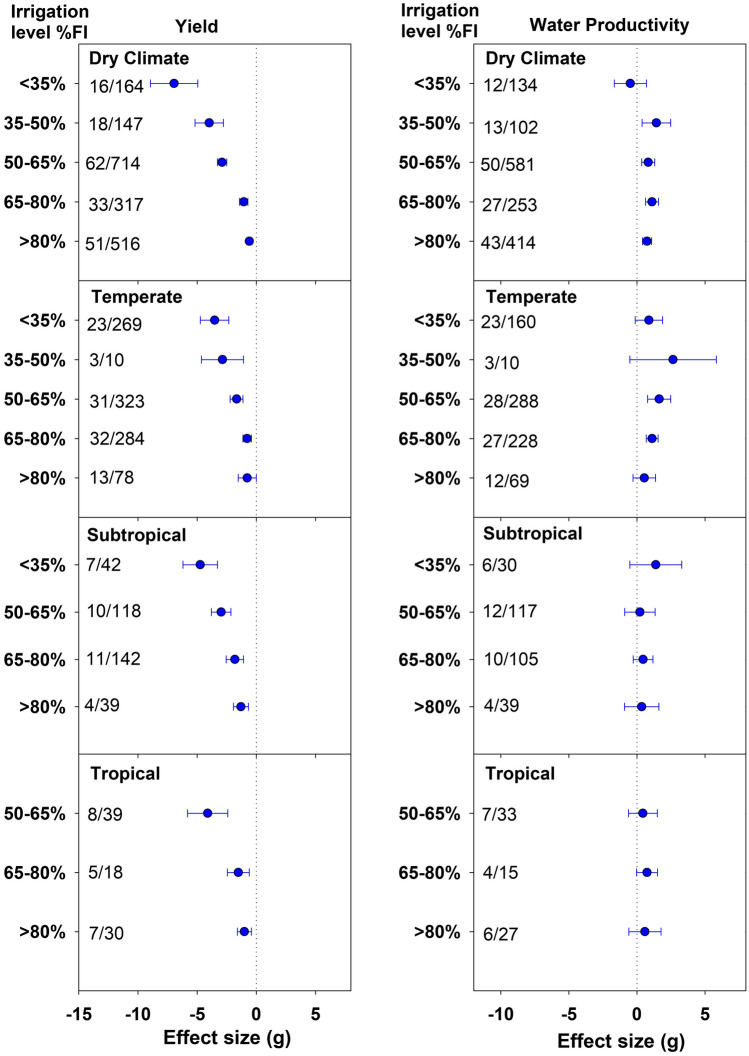
Strategies promoting efficient water use and conserving irrigation water are needed to attain water security to meet growing food demands. This meta-analysis study evaluated the effect of deficit irrigation (DI) strategy on eight vegetables to provide a quantitative estimate of yield and water productivity (WP) responses under variable soil textures, climates, and production systems (open-field and greenhouse). This study analyzed 425 yield and 388 WP comparisons of different DI levels to full irrigation (FI), extracted from 185 published studies representing 30 countries. Moving from the highest (> 80%FI) to the lowest (< 35%FI) irrigation level, the overall yield decline was 6.9 to 51.1% compared to FI, respectively. The WP gains ranged from 8.1 to 30.1%, with 35-50%FI recording the highest benefits. Soil texture affected the yield significantly only under the least irrigation class (< 35%FI), wherein sandy clay and loam recorded the highest (82.1%) and the lowest (26.9%) yield decline, respectively. Among the climates, temperate climate was overall the most advantageous with the least yield penalty (21.9%) and the highest WP gain (21.78%) across various DI levels. The DI application under the greenhouse caused lesser yield reduction compared to the open-field. The WP gains due to DI were also higher for greenhouse (18.4%) than open-field (13.6%). Consideration of yield penalties and the cost of saved irrigation water is crucial while devising the reduced irrigation amounts to the crops. The yield reductions under low to moderate water deficits (> 65%FI) accompanied by gains in WP may be justifiable in the light of anticipated water restriction.
为了实现水资源安全以满足不断增长的粮食需求,需要采取促进高效用水和节约灌溉用水的策略。本元分析研究评估了亏缺灌溉(DI)策略对 8 种蔬菜的影响,为不同土壤质地、气候和生产系统(露天和温室)下的产量和水分生产力(WP)响应提供了定量估计。本研究分析了从 185 项代表 30 个国家的已发表研究中提取的不同 DI 水平与全灌溉(FI)相比的 425 个产量和 388 个 WP 比较,从最高(>80%FI)到最低(<35%FI)灌溉水平,总体产量下降分别为 6.9%至 51.1%。WP 增益范围为 8.1%至 30.1%,35-50%FI 记录的增益最高。仅在最低灌溉等级(<35%FI)下,土壤质地对产量的影响才显著,其中砂壤土和壤土的产量分别下降了 82.1%和 26.9%。在气候方面,在各种 DI 水平下,温带气候总体上最有利,减产最少(21.9%),WP 增益最高(21.78%)。与露天相比,温室中应用 DI 导致的产量减少较少。由于 DI,温室中的 WP 增益也高于露天(18.4%比 13.6%)。在为作物设计减少灌溉量时,必须考虑产量损失和节约灌溉用水的成本。在预期的水资源限制下,低至中度水分亏缺(>65%FI)下的产量减少伴随着 WP 的增加可能是合理的。