Liu Junhui, Gao Wei, Liu Zigang, Zhao Kun, Luo Gang, Gao Shuai, Sun Yi, Pan Silin
Heart Center, Women and Children's Hospital, Qingdao University, Qingdao, China.
Cardiology, Shanghai Children's Medical Center, School of Medicine, Shanghai Jiao Tong University, Shanghai, China.
Front Pediatr. 2025 Jul 28;13:1650335. doi: 10.3389/fped.2025.1650335. eCollection 2025.
Although transcatheter patent ductus arteriosus (PDA) closure is becoming increasingly common in very low birth weight (VLBW) preterm infants, several key issues remain controversial. These include identifying suitable patient characteristics, determining the optimal timing for PDA closure, preventing potential complications, and accurately assessing mid- and long-term outcomes. This study aims to summarize our preliminary experience in selecting appropriate patients and timing for PDA closure, and to report the early and mid-term outcomes of transcatheter PDA closure in VLBW preterm infants.
This was a single-center retrospective study. Eligible participants included preterm infants with gestational age <37 weeks and birth weight <1,500 g who underwent transcatheter PDA closure between January 2024 and January 2025 at Qingdao Women and Children's Hospital. Data on patient characteristics, procedural age, PDA closure, survival, and intraoperative or postoperative complications were collected. Outcomes were assessed immediately after the procedure, at discharge, and 6 months post-discharge.
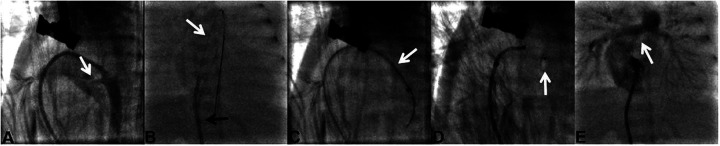
Procedures were performed in 8 VLBW preterm infants [median procedural age 23 days (range: 13-36 days), median procedural weight 1,350 g (range: 810-1,480 g), median PDA diameter 3.75 mm (range: 2.3-4.1 mm)]. The devices were Amplatzer Piccolo ( = 8). Procedures were successful in 100% and uneventful in 87.5% (7 of 8). One patient experienced mild left pulmonary artery compression intraoperatively, which resolved with device repositioning. 25% (2 of 8) patients experienced transient systemic hypertension within 24 h postoperatively, which resolved with diuretic and sedative treatment. No patients experienced ventilation or oxygenation failure, residual PDA, device malposition, or embolization. Survival to discharge was 100%. At 6-month follow-up, all patients were alive and well, without residual PDA, left pulmonary artery stenosis, and aortic coarctation.
The promising early and mid-term outcomes suggest that transcatheter PDA closure in VLBW preterm infants is feasible. Suitable patient characteristics, accurate PDA closure timing, and careful postoperative care are crucial determinants for procedural success. Future studies need to further expand the sample size and extend the follow-up period to evaluate the long-term efficacy and potential complications of this intervention.
尽管经导管动脉导管未闭(PDA)封堵术在极低出生体重(VLBW)早产儿中越来越普遍,但几个关键问题仍存在争议。这些问题包括确定合适的患者特征、确定PDA封堵的最佳时机、预防潜在并发症以及准确评估中期和长期结局。本研究旨在总结我们在选择合适患者和PDA封堵时机方面的初步经验,并报告VLBW早产儿经导管PDA封堵术的早期和中期结局。
这是一项单中心回顾性研究。符合条件的参与者包括2024年1月至2025年1月在青岛妇女儿童医院接受经导管PDA封堵术的孕周<37周且出生体重<1500g的早产儿。收集患者特征、手术年龄、PDA封堵情况、生存情况以及术中或术后并发症的数据。在术后立即、出院时和出院后6个月评估结局。
对8例VLBW早产儿进行了手术[中位手术年龄23天(范围:13 - 36天),中位手术体重1350g(范围:810 - 1480g),中位PDA直径3.75mm(范围:2.3 - 4.1mm)]。使用的封堵器为Amplatzer Piccolo(n = 8)。手术成功率为100%,87.5%(8例中的7例)手术过程顺利。1例患者术中出现轻度左肺动脉受压,通过调整封堵器位置得以解决。25%(8例中的2例)患者术后24小时内出现短暂性系统性高血压,通过利尿和镇静治疗得以缓解。没有患者出现通气或氧合失败、PDA残余、封堵器位置不当或栓塞。出院生存率为100%。在6个月随访时,所有患者均存活且情况良好,无PDA残余、左肺动脉狭窄和主动脉缩窄。
良好的早期和中期结局表明,VLBW早产儿经导管PDA封堵术是可行的。合适的患者特征、准确的PDA封堵时机以及精心的术后护理是手术成功的关键决定因素。未来的研究需要进一步扩大样本量并延长随访时间,以评估该干预措施的长期疗效和潜在并发症。