• 文献检索
  • 文档翻译
  • 深度研究
  • 学术资讯
  • Suppr Zotero 插件Zotero 插件
  • 邀请有礼
  • 套餐&价格
  • 历史记录
应用&插件
Suppr Zotero 插件Zotero 插件浏览器插件Mac 客户端Windows 客户端微信小程序
定价
高级版会员购买积分包购买API积分包
服务
文献检索文档翻译深度研究API 文档MCP 服务
关于我们
关于 Suppr公司介绍联系我们用户协议隐私条款
关注我们

Suppr 超能文献

核心技术专利:CN118964589B侵权必究
粤ICP备2023148730 号-1Suppr @ 2026

文献检索

告别复杂PubMed语法,用中文像聊天一样搜索,搜遍4000万医学文献。AI智能推荐,让科研检索更轻松。

立即免费搜索

文件翻译

保留排版,准确专业,支持PDF/Word/PPT等文件格式,支持 12+语言互译。

免费翻译文档

深度研究

AI帮你快速写综述,25分钟生成高质量综述,智能提取关键信息,辅助科研写作。

立即免费体验

菜豆中原花青素的生物合成及采后种皮变黑现象

Proanthocyanidin biosynthesis and postharvest seed coat darkening in pinto bean.

作者信息

Islam Nishat S, Dhaubhadel Sangeeta

机构信息

London Research and Development Centre, Agriculture and Agri-Food Canada, London, ON Canada.

Department of Biology, University of Western Ontario, London, ON Canada.

出版信息

Phytochem Rev. 2025;24(4):2445-2461. doi: 10.1007/s11101-023-09895-8. Epub 2023 Oct 12.

DOI:10.1007/s11101-023-09895-8
PMID:40792059
原文链接:https://pmc.ncbi.nlm.nih.gov/articles/PMC12335405/
Abstract

Proanthocyanidins (PAs) are polyphenolic compounds present widely in the plant kingdom. These specialized metabolites are derived from the phenylpropanoid pathway and are known for producing brown pigments in different plant organs. PAs accumulate in the seed coat tissues of flowering plants and play a determinant role in seed germination and viability, protect seeds from biotic and abiotic stresses, and thus ensure the long-term storage potential of seeds. In addition, PAs are a rich source of antioxidants for the health of both human and livestock. Many of the commercially relevant dry beans () contain high levels of PAs, which when oxidized cause the beans to overdarken, a phenomenon known as postharvest darkening. These darker beans give the impression of oldness, and consumers tend to avoid buying them which, in turn, affects their market value. Pinto beans, one of the leading market classes of dry beans, are affected the most by the postharvest darkening. Therefore, exploring the regulation of PA biosynthesis and accumulation in bean seed coat tissues will help to develop strategy to manage the postharvest darkening effect in pintos. In this review, we discuss the PA biosynthesis and its regulation, connecting it to seed coat color genetics for a better understanding of the mechanism of seed coat darkening.

摘要

原花青素(PAs)是广泛存在于植物界的多酚类化合物。这些特殊的代谢产物源自苯丙烷类途径,以在不同植物器官中产生褐色色素而闻名。PAs在开花植物的种皮组织中积累,在种子萌发和活力方面起决定性作用,保护种子免受生物和非生物胁迫,从而确保种子的长期储存潜力。此外,PAs是人类和牲畜健康的丰富抗氧化剂来源。许多具有商业价值的干豆含有高水平的PAs,氧化时会导致豆子过度变黑,这种现象称为采后变黑。这些颜色较深的豆子给人陈旧的印象,消费者往往会避免购买,这反过来又会影响它们的市场价值。斑豆是干豆的主要市场类别之一,受采后变黑的影响最大。因此,探索豆种皮组织中PA生物合成和积累的调控将有助于制定管理斑豆采后变黑效应的策略。在这篇综述中,我们讨论了PA生物合成及其调控,并将其与种皮颜色遗传学联系起来,以更好地理解种皮变黑的机制。
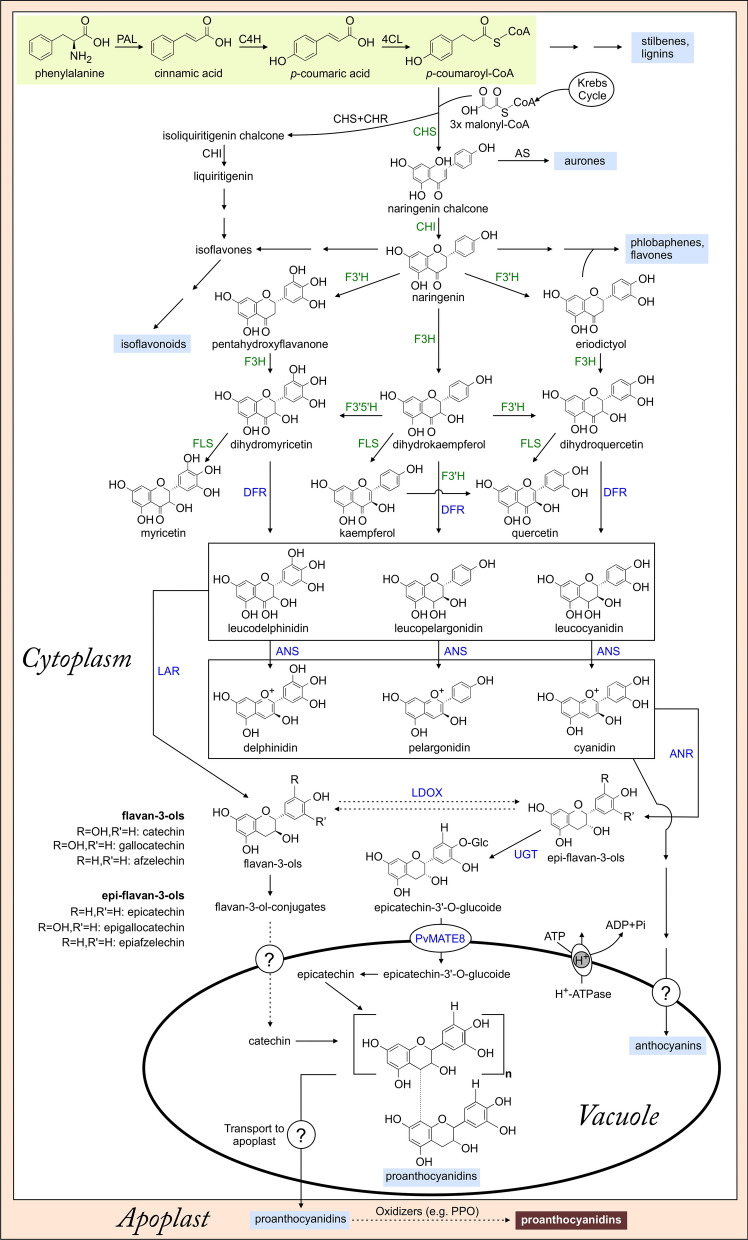
https://cdn.ncbi.nlm.nih.gov/pmc/blobs/d54d/12335405/a0b2ead94574/11101_2023_9895_Fig5_HTML.jpg
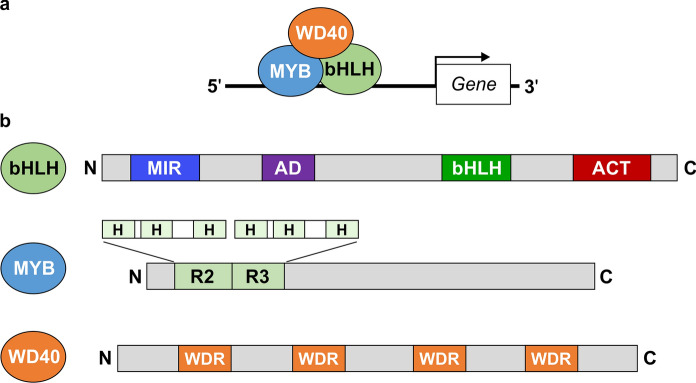
https://cdn.ncbi.nlm.nih.gov/pmc/blobs/d54d/12335405/e3be5b973290/11101_2023_9895_Fig2_HTML.jpg
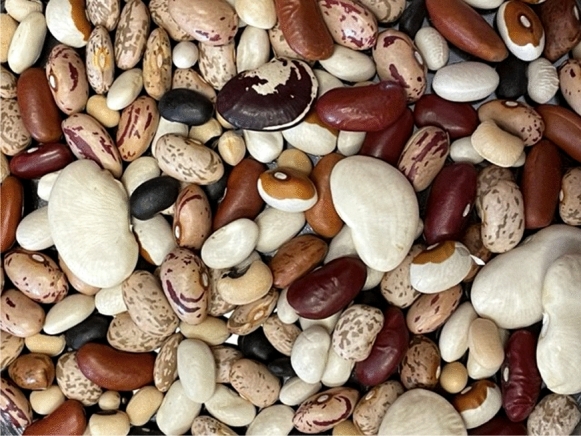
https://cdn.ncbi.nlm.nih.gov/pmc/blobs/d54d/12335405/f9e78c3f2144/11101_2023_9895_Fig3_HTML.jpg
https://cdn.ncbi.nlm.nih.gov/pmc/blobs/d54d/12335405/a0b2ead94574/11101_2023_9895_Fig5_HTML.jpg
https://cdn.ncbi.nlm.nih.gov/pmc/blobs/d54d/12335405/e3be5b973290/11101_2023_9895_Fig2_HTML.jpg
https://cdn.ncbi.nlm.nih.gov/pmc/blobs/d54d/12335405/f9e78c3f2144/11101_2023_9895_Fig3_HTML.jpg
https://cdn.ncbi.nlm.nih.gov/pmc/blobs/d54d/12335405/a0b2ead94574/11101_2023_9895_Fig5_HTML.jpg

相似文献

1
Proanthocyanidin biosynthesis and postharvest seed coat darkening in pinto bean.菜豆中原花青素的生物合成及采后种皮变黑现象
Phytochem Rev. 2025;24(4):2445-2461. doi: 10.1007/s11101-023-09895-8. Epub 2023 Oct 12.
2
Postharvest seed coat darkening in pinto bean () is regulated by , an allele of the basic helix-loop-helix transcription factor .菜豆采后种皮变黑受basic helix-loop-helix转录因子的一个等位基因 调控。
Plants People Planet. 2020 Nov;2(6):663-677. doi: 10.1002/ppp3.10132. Epub 2020 Aug 19.
3
Proanthocyanidin accumulation and transcriptional responses in the seed coat of cranberry beans (Phaseolus vulgaris L.) with different susceptibility to postharvest darkening.不同采后褐变敏感性的蔓越莓豆(菜豆)种皮中原花青素的积累及转录反应
BMC Plant Biol. 2017 May 25;17(1):89. doi: 10.1186/s12870-017-1037-z.
4
Genome-wide association study for the extractable phenolic profile and coat color of common bean seeds (Phaseolus vulgaris L.).全基因组关联研究可提取酚类谱和普通豆种子(菜豆)的毛色。
BMC Plant Biol. 2023 Mar 23;23(1):158. doi: 10.1186/s12870-023-04177-z.
5
A R2R3-MYB gene-based marker for the non-darkening seed coat trait in pinto and cranberry beans (Phaseolus vulgaris L.) derived from 'Wit-rood boontje'.一个基于 R2R3-MYB 基因的标记,用于从 'Wit-rood boontje' 衍生的斑豆和小红豆(菜豆)中的非暗化种皮性状。
Theor Appl Genet. 2020 Jun;133(6):1977-1994. doi: 10.1007/s00122-020-03571-7. Epub 2020 Feb 28.
6
Global analysis of common bean multidrug and toxic compound extrusion transporters (PvMATEs): PvMATE8 and pinto bean seed coat darkening.普通菜豆多药和有毒化合物外排转运蛋白(PvMATEs)的全局分析:PvMATE8与菜豆种皮变黑
Front Plant Sci. 2022 Nov 10;13:1046597. doi: 10.3389/fpls.2022.1046597. eCollection 2022.
7
Slow darkening of pinto bean seed coat is associated with significant metabolite and transcript differences related to proanthocyanidin biosynthesis.利马豆种皮颜色的缓慢加深与与原花青素生物合成相关的显著代谢物和转录物差异有关。
BMC Genomics. 2018 Apr 16;19(1):260. doi: 10.1186/s12864-018-4550-z.
8
Mapping the non-darkening trait from 'Wit-rood boontje' in bean (Phaseolus vulgaris).定位菜豆(Phaseolus vulgaris)品种“Wit-rood boontje”中非暗化特性。
Theor Appl Genet. 2018 Jun;131(6):1331-1343. doi: 10.1007/s00122-018-3081-y. Epub 2018 Mar 3.
9
Genomic Prediction of Adaptation in Common Bean ( L.) × Tepary Bean ( A. Gray) Hybrids.普通菜豆(Phaseolus vulgaris L.)× tepary豆(Phaseolus acutifolius A. Gray)杂交种适应性的基因组预测
Int J Mol Sci. 2025 Jul 30;26(15):7370. doi: 10.3390/ijms26157370.
10
Elucidating the interplay between metabolites and microorganisms in the spermosphere of common bean ( L.) seeds.阐明菜豆种子精子球中代谢物与微生物之间的相互作用。
mSystems. 2025 Aug 19;10(8):e0070725. doi: 10.1128/msystems.00707-25. Epub 2025 Jul 31.

引用本文的文献

1
Molecular insights into postharvest seed coat darkening in common beans: a look beyond the gene.菜豆采后种皮变黑的分子机制洞察:超越基因的研究
Front Plant Sci. 2025 Aug 19;16:1595906. doi: 10.3389/fpls.2025.1595906. eCollection 2025.

本文引用的文献

1
Recent progress in molecular genetics and omics-driven research in seed biology.种子生物学中分子遗传学和组学驱动研究的最新进展。
C R Biol. 2023 Feb 16;345(4):61-110. doi: 10.5802/crbiol.104.
2
Global analysis of common bean multidrug and toxic compound extrusion transporters (PvMATEs): PvMATE8 and pinto bean seed coat darkening.普通菜豆多药和有毒化合物外排转运蛋白(PvMATEs)的全局分析:PvMATE8与菜豆种皮变黑
Front Plant Sci. 2022 Nov 10;13:1046597. doi: 10.3389/fpls.2022.1046597. eCollection 2022.
3
The complexities of proanthocyanidin biosynthesis and its regulation in plants.
植物中原花青素生物合成及其调控的复杂性。
Plant Commun. 2023 Mar 13;4(2):100498. doi: 10.1016/j.xplc.2022.100498. Epub 2022 Nov 26.
4
A role for ascorbate conjugates of (+)-catechin in proanthocyanidin polymerization.表儿茶素 (+)-儿茶素缀合物在原花青素聚合中的作用。
Nat Commun. 2022 Jun 14;13(1):3425. doi: 10.1038/s41467-022-31153-2.
5
The loss of polyphenol oxidase function is associated with hilum pigmentation and has been selected during pea domestication.多酚氧化酶功能的丧失与种脐色素沉着有关,并在豌豆驯化过程中被选择。
New Phytol. 2022 Sep;235(5):1807-1821. doi: 10.1111/nph.18256. Epub 2022 Jun 10.
6
The Common Bean Gene Encodes Flavonoid 3'5' Hydroxylase: A Major Mutational Target for Flavonoid Diversity in Angiosperms.普通菜豆基因编码类黄酮3'5'羟化酶:被子植物中类黄酮多样性的主要突变靶点。
Front Plant Sci. 2022 Mar 31;13:869582. doi: 10.3389/fpls.2022.869582. eCollection 2022.
7
Significance of miRNA in enhancement of flavonoid biosynthesis.miRNA 在增强类黄酮生物合成中的意义。
Plant Biol (Stuttg). 2022 Mar;24(2):217-226. doi: 10.1111/plb.13361. Epub 2021 Nov 21.
8
Postharvest seed coat darkening in pinto bean () is regulated by , an allele of the basic helix-loop-helix transcription factor .菜豆采后种皮变黑受basic helix-loop-helix转录因子的一个等位基因 调控。
Plants People Planet. 2020 Nov;2(6):663-677. doi: 10.1002/ppp3.10132. Epub 2020 Aug 19.
9
MiR858b Inhibits Proanthocyanidin Accumulation by the Repression of and in Persimmon.MiR858b通过抑制柿子中的 和 来抑制原花青素积累。
Front Plant Sci. 2020 Dec 21;11:576378. doi: 10.3389/fpls.2020.576378. eCollection 2020.
10
Proanthocyanidin Biosynthesis-a Matter of Protection.原花青素生物合成——关乎保护的问题。
Plant Physiol. 2020 Oct;184(2):579-591. doi: 10.1104/pp.20.00973. Epub 2020 Aug 18.