Zhu Yu, Brulois Kevin F, Dinh Thanh T, Pan Junliang, Butcher Eugene C
Laboratory of Immunology and Vascular Biology, Department of Pathology, Stanford University School of Medicine, Stanford, CA, USA.
Palo Alto Veterans Institute for Research, Veterans Affairs Palo Alto Health Care System, Palo Alto, CA, USA.
Nat Commun. 2025 Aug 12;16(1):7457. doi: 10.1038/s41467-025-62399-1.
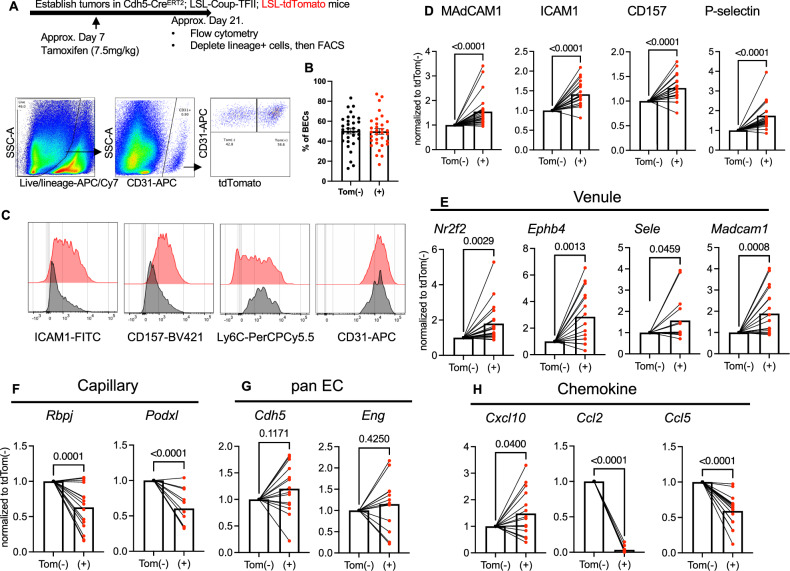
T cell scarcity in tumor tissues poses a critical challenge to cancer immunotherapy. Here we manipulate the tumor vasculature, an essential regulator of immune cell trafficking, to reinvigorate anti-tumor T cell responses in "cold" tumors. We show that ectopic pan-endothelial expression of COUP-TFII, a master transcription factor for venous development, induces molecular programs of post-capillary venules in tumor endothelium. Venular reprogramming selectively promotes T cell recruitment into tumors, inhibits tumor growth in mouse models of breast and pancreatic cancers, and sensitizes tumors to immune checkpoint blockade and adoptive T cell transfer therapies. Mechanistic studies show that enhanced recruitment of anti-tumor T cells and tumor inhibition are mediated by COUP-TFII-induced vascular adhesion receptors. Our study supports a pivotal role of vascular endothelial cells in governing tumor immune evasion, and proposes venular reprogramming as a therapeutic strategy to bolster anti-tumor immunity and immunotherapy.
肿瘤组织中T细胞稀缺对癌症免疫疗法构成了严峻挑战。在此,我们操控肿瘤脉管系统(免疫细胞运输的关键调节因子),以重振“冷”肿瘤中的抗肿瘤T细胞反应。我们发现,异位泛内皮表达COUP-TFII(静脉发育的主要转录因子)可诱导肿瘤内皮后毛细血管微静脉的分子程序。微静脉重编程选择性地促进T细胞募集到肿瘤中,抑制乳腺癌和胰腺癌小鼠模型中的肿瘤生长,并使肿瘤对免疫检查点阻断和过继性T细胞转移疗法敏感。机制研究表明,抗肿瘤T细胞募集增强和肿瘤抑制是由COUP-TFII诱导的血管粘附受体介导的。我们的研究支持血管内皮细胞在控制肿瘤免疫逃逸中的关键作用,并提出微静脉重编程作为一种增强抗肿瘤免疫力和免疫疗法的治疗策略。