Su Guobin, Xiao Ruowei, Ji Dongze, He Kaiyu, Hallert Anna, Savarese Gianluigi, Lund Lars H, Xu Yang, Carrero Juan Jesus
State Key Laboratory of Traditional Chinese Medicine Syndrome, Guangdong Provincial Key Laboratory of Chinese Medicine for Prevention and Treatment of Refractory Chronic Diseases, Big Data Research Center of Chinese Medicine, Department of Nephrology, Chinese Medicine Guangdong Laboratory, The Second Affiliated Hospital, the Second Clinical College of Guangzhou University of Chinese Medicine, Guangdong Provincial Hospital of Chinese Medicine, Guangzhou, China.
Department of Medical Epidemiology and Biostatistics, Karolinska Institutet, Stockholm, Sweden.
BMC Med. 2025 Aug 12;23(1):471. doi: 10.1186/s12916-025-04303-8.
Anemia is common in patients with heart failure (HF). Although iron testing is recommended, it is uncertain that solely emphasizing iron testing could result in lesser attention to other causes, like bleeding or cancer. This study aimed to evaluate the diagnostic work-up of incident anemia in patients with HF in routine care and associated health outcomes.
Observational study of 8932 non-anemic adults with HF in Stockholm, Sweden, was quantified for incidence of anemia, diagnostic work-up (recognition, laboratory/invasive testing) and treatment across severity of anemia and setting of care. Time-varying Cox regression explored associations between developing anemia and rate of major adverse cardiovascular events (MACE), HF hospitalization, cancer, and death.
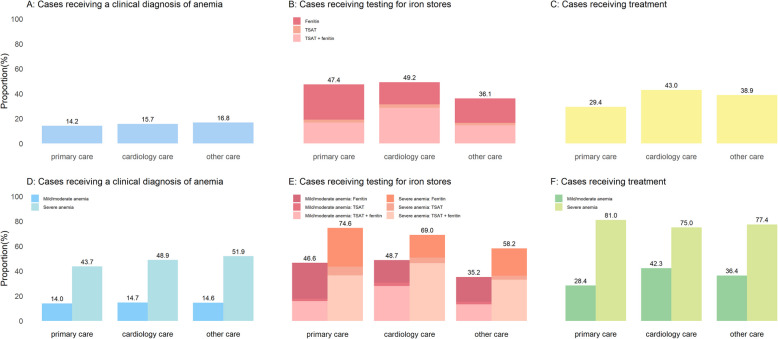
During median 2.7 years, 34% of patients developed incident anemia, and 13% developed severe anemia. Within 6 months from incident anemia, ferritin and transferrin saturation were tested in 44% overall and 65% of severe cases. Testing of liver enzymes, creatinine, and C-reactive protein was, however, done in > 90% of cases. Colonoscopy, esophagogastroduodenoscopy, urinalysis, and cystoscopy were performed in 2-10% of cases. Few patients were recognized with an ICD code diagnosis of anemia (16%). Treatments were infrequent: oral iron (10%), intravenous iron (16%), blood transfusions (6%), and erythropoietin-stimulating agents (< 1%). More anemia cases received treatment in cardiology care (43%) versus primary care (29%). New-onset anemia was associated with risk of MACE (adjusted HR 2.13, 95% CI 1.85-2.44), HF hospitalization (4.85, 4.30-5.48), cancer (3.41, 3.09-3.77), and death (2.04, 1.82-2.29).
One in three patients with HF experienced anemia, which was associated with adverse health outcomes. Testing for iron stores and invasive work-up was suboptimal. A large proportion of anemia events remained under-recognized and untreated, a pattern of care that warrants correction.
贫血在心力衰竭(HF)患者中很常见。尽管推荐进行铁检测,但仅强调铁检测是否会导致对其他病因(如出血或癌症)的关注减少尚不确定。本研究旨在评估常规护理中HF患者新发贫血的诊断检查及相关健康结局。
对瑞典斯德哥尔摩8932名非贫血HF成年患者进行观察性研究,量化贫血发生率、诊断检查(识别、实验室/侵入性检查)以及不同贫血严重程度和护理环境下的治疗情况。采用时变Cox回归分析新发贫血与主要不良心血管事件(MACE)、HF住院、癌症和死亡发生率之间的关联。
在中位2.7年期间,34%的患者发生新发贫血,13%的患者发生严重贫血。在新发贫血后的6个月内,总体上44%的患者以及65%的严重贫血患者进行了铁蛋白和转铁蛋白饱和度检测。然而,超过90%的患者进行了肝酶、肌酐和C反应蛋白检测。2% - 10%的患者进行了结肠镜检查、食管胃十二指肠镜检查、尿液分析和膀胱镜检查。很少有患者通过国际疾病分类(ICD)编码诊断为贫血(16%)。治疗并不常见:口服铁剂(10%)、静脉注射铁剂(16%)、输血(6%)和促红细胞生成素(<1%)。与初级护理(29%)相比,更多贫血患者在心脏病护理中接受了治疗(43%)。新发贫血与MACE风险(调整后HR 2.13,95%CI 1.85 - 2.44)、HF住院(4.85,4.30 - 5.48)、癌症(3.41,3.09 - 3.77)和死亡(2.04,1.82 - 2.29)相关。
三分之一的HF患者发生贫血,这与不良健康结局相关。铁储备检测和侵入性检查并不理想。很大一部分贫血事件仍未得到充分识别和治疗,这种护理模式需要纠正。