
透视下静脉造影在血液透析动静脉通路建立中的应用:一例报告。
The utility of fluoroscopic venography during arteriovenous access creation for hemodialysis: A case report.
作者信息
Jo Yejin, Lee Sangho, Park Suehyun, Kim Hyung-Kee, Huh Seung, Hwang Deokbi
机构信息
Department of Surgery, Division of Vascular and Endovascular Surgery, Kyungpook National University Hospital, Daegu, Republic of Korea.
Department of Surgery, Division of Vascular and Endovascular Surgery, Kyungpook National University Chilgok Hospital, Daegu, Republic of Korea.
出版信息
Medicine (Baltimore). 2025 Aug 8;104(32):e43727. doi: 10.1097/MD.0000000000043727.
RATIONALE
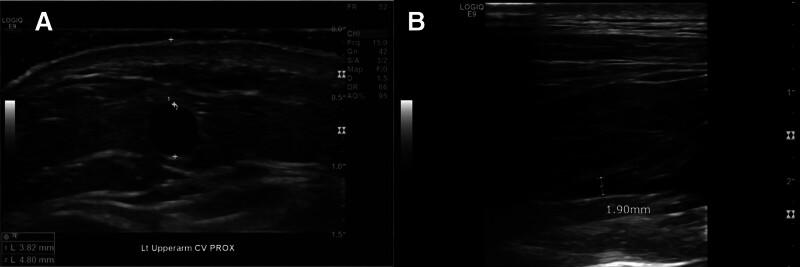
As the end-stage kidney disease (ESKD) population requiring vascular access for hemodialysis continues to grow, the Kidney Disease Outcomes Quality Initiative guidelines emphasize vessel preservation to ensure viability for future access. Preoperative ultrasound is commonly performed prior to arteriovenous (AV) access creation when available. However, its major limitation is the restricted imaging range, which impedes visualization of the complete vascular network. This study highlights the importance of reconsidering fluoroscopic venography as a complementary tool to ultrasound for improving AV access planning.
PATIENT CONCERNS
A man in his late forties and a septuagenarian woman with ESKD underwent AV access creation surgery for ongoing hemodialysis.
DIAGNOSES
The surgical plans could not be determined solely based on preoperative ultrasound findings. In Patient 1, AV access using an artificial graft with the brachial artery as the inflow and the brachial vein as the outflow in a forearm loop configuration was considered as the primary option. In Patient 2, the cephalic vein drainage was unclear with ultrasound due to the clavicle.
INTERVENTIONS
The operation was performed with a transverse incision just below the elbow. Before the anastomosis, we conducted intraoperative fluoroscopic venography through the surgically exposed median cubital vein using a small amount of diluted contrast media to assess the overall venous drainage system in the upper arm.
OUTCOMES
The initial surgical plans based on ultrasound findings were modified through intraoperative fluoroscopic venography. In Patient 1, the distal anastomosis was redirected to the median cubital vein, thereby preserving the deep vein. In Patient 2, fluoroscopic venography enabled the successful creation of AV access using an autologous vein instead of a graft by directly visualizing the cephalic vein drainage. At early follow-up, both accesses achieved successful maturation; however, long-term outcomes could not be fully assessed, and no access-related complications were observed during the observation period.
LESSONS
Intraoperative fluoroscopic venography allowed for more precise AV access planning by providing real-time visualization of venous anatomy. This approach can facilitate intraoperative decision-making and help expand access options for ESKD patients while preserving future options.
原理
随着需要血管通路进行血液透析的终末期肾病(ESKD)患者群体持续增长,《肾脏病预后质量倡议》指南强调血管保护以确保未来通路的可行性。术前超声在有条件时通常在动静脉(AV)通路建立之前进行。然而,其主要局限性是成像范围受限,这妨碍了对完整血管网络的可视化。本研究强调了重新考虑荧光透视静脉造影作为超声的补充工具以改善AV通路规划的重要性。
患者情况
一名近五十岁男性和一名七十多岁女性ESKD患者接受了用于持续血液透析的AV通路建立手术。
诊断
手术方案不能仅根据术前超声检查结果确定。在患者1中,以肱动脉为流入道、肱静脉为流出道的前臂袢式人工血管AV通路被视为主要选择。在患者2中,由于锁骨的原因,超声检查显示头静脉引流情况不明确。
干预措施
手术在肘部下方做横向切口进行。在吻合之前,我们通过手术暴露的肘正中静脉使用少量稀释造影剂进行术中荧光透视静脉造影,以评估上臂的整体静脉引流系统。
结果
基于超声检查结果的初始手术方案通过术中荧光透视静脉造影进行了修改。在患者1中,远端吻合口改至肘正中静脉,从而保留了深静脉。在患者2中,荧光透视静脉造影通过直接观察头静脉引流,成功使用自体静脉而非人工血管建立了AV通路。在早期随访中,两条通路均成功成熟;然而,长期结果无法全面评估,且在观察期内未观察到与通路相关的并发症。
经验教训
术中荧光透视静脉造影通过实时显示静脉解剖结构,实现了更精确的AV通路规划。这种方法有助于术中决策,并有助于在保留未来选择的同时,为ESKD患者扩展通路选择。



 Zotero 插件