Fedor Noelle, Abrahamson E Axel, Weygand Joseph
Division of Global Radiation Oncology, Department of Radiation Oncology and Applied Sciences, Dartmouth-Hitchcock Medical Center, Lebanon, NH, United States.
Front Med (Lausanne). 2025 Jul 29;12:1625455. doi: 10.3389/fmed.2025.1625455. eCollection 2025.
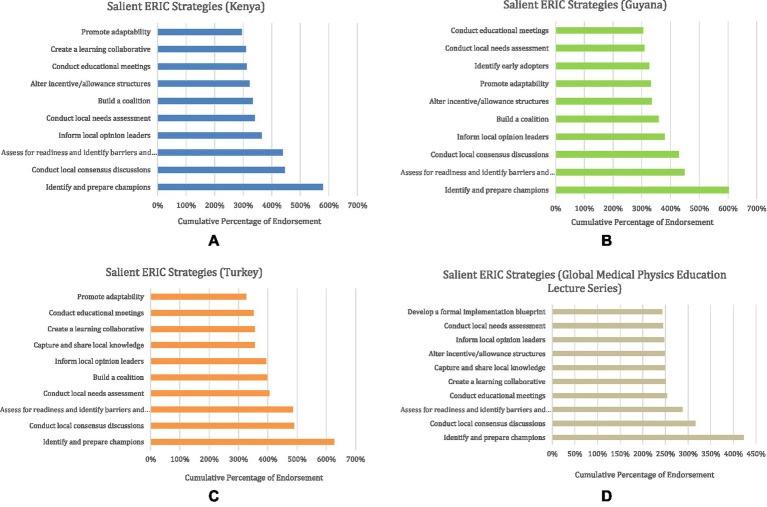
Global disparities in access to radiation medicine are driven not only by infrastructure deficits but also by shortages of trained medical physicists. To address these gaps, RAD-AID International implemented four virtual educational initiatives in Kenya, Guyana, and Türkiye, along with a global lecture series, each aimed at strengthening local capacity in medical physics. Implementing such programs across diverse low- and middle-income country (LMIC) contexts presents significant challenges, particularly with regard to adaptability, engagement, and sustainability. To evaluate these efforts, we applied the Consolidated Framework for Implementation Research (CFIR) and the CFIR Expert Recommendations for Implementing Change (ERIC) Matching Tool to retrospectively identify barriers and recommend strategies to strengthen future initiatives. Stakeholders across all programs consistently cited limited access to knowledge and information as a key barrier. In response, the ERIC strategy "Conduct Educational Meetings" was highly endorsed, with 79% of experts identifying it as a top recommendation. Additional barriers, such as adaptability, planning, and responsiveness to patient needs, were matched with strategies including promoting adaptability, developing formal implementation blueprints, and engaging patients and families. By linking CFIR constructs to concrete examples, this study demonstrates the utility of structured implementation frameworks in radiological education and underscores the need for contextual sensitivity in resource-limited settings.
获得放射医学服务的全球差异不仅是由基础设施不足造成的,也是由训练有素的医学物理师短缺导致的。为了弥补这些差距,国际放射援助组织在肯尼亚、圭亚那和土耳其实施了四项虚拟教育倡议,以及一个全球讲座系列,每项举措都旨在加强当地医学物理方面的能力。在不同的低收入和中等收入国家(LMIC)背景下实施此类项目面临重大挑战,特别是在适应性、参与度和可持续性方面。为了评估这些努力,我们应用了实施研究综合框架(CFIR)和CFIR实施变革专家建议(ERIC)匹配工具,以回顾性地识别障碍并推荐加强未来举措的策略。所有项目的利益相关者一致认为,获取知识和信息的机会有限是一个关键障碍。对此,ERIC策略“召开教育会议”得到了高度认可,79%的专家将其列为首要建议。其他障碍,如适应性、规划以及对患者需求的响应能力,与包括促进适应性、制定正式实施蓝图以及让患者和家庭参与等策略相匹配。通过将CFIR结构与具体实例相联系,本研究证明了结构化实施框架在放射教育中的效用,并强调了在资源有限环境中考虑背景敏感性的必要性。