
多机构脑转移瘤队列中首次立体定向放射治疗后与颅内进展负担相关的临床参数
Clinical Parameters Associated With Intracranial Progression Burden Following an Initial Stereotactic Radiosurgery Course in a Multi-institutional Brain Metastases Cohort.
作者信息
Huang Christina C, Carpenter David J, Leng Jim, Qazi Jamiluddin, Natarajan Brahma, Arshad Muzamil, Moravan Michael J, Vaios Eugene J, Reitman Zachary J, Kirkpatrick John P, Floyd Scott R, Chmura Steven J, Hong Julian C, Salama Joseph K, Mullikin Trey C
机构信息
Department of Radiation Oncology, Duke University Medical Center, Durham, North Carolina.
Wellstar Radiation Oncology, Wellstar Health System, Hiram, Georgia.
出版信息
Adv Radiat Oncol. 2025 Jul 11;10(9):101859. doi: 10.1016/j.adro.2025.101859. eCollection 2025 Sep.
PURPOSE
Following initial stereotactic radiosurgery (SRS), risk factors for high-burden intracranial progression (ICP) necessitating whole brain radiation remain poorly characterized. We hypothesize that specific clinical parameters at initial SRS are associated with high-burden ICP-defined as either ≥5 brain metastases (BMs) (ICP5) or ≥11 BMs (ICP11).
MATERIALS AND METHODS
Across 2 institutions, we retrospectively identified all patients completing an initial SRS course from January 2015 to December 2020. ICP was defined as any radiographic concern for distant and/or in-field progression. Overall survival (OS) and freedom from ICP were estimated via the Kaplan-Meier method. Cox models assessed the association between clinical parameters and freedom from ICP5 and ICP11.
RESULTS
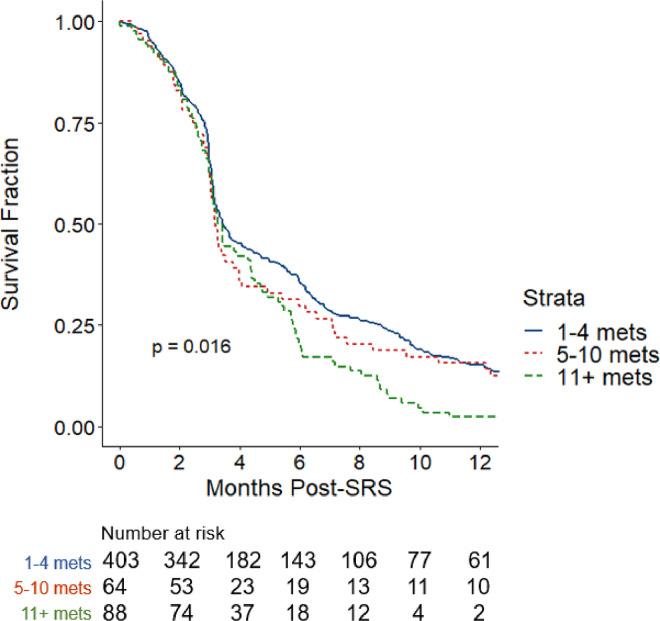
We identified 1383 patients completing SRS. Post-SRS ICP was identified for 555 (40.1%) patients: 72.6% had 1 to 4 progressive BMs, 11.5% had 5 to 10 BMs, and 15.9% had ≥11 new BMs. Among these groups, 12-month OS was 56.8% (95% CI: 52.1%-61.9%), 46.0% (95% CI: 35.1%-60.1%), and 38.7% (95% CI: 29.4%-50.9%), respectively ( < .001). Neurologic symptoms at ICP were observed in 21.1%, 28.1%, and 50.0% of cases, respectively ( .001). Oligometastatic disease at the time of SRS [ICP5: hazard ratio (HR) 0.68, 95% CI: 0.47-0.99; ICP11: 0.59; 95% CI: 0.36-0.97], no pre-SRS immunotherapy (ICP11: HR 1.74, 95% CI: 1.03-2.97), receipt of post-SRS immunotherapy (ICP5: HR 0.60, 95% CI: 0.402-0.906; ICP11: HR 0.57, 95% CI: 0.332-0.988), and a single BM at initial SRS (1 vs 2 BM, ICP 5: HR 0.51, 95% CI: 0.31-0.82; ICP11: HR 0.45, 95% CI: 0.24-0.84) were negative predictive factors of high-burden ICP.
CONCLUSIONS
High-burden ICP was associated with decreased OS and neurologic decline. Patients who had oligometastatic disease, who received post-SRS immunotherapy, who did not receive pre-SRS immunotherapy, and who had a single BM had improved freedom from high-burden ICP. These findings may justify consideration of upfront whole brain radiation for those at risk for high-burden ICP and prospective analysis of short-interval post-SRS surveillance in this population.
目的
在初次立体定向放射外科治疗(SRS)后,对于需要进行全脑放疗的高负担颅内进展(ICP)的危险因素仍知之甚少。我们假设初次SRS时的特定临床参数与高负担ICP相关,高负担ICP定义为≥5个脑转移瘤(BMs)(ICP5)或≥11个BMs(ICP11)。
材料与方法
在2个机构中,我们回顾性地确定了2015年1月至2020年12月期间完成初次SRS疗程的所有患者。ICP被定义为任何影像学上对远处和/或野内进展的担忧。通过Kaplan-Meier方法估计总生存期(OS)和无ICP生存期。Cox模型评估临床参数与无ICP5和ICP11生存期之间的关联。
结果
我们确定了1383例完成SRS的患者。555例(40.1%)患者出现SRS后ICP:72.6%有1至4个进展性BMs,11.5%有5至10个BMs,15.9%有≥11个新的BMs。在这些组中,12个月的OS分别为56.8%(95%CI:52.1%-61.9%)、46.0%(95%CI:35.1%-60.1%)和38.7%(95%CI:29.4%-50.9%)(P<0.001)。ICP时出现神经症状的病例分别为21.1%、28.1%和50.0%(P = 0.001)。SRS时的寡转移疾病[ICP5:风险比(HR)0.68,95%CI:0.47-0.99;ICP11:0.59;95%CI:0.36-0.97]、初次SRS前未接受免疫治疗(ICP11:HR 1.74,95%CI:1.03-2.97)、接受SRS后免疫治疗(ICP5:HR 0.60,95%CI:0.402-0.906;ICP11:HR 0.57,95%CI:0.332-0.9⑧)以及初次SRS时单个BM(1个BM与2个BM相比,ICP 5:HR 0.51,95%CI:0.31-0.82;ICP11:HR 0.45,95%CI:0.24-0.84)是高负担ICP的阴性预测因素。
结论
高负担ICP与OS降低和神经功能衰退相关。患有寡转移疾病、接受SRS后免疫治疗、未接受SRS前免疫治疗以及有单个BM的患者无高负担ICP生存期得到改善。这些发现可能为考虑对有高负担ICP风险的患者进行 upfront全脑放疗以及对该人群进行SRS后短间隔监测的前瞻性分析提供依据。


 Zotero 插件