Fleming Justin T, Njoroge J Michelle, Noyce Abigail L, Perrachione Tyler K, Shinn-Cunningham Barbara G
Department of Speech-Language-Hearing Sciences, University of Minnesota, Minneapolis, MN, United States.
Department of Speech, Language, and Hearing Sciences, Boston University, Boston, MA, United States.
Imaging Neurosci (Camb). 2024 Apr 8;2. doi: 10.1162/imag_a_00130. eCollection 2024.
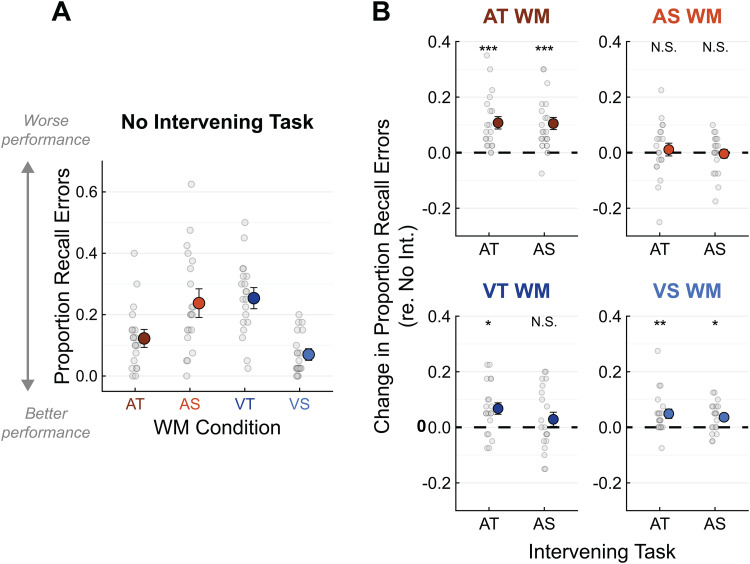
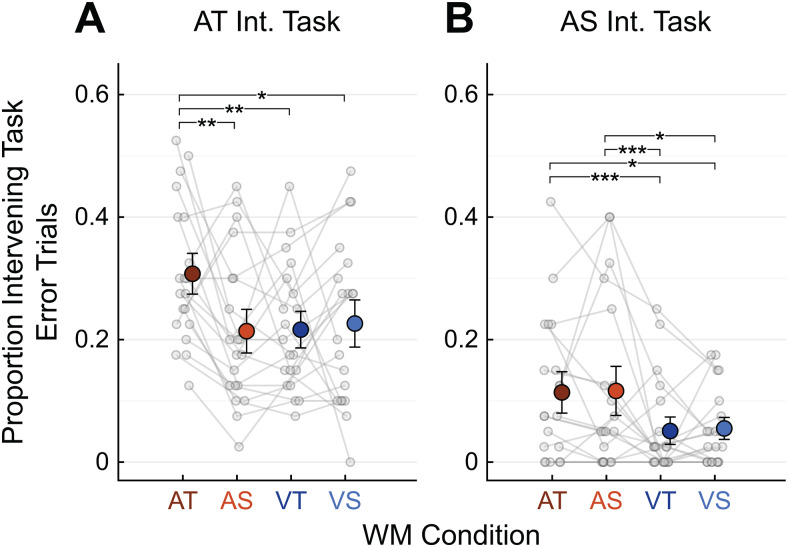
Making sense of our environment requires us to extract temporal and spatial information from multiple sensory modalities, particularly audition and vision. Often, we must hold this sensory information in working memory (WM) to guide future actions, while simultaneously processing new sensory inputs as they arise. However, these processes of WM maintenance and perceptual processing can interfere with one another when the tasks rely on similar cognitive resources. fMRI studies have uncovered attention and WM networks that are specialized for either auditory-temporal or visual-spatial processing; the functional specialization of these networks makes specific predictions about patterns of interference between perceptual processing and WM. Specifically, we hypothesized that dual-task interference should increase when the tasks share a common sensory modality, a common information domain (temporal vs. spatial processing), or both. To test these predictions, we asked participants to store temporal or spatial information about auditory or visual stimuli in WM. On some trials, participants also performed an intervening auditory task, which was either temporal or spatial, during WM retention. Errors on WM recall and perceptual judgment tasks both generally increased when the tasks relied on shared modality- and domain-biased resources, with maximal interference when both tasks were auditory-temporal. Pupil dilations were also larger and started earlier when both tasks were auditory-temporal, indicating an increase in cognitive effort to overcome the interference. Event-related potentials (ERPs) and alpha-band oscillatory activity revealed neural signatures of domain-based interference even when the tasks were presented in different sensory modalities, when behavioral differences were masked by ceiling effects. These results demonstrate that sensory modality and information domain jointly affect how task information is represented in WM, consistent with past work demonstrating how tasks engage complementary auditory-temporal and visual-spatial cognitive control networks.
理解我们的环境需要我们从多种感官模态中提取时间和空间信息,尤其是听觉和视觉。通常,我们必须将这些感官信息保存在工作记忆(WM)中,以指导未来的行动,同时在新的感官输入出现时对其进行处理。然而,当任务依赖于相似的认知资源时,WM维持和感知处理的这些过程可能会相互干扰。功能磁共振成像(fMRI)研究发现了专门用于听觉时间或视觉空间处理的注意力和WM网络;这些网络的功能特化对感知处理和WM之间的干扰模式做出了具体预测。具体而言,我们假设当任务共享共同的感官模态、共同的信息域(时间与空间处理)或两者都共享时,双任务干扰应该会增加。为了检验这些预测,我们要求参与者将关于听觉或视觉刺激的时间或空间信息存储在WM中。在一些试验中,参与者在WM保持期间还执行了一项干预性听觉任务,该任务要么是时间性的,要么是空间性的。当任务依赖于共享的模态和域偏向资源时,WM回忆和感知判断任务的错误通常都会增加,当两个任务都是听觉时间任务时干扰最大。当两个任务都是听觉时间任务时,瞳孔扩张也更大且开始得更早,这表明为克服干扰而付出的认知努力增加。即使任务以不同的感官模态呈现,当行为差异被天花板效应掩盖时,事件相关电位(ERP)和α波段振荡活动也揭示了基于域的干扰的神经特征。这些结果表明,感官模态和信息域共同影响任务信息在WM中的表示方式,这与过去的研究结果一致,即任务如何激活互补的听觉时间和视觉空间认知控制网络。