Er Hüseyin, Tören Murat, Asan Berkutay, Kaba Esat, Beyazal Mehmet
Faculty of Medicine, Recep Tayyip Erdoğan University, Training and Research Hospital, Rize 53020, Türkiye.
Department of Electrical and Electronics Engineering, Recep Tayyip Erdogan University, Rize 53020, Türkiye.
Diagnostics (Basel). 2025 Jul 24;15(15):1862. doi: 10.3390/diagnostics15151862.
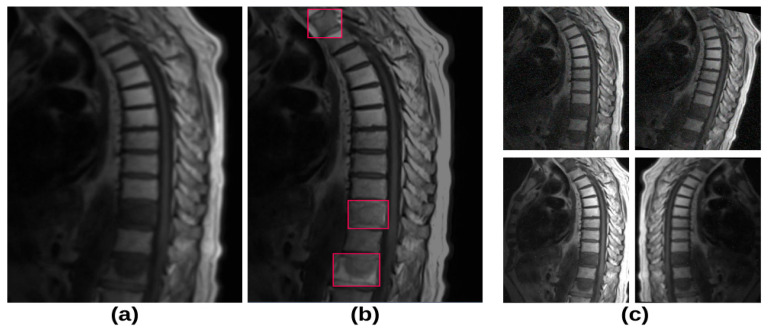
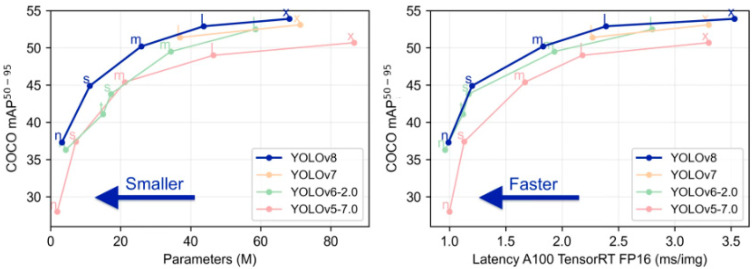
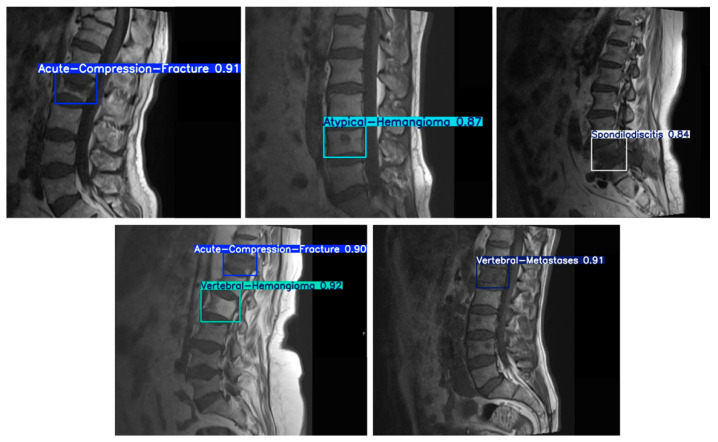
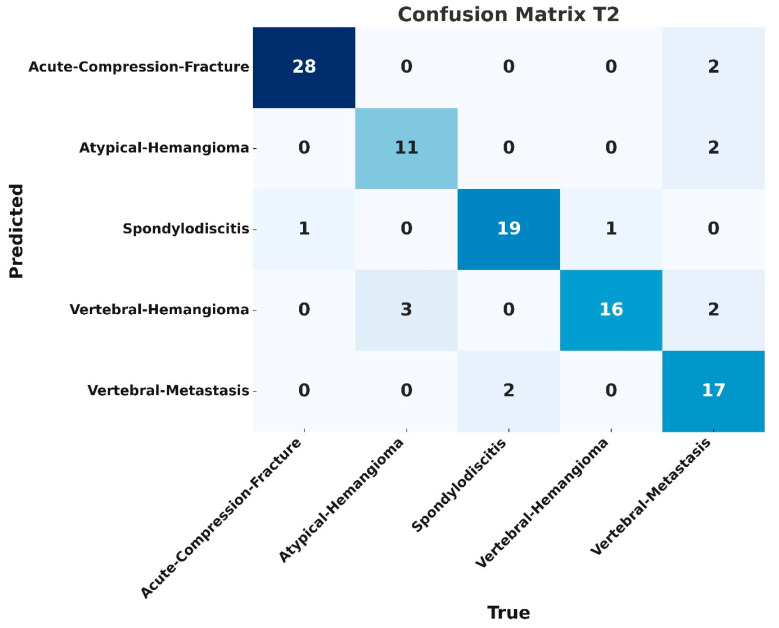
Spinal diseases are commonly encountered health problems with a wide spectrum. In addition to degenerative changes, other common spinal pathologies include metastases and compression fractures. Benign tumors like hemangiomas and infections such as spondylodiscitis are also frequently observed. Although magnetic resonance imaging (MRI) is considered the gold standard in diagnostic imaging, the morphological similarities of lesions can pose significant challenges in differential diagnoses. In recent years, the use of artificial intelligence applications in medical imaging has become increasingly widespread. In this study, we aim to detect and classify vertebral body lesions using the YOLO-v8 (You Only Look Once, version 8) deep learning architecture. This study included MRI data from 235 patients with vertebral body lesions. The dataset comprised sagittal T1- and T2-weighted sequences. The diagnostic categories consisted of acute compression fractures, metastases, hemangiomas, atypical hemangiomas, and spondylodiscitis. For automated detection and classification of vertebral lesions, the YOLOv8 deep learning model was employed. Following image standardization and data augmentation, a total of 4179 images were generated. The dataset was randomly split into training (80%) and validation (20%) subsets. Additionally, an independent test set was constructed using MRI images from 54 patients who were not included in the training or validation phases to evaluate the model's performance. In the test, the YOLOv8 model achieved classification accuracies of 0.84 and 0.85 for T1- and T2-weighted MRI sequences, respectively. Among the diagnostic categories, spondylodiscitis had the highest accuracy in the T1 dataset (0.94), while acute compression fractures were most accurately detected in the T2 dataset (0.93). Hemangiomas exhibited the lowest classification accuracy in both modalities (0.73). The F1 scores were calculated as 0.83 for T1-weighted and 0.82 for T2-weighted sequences at optimal confidence thresholds. The model's mean average precision (mAP) 0.5 values were 0.82 for T1 and 0.86 for T2 datasets, indicating high precision in lesion detection. The YOLO-v8 deep learning model we used demonstrates effective performance in distinguishing vertebral body metastases from different groups of benign pathologies.
脊柱疾病是常见的健康问题,范围广泛。除了退行性改变外,其他常见的脊柱病变还包括转移瘤和压缩性骨折。像血管瘤这样的良性肿瘤以及诸如脊椎椎间盘炎等感染也经常被观察到。尽管磁共振成像(MRI)被认为是诊断成像的金标准,但病变的形态相似性在鉴别诊断中可能带来重大挑战。近年来,人工智能应用在医学成像中的使用越来越广泛。在本研究中,我们旨在使用YOLO-v8(你只看一次,第8版)深度学习架构检测和分类椎体病变。本研究纳入了235例椎体病变患者的MRI数据。数据集包括矢状位T1加权和T2加权序列。诊断类别包括急性压缩性骨折、转移瘤、血管瘤、非典型血管瘤和脊椎椎间盘炎。为了对椎体病变进行自动检测和分类,采用了YOLOv8深度学习模型。经过图像标准化和数据增强后,共生成了4179张图像。数据集被随机分为训练集(80%)和验证集(20%)子集。此外,使用未纳入训练或验证阶段的54例患者的MRI图像构建了一个独立测试集,以评估模型的性能。在测试中,YOLOv8模型在T1加权和T2加权MRI序列上的分类准确率分别为0.84和0.85。在诊断类别中,脊椎椎间盘炎在T1数据集中的准确率最高(0.94),而急性压缩性骨折在T2数据集中的检测最为准确(0.93)。血管瘤在两种模态下的分类准确率最低(0.73)。在最佳置信阈值下,T1加权序列的F1分数计算为0.83,T2加权序列为0.82。该模型的平均精度均值(mAP)0.5值在T1数据集中为0.82,在T2数据集中为0.86,表明在病变检测中具有高精度。我们使用的YOLO-v8深度学习模型在区分椎体转移瘤与不同组良性病变方面表现出有效性能。