
运用综合分类学方法对来自中国贵州的一种新型无眼洞穴鱼类(鲤形目,鲤科)的描述
Description of a New Eyeless Cavefish Using Integrative Taxonomic Methods- (Cypriniformes, Cyprinidae), from Guizhou, China.
作者信息
Liu Yewei, Mao Tingru, Sudasinghe Hiranya, Chen Rongjiao, Yang Jian, Meegaskumbura Madhava
机构信息
Guangxi Key Laboratory for Forest Ecology and Conservation, College of Forestry, Guangxi University, Nanning 530004, China.
Division of Evolutionary Ecology, Institute of Ecology and Evolution, University of Bern, 3012 Bern, Switzerland.
出版信息
Animals (Basel). 2025 Jul 28;15(15):2216. doi: 10.3390/ani15152216.
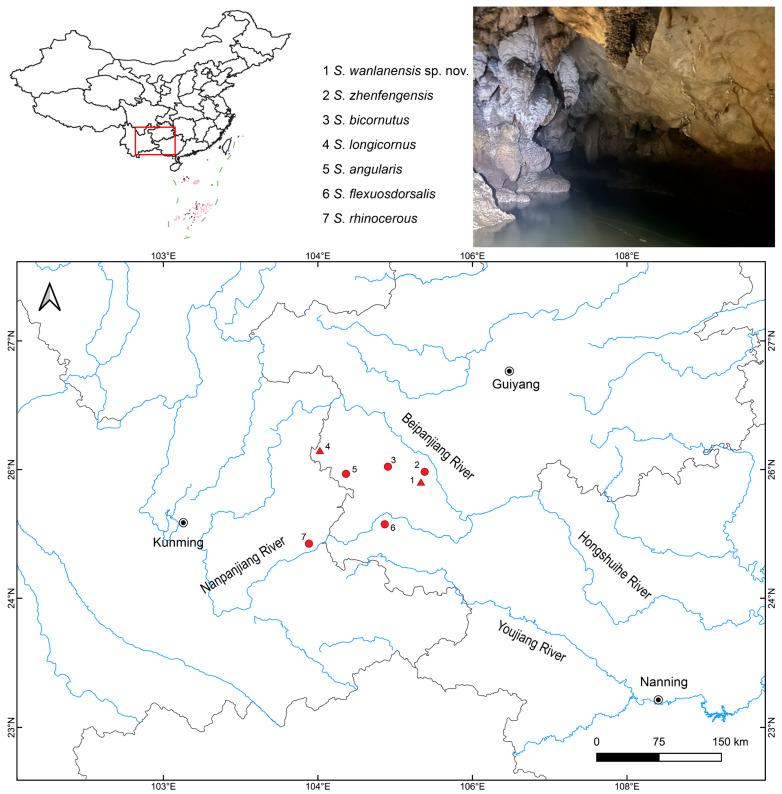
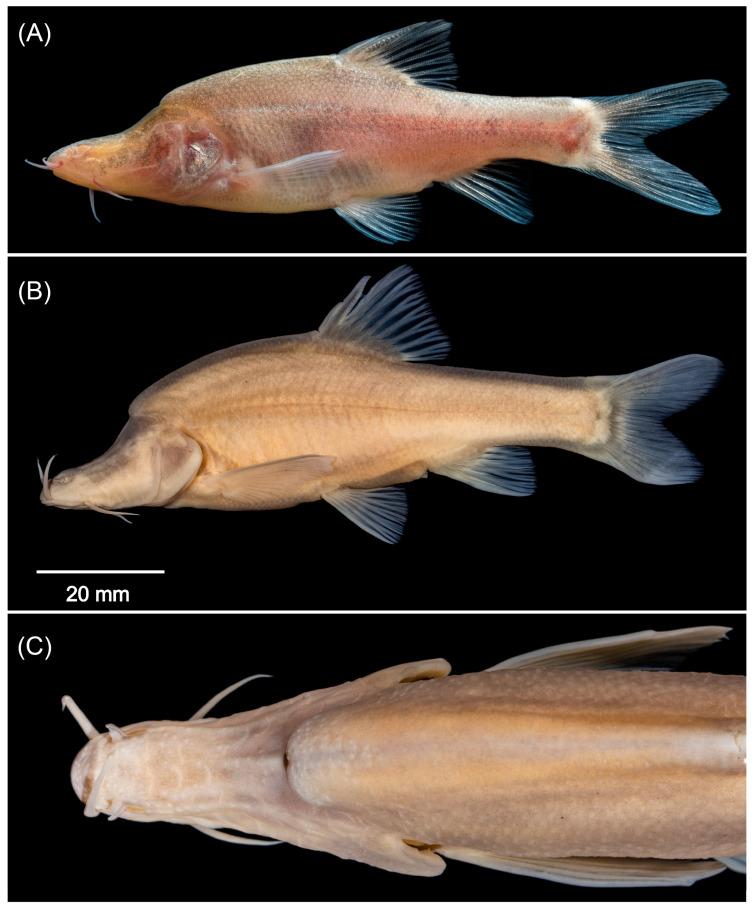
China's southwestern karst landscapes support remarkable cavefish diversity, especially within , the world's largest cavefish genus. Using integrative taxonomic methods, we describe sp. nov., found in a subterranean river in Guizhou Province. This species lacks horn-like cranial structures; its eyes are either reduced to a dark spot or absent. It possesses a pronounced nuchal hump and a forward-protruding, duckbill-shaped head. Morphometric analysis of 28 individuals from six species shows clear separation from related taxa. Nano-CT imaging reveals distinct vertebral and cranial features. Phylogenetic analyses of mitochondrial and genes place within group as sister to , with p-distances of 1.7% () and 0.7% (), consistent with sister-species patterns within the genus. is differentiated from by its eyeless or degenerate-eye condition and lack of bifurcated horns. It differs from , its morphologically closest species, in having degenerate or absent eyes, shorter maxillary barbels, and pelvic fins that reach the anus. The combination of morphological and molecular evidence supports its recognition as a distinct species. Accurate documentation of such endemic and narrowly distributed taxa is important for conservation and for understanding speciation in cave habitats.
中国西南部的喀斯特地貌拥有丰富的洞穴鱼类多样性,尤其是在世界上最大的洞穴鱼类属内。我们运用综合分类学方法,描述了在贵州省一条地下河中发现的新物种。该物种没有角状的头部结构;眼睛要么退化为一个黑点,要么完全缺失。它有一个明显的颈背隆起和一个向前突出的鸭嘴状头部。对来自六个物种的28个个体进行的形态测量分析显示,它与相关分类群有明显区别。纳米CT成像揭示了独特的脊椎和头部特征。对线粒体和基因的系统发育分析表明,该物种在组内与为姐妹关系,p距离分别为1.7%()和0.7%(),这与该属内姐妹物种的模式一致。该物种与的区别在于其无眼或眼睛退化以及没有分叉的角。它与形态上最接近的物种的区别在于眼睛退化或缺失、上颌触须较短以及腹鳍延伸至肛门。形态学和分子证据的结合支持将其认定为一个独特的物种。准确记录这些特有且分布狭窄的分类群对于保护以及理解洞穴栖息地的物种形成非常重要。



 Zotero 插件