Torres-Estay Verónica, Azocar Lorena, Schmidt Camila, Aguilera-Olguín Macarena, Ramírez-Santelices Catalina, Flores-Faúndez Emilia, Sotomayor Paula, Solis Nancy, Cabrera Daniel, Contreras-Porcia Loretto, Bronfman Francisca C, Godoy Alejandro S
Escuela de Química y Farmacia, Facultad de Ciencias, Universidad San Sebastián, Santiago 7510157, Chile.
Centro de Biología Celular y Biomedicina (CEBICEM), Facultad de Ciencias, Universidad San Sebastián, Santiago 8580704, Chile.
Plants (Basel). 2025 Jul 31;14(15):2352. doi: 10.3390/plants14152352.
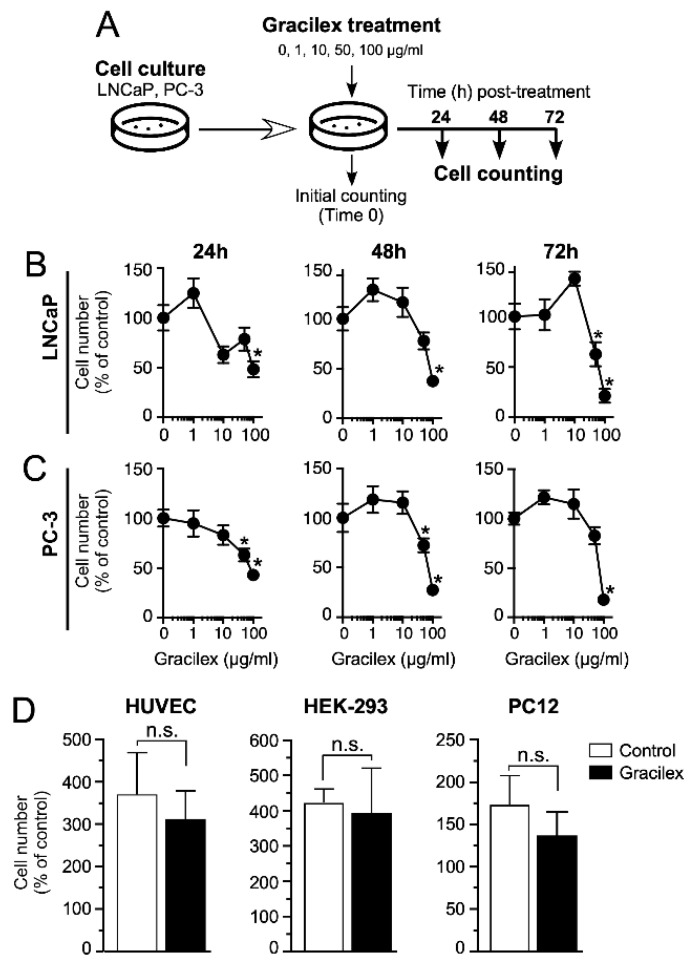
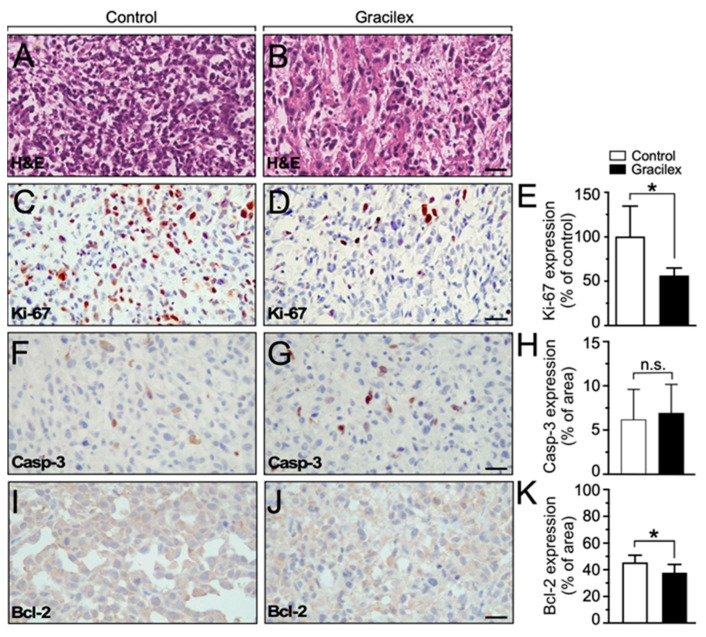
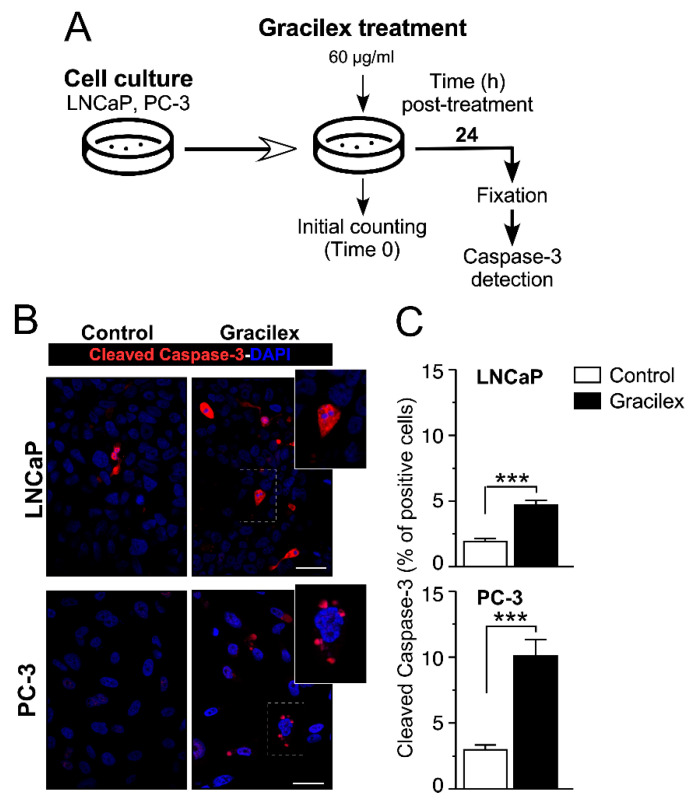
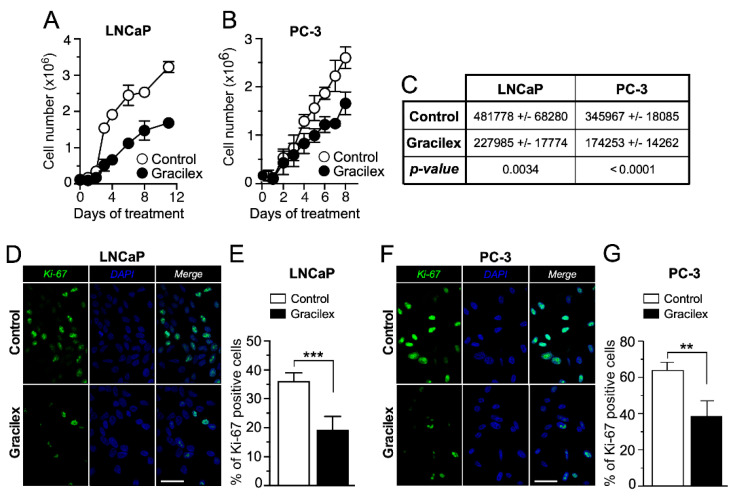
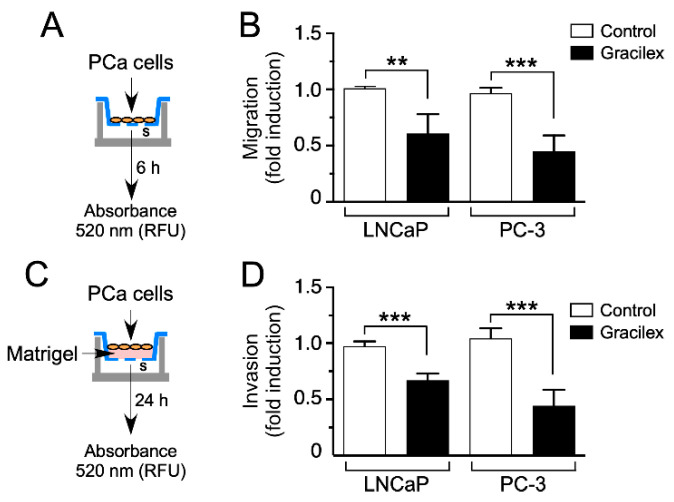
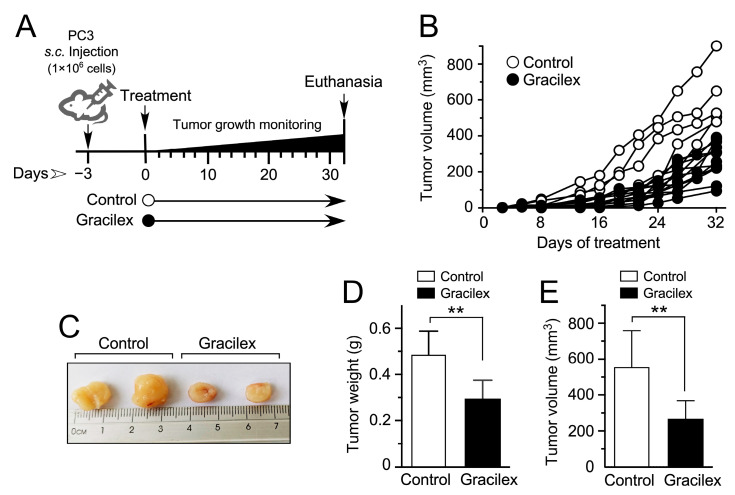
Prostate cancer (PCa) is the second leading cause of cancer-related death among men in most Western countries. Current therapies for PCa are limited, often ineffective, and associated with significant side effects. As a result, there is a growing interest in exploring new therapeutic agents, particularly from the polyphyletic group of algae, which offers a promising source of compounds with anticancer properties. Our research group has focused on investigating the effects of a novel oleoresin from , known as Gracilex, as a potential therapeutic agent against PCa using both in vitro and in vivo models. Our findings indicate that Gracilex exhibits a time- and dose-dependent inhibitory effect on cell survival in LNCaP and PC-3 PCa, reducing viability by over 50% and inducing apoptosis, as evidenced by a significant increase in activated caspase-3 expression in both cell lines. Moreover, Gracilex significantly reduces the proliferation rate of both LNCaP and PC-3 prostate cancer cell lines, as evidenced by a marked decrease in the growth curve slope ( = 0.0034 for LNCaP; < 0.0001 for PC-3) and a 40-50% reduction in the proportion of Ki-67-positive PCa cells. In addition, Gracilex significantly reduces in vitro cell migration and invasion in LNCaP and PC-3 cell lines. Lastly, Gracilex inhibits tumor growth in an in vivo xenograft model, an effect that correlates with the reduced PCa cell proliferation observed in tumor tissue sections. Collectively, our data strongly support the broad antitumoral effects of Gracilex on PCa cells in vitro and in vivo. These findings advance our understanding of its potential therapeutic role in PCa and highlight the relevance of further investigating algae-derived compounds for cancer treatment.
在大多数西方国家,前列腺癌(PCa)是男性癌症相关死亡的第二大主要原因。目前用于治疗PCa的方法有限,通常效果不佳,且伴有严重的副作用。因此,人们越来越有兴趣探索新的治疗药物,特别是来自多系藻类的药物,藻类提供了具有抗癌特性的化合物的有前景来源。我们的研究小组专注于研究一种来自[具体藻类名称未给出]的新型油树脂(称为Gracilex)作为抗PCa潜在治疗药物的作用,使用了体外和体内模型。我们的研究结果表明,Gracilex对LNCaP和PC-3前列腺癌细胞的细胞存活具有时间和剂量依赖性抑制作用,使细胞活力降低超过50%并诱导细胞凋亡,这在两种细胞系中活化的caspase-3表达显著增加中得到证明。此外,Gracilex显著降低了LNCaP和PC-3前列腺癌细胞系的增殖率,生长曲线斜率明显下降(LNCaP为0.0034;PC-3小于0.0001)以及Ki-67阳性PCa细胞比例降低40 - 50%证明了这一点。此外,Gracilex显著降低了LNCaP和PC-3细胞系的体外细胞迁移和侵袭。最后,Gracilex在体内异种移植模型中抑制肿瘤生长,这种作用与在肿瘤组织切片中观察到的PCa细胞增殖减少相关。总体而言,我们的数据有力地支持了Gracilex在体外和体内对PCa细胞具有广泛的抗肿瘤作用。这些发现推进了我们对其在PCa中潜在治疗作用的理解,并突出了进一步研究藻类衍生化合物用于癌症治疗的相关性。