Yin Tao, Song Chaoyu, Li Huan, Wang Shaoxia, Wei Wenliang, Meng Jie, Liu Qing
College of Resources and Environment, Qingdao Agricultural University, Qingdao 266109, China.
Qingdao Academy of Agricultural Sciences, Qingdao 266100, China.
Plants (Basel). 2025 Aug 2;14(15):2383. doi: 10.3390/plants14152383.
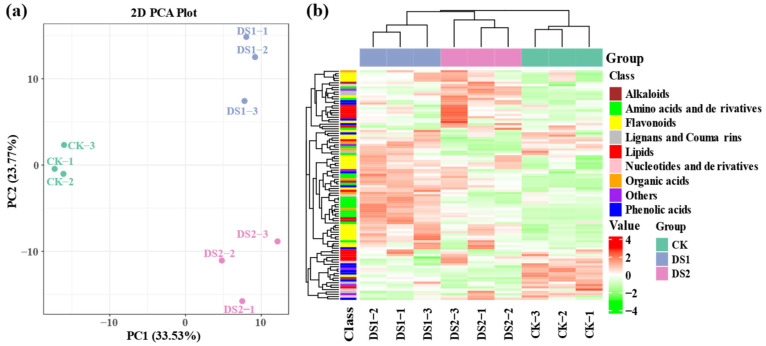
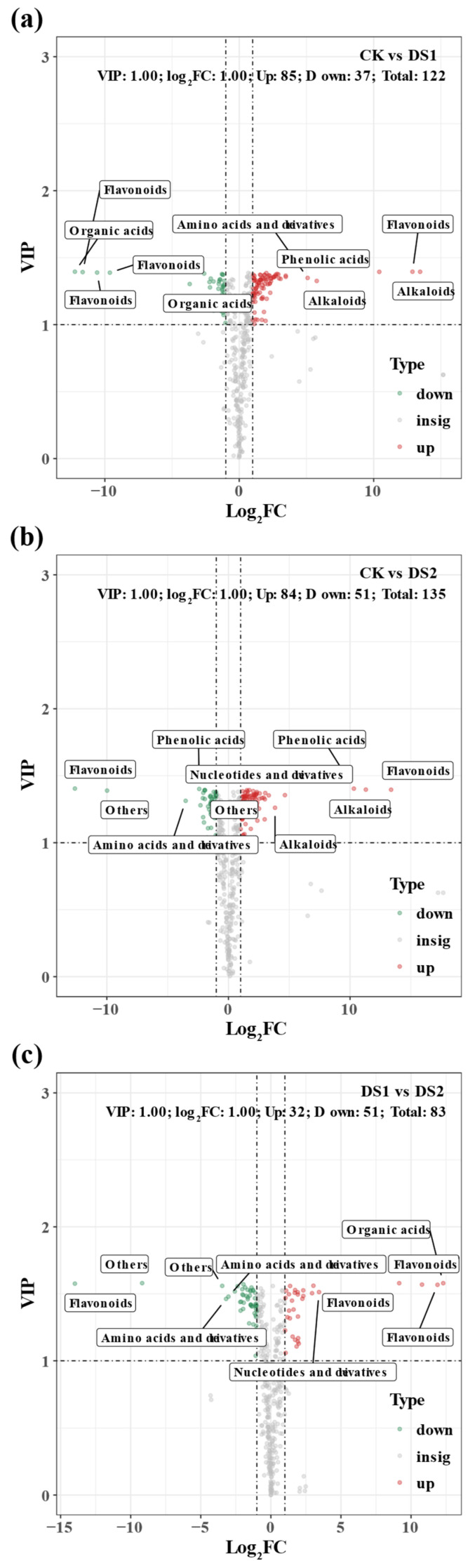
Drought stress severely limits the productivity of sweet potato ( L.), yet the stage-specific molecular mechanisms of its adaptation remain poorly understood. Therefore, we integrated transcriptomics and extensive targeted metabolomics analysis to investigate the drought responses of the sweet potato cultivar 'Luoyu 11' during the branching and tuber formation stage (DS1) and the storage root expansion stage (DS2) under controlled drought conditions (45 ± 5% field capacity). Transcriptome analysis identified 8292 and 13,509 differentially expressed genes in DS1 and DS2, respectively, compared with the well-watered control (75 ± 5% field capacity). KEGG enrichment analysis revealed the activation of plant hormone signaling, carbon metabolism, and flavonoid biosynthesis pathways, and more pronounced transcriptional changes were observed during the DS2 stage. Metabolomic analysis identified 415 differentially accumulated metabolites across the two growth periods, with flavonoids being the most abundant (accounting for 30.3% in DS1 and 23.7% in DS2), followed by amino acids and organic acids, which highlighted their roles in osmotic regulation and oxidative stress alleviation. Integrated omics analysis revealed stage-specific regulation of flavonoid biosynthesis under drought stress. Genes such as and were consistently downregulated, whereas flavonol synthase and glycosyltransferases exhibited differential expression patterns, which correlated with the selective accumulation of trifolin and luteoloside. Our findings provide novel insights into the molecular basis of drought tolerance in sweet potato and offer actionable targets for breeding and precision water management in drought-prone regions.
干旱胁迫严重限制了甘薯(Ipomoea batatas (L.))的生产力,但其适应的阶段特异性分子机制仍知之甚少。因此,我们整合了转录组学和广泛的靶向代谢组学分析,以研究甘薯品种‘洛薯11’在分枝和块根形成阶段(DS1)以及在可控干旱条件(田间持水量45±5%)下的贮藏根膨大阶段(DS2)的干旱响应。与充分浇水的对照(田间持水量75±5%)相比,转录组分析分别在DS1和DS2中鉴定出8292个和13509个差异表达基因。KEGG富集分析揭示了植物激素信号传导、碳代谢和类黄酮生物合成途径的激活,并且在DS2阶段观察到更明显的转录变化。代谢组学分析在两个生长时期鉴定出415种差异积累的代谢物,其中类黄酮含量最高(在DS1中占30.3%,在DS2中占23.7%),其次是氨基酸和有机酸,这突出了它们在渗透调节和减轻氧化应激中的作用。综合组学分析揭示了干旱胁迫下类黄酮生物合成的阶段特异性调控。诸如CHS和CHI等基因持续下调,而黄酮醇合酶和糖基转移酶表现出差异表达模式,这与三叶豆苷和木犀草苷的选择性积累相关。我们的研究结果为甘薯耐旱性的分子基础提供了新的见解,并为干旱易发地区的育种和精准水分管理提供了可操作的靶点。