Arcieri Martina, Cuman Margherita, Restaino Stefano, Tius Veronica, Cianci Stefano, Ronsini Carlo, Martinelli Canio, Bordin Filippo, Pregnolato Sara, Di Donato Violante, Crestani Alessandro, Morlacco Alessandro, Dal Moro Fabrizio, Driul Lorenza, Cucinella Giuseppe, Chiantera Vito, Ercoli Alfredo, Scambia Giovanni, Vizzielli Giuseppe
Department of Obstetrics and Gynaecology, Azienda Sanitaria Universitaria Friuli Centrale, Ospedale Santa Maria della Misericordia, 33100 Udine, Italy.
Obstetrics and Gynaecology, Department of Medical Area (DAME), University of Udine, 33100 Udine, Italy.
Healthcare (Basel). 2025 Jul 23;13(15):1780. doi: 10.3390/healthcare13151780.
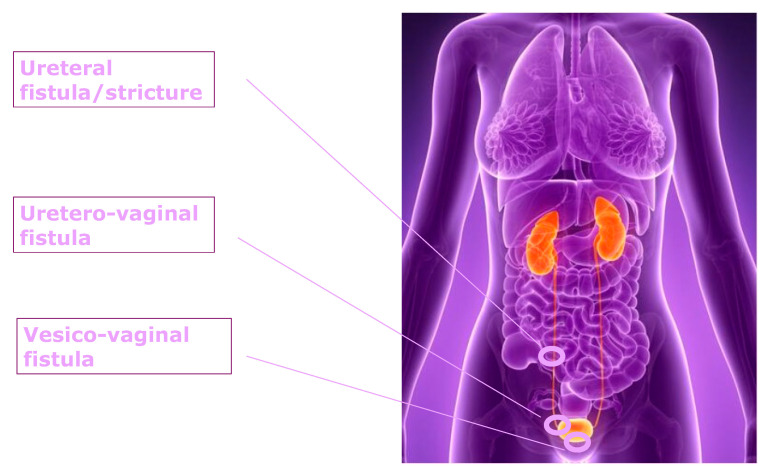
Iatrogenic urinary tract injury is a known complication of pelvic surgery, most commonly occurring during gynecological procedures. The bladder and ureters are particularly vulnerable due to their close anatomical proximity to the uterus. Urinary tract damage can result from various mechanisms, including laceration, ligation, and thermal injury. Incidence rates vary according to the affected organ and surgical type; bladder injuries occur in 0.24% of benign and 0.4-3.7% of oncologic surgeries, whereas ureteral injuries are reported in 0.08% of benign and 0.39-1.1% of oncologic procedures. Timely diagnosis is essential for effective management. When detected intraoperatively, the injury can often be repaired immediately. Surgical treatment options vary depending on the specific nature and location of the bladder or ureteral damage. Delayed diagnosis can significantly impact the patient's quality of life, increasing the risk of severe complications such as genitourinary fistulas. This narrative review aims to summarize current evidence on the diagnosis, prevention, and treatment of urinary tract injuries occurring during gynecological surgery. It evaluates risk factors, incidence, management, complications, and prevention strategies for iatrogenic bladder and ureteral injuries. Additionally, it highlights the innovative role of artificial intelligence in preventing urologic damage during gynecological procedures. The relevant literature was identified through a structured search of the PubMed database using predefined keywords related to gynecological surgery and urinary tract injury.
医源性尿路损伤是盆腔手术已知的并发症,最常发生于妇科手术过程中。膀胱和输尿管因其与子宫在解剖位置上紧密相邻而特别容易受损。尿路损伤可由多种机制引起,包括撕裂、结扎和热损伤。发病率因受影响的器官和手术类型而异;膀胱损伤在良性手术中发生率为0.24%,在肿瘤手术中为0.4 - 3.7%,而输尿管损伤在良性手术中报告发生率为0.08%,在肿瘤手术中为0.39 - 1.1%。及时诊断对于有效治疗至关重要。术中检测到损伤时,通常可立即进行修复。手术治疗方案因膀胱或输尿管损伤的具体性质和位置而异。延迟诊断会显著影响患者的生活质量,增加诸如泌尿生殖瘘等严重并发症的风险。本叙述性综述旨在总结妇科手术中发生的尿路损伤的诊断、预防和治疗的当前证据。它评估医源性膀胱和输尿管损伤的危险因素、发病率、治疗、并发症及预防策略。此外,它还强调了人工智能在预防妇科手术中泌尿系统损伤方面的创新作用。通过使用与妇科手术和尿路损伤相关的预定义关键词对PubMed数据库进行结构化检索,确定了相关文献。