Chang Heekyung, Do Youngjoo, Ahn Jinyeong, Kim Yumi
College of Nursing, Gyeongsang National University, Jinju 52727, Republic of Korea.
College of Nursing, Cheongam University, Jinju 57997, Republic of Korea.
Healthcare (Basel). 2025 Jul 25;13(15):1809. doi: 10.3390/healthcare13151809.
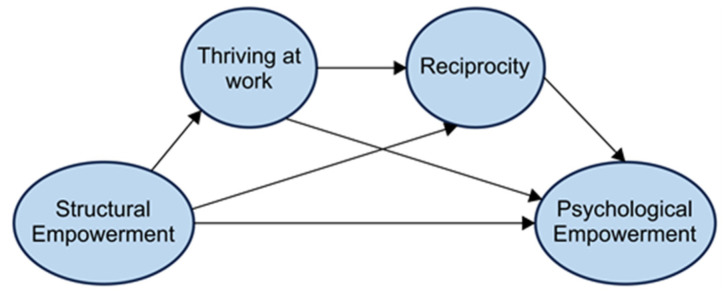
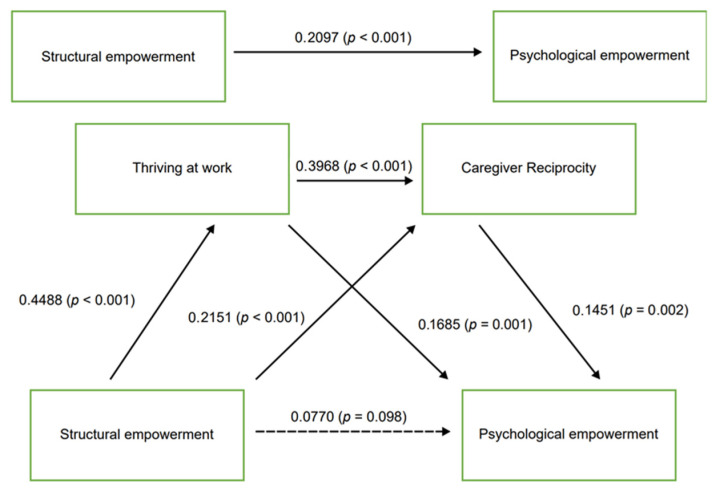
Given the critical workforce challenges in home care settings and the limited understanding of empowerment mechanisms in isolated work environments, this study aimed to examine how structural empowerment influences psychological empowerment among home care workers in South Korea through the mediating pathways of thriving at work and caregiver reciprocity. Based on Kanter's empowerment theory, we specifically investigated the serial mediation effects to understand the complex processes through which organizational support structures translate into enhanced worker empowerment. A cross-sectional survey was conducted with 192 home care workers. Data were analyzed using descriptive statistics, correlation analysis, and serial multiple mediation analysis using SPSS Process Macro Model 6. Structural empowerment demonstrated significant positive correlations with thriving at work (r = 0.445, < 0.001), caregiver reciprocity (r = 0.490, < 0.001), and psychological empowerment (r = 0.337, < 0.001). Thriving at work significantly influenced both caregiver reciprocity (β = 0.3968, < 0.001) and psychological empowerment (β = 0.1685, < 0.001). The serial mediation analysis revealed that the indirect effect of structural empowerment on psychological empowerment through thriving at work and caregiver reciprocity was statistically significant (indirect effect = 0.1327, 95% CI [0.0713, 0.1929]), with the model explaining 58% of the variance in psychological empowerment. Structural empowerment significantly enhances psychological empowerment among home care workers through the sequential mediation of thriving at work and caregiver reciprocity. Healthcare organizations should prioritize strengthening structural empowerment through comprehensive support systems and conducive work environments to optimize care quality and worker well-being.
鉴于家庭护理环境中关键的劳动力挑战以及对孤立工作环境中赋权机制的理解有限,本研究旨在探讨结构赋权如何通过工作蓬勃发展和照顾者互惠的中介途径影响韩国家庭护理工作者的心理赋权。基于坎特的赋权理论,我们特别研究了系列中介效应,以了解组织支持结构转化为增强工作者赋权的复杂过程。对192名家庭护理工作者进行了横断面调查。使用描述性统计、相关性分析以及使用SPSS Process宏模型6进行系列多重中介分析对数据进行了分析。结构赋权与工作蓬勃发展(r = 0.445,<0.001)、照顾者互惠(r = 0.490,<0.001)和心理赋权(r = 0.337,<0.001)呈显著正相关。工作蓬勃发展对照顾者互惠(β = 0.3968,<0.001)和心理赋权(β = 0.1685,<0.001)均有显著影响。系列中介分析表明,结构赋权通过工作蓬勃发展和照顾者互惠对心理赋权的间接效应具有统计学意义(间接效应 = 0.1327,95% CI [0.0713, 0.1929]),该模型解释了心理赋权方差的58%。结构赋权通过工作蓬勃发展和照顾者互惠的顺序中介显著增强了家庭护理工作者的心理赋权。医疗保健组织应优先通过全面的支持系统和有利的工作环境加强结构赋权,以优化护理质量和工作者福祉。