Schuler Rahel, Kreidler Alice Louise, Waitz Markus, Kampschulte Birgit, Petzinger Jutta, Frodermann Tina, Hahn Andreas, Mihatsch Walter A
Department of General Pediatrics and Neonatology, Justus-Liebig-University, Feulgenstrasse 12, D-35392 Giessen, Germany.
Department of Pediatric Neurology, Justus-Liebig-University, Feulgenstrasse 12, D-35392 Giessen, Germany.
Nutrients. 2025 Jul 26;17(15):2444. doi: 10.3390/nu17152444.
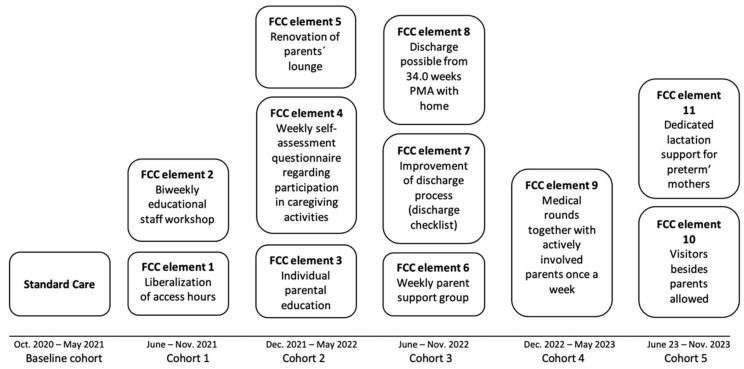
: Breastmilk offers numerous benefits for the health and development of preterm infants, while prolonged hospitalization may impair neurodevelopment. At our institution, the implementation of enhanced family-centered care (FCC) has enabled earlier discharge of preterm infants. This study aimed to assess the impact of early discharge on breastfeeding and breastmilk provision. : This analysis is based on data from a prospective single-center longitudinal cohort study conducted from October 2020 to November 2023, involving six consecutive cohorts (one baseline and five intervention cohorts; n = 184). FCC was progressively enhanced across cohorts. The primary outcome of the main study was postmenstrual age (PMA) at discharge. In this secondary analysis, breastfeeding and breastmilk provision were assessed at four time points: 4 weeks postnatal age, at discharge, 4 weeks post-discharge, and at 3 months PMA. : From baseline to intervention cohort 5, the PMA at discharge declined significantly from 37.8 ± 2.1 to 35.7 ± 0.91 weeks ( = 0.03), while the percentage of infants necessitating home nasogastric tube feeding increased from 6.3% to 66.7% ( < 0.01). The proportion of breastmilk of daily feeding volume remained unchanged at 4 weeks postnatal age (0.66 ± 0.42 vs. 0.9 ± 0.28) and at discharge (0.6 ± 0.45 vs. 0.79 ± 0.36). At 4 weeks post-discharge, 65.8% vs. 62.5% of the infants were on partial or exclusive breastmilk ( = 0.91) feeding. Similarly, the percentage of exclusively breastfed infants at 4 weeks post-discharge (23.7% vs. 19.8%) and at 3 months PMA (20% vs. 28.6%) did not differ significantly between baseline and intervention cohort 5. : Early discharge did not reduce breastmilk supply or exclusive breastfeeding. However, the persistently low rate of exclusive breastfeeding post-discharge highlights the need for additional support strategies during and after hospitalization.
母乳对早产儿的健康和发育有诸多益处,而长期住院可能会损害神经发育。在我们机构,强化以家庭为中心的护理(FCC)的实施使早产儿能够更早出院。本研究旨在评估早期出院对母乳喂养和母乳供应的影响。:本分析基于2020年10月至2023年11月进行的一项前瞻性单中心纵向队列研究的数据,涉及六个连续队列(一个基线队列和五个干预队列;n = 184)。FCC在各队列中逐步强化。主要研究的主要结局是出院时的月经后年龄(PMA)。在这项二次分析中,在四个时间点评估母乳喂养和母乳供应情况:出生后4周、出院时、出院后4周以及PMA为3个月时。:从基线到干预队列5,出院时的PMA从37.8±2.1周显著下降至35.7±0.91周(P = 0.03),而需要在家进行鼻胃管喂养的婴儿比例从6.3%增加至66.7%(P < 0.01)。出生后4周(0.66±0.42对0.9±0.28)和出院时(0.6±0.45对0.79±0.36),每日喂养量中母乳的比例保持不变。出院后4周,65.8%对62.5%的婴儿进行部分或纯母乳喂养(P = 0.91)。同样,出院后4周(23.7%对19.8%)和PMA为3个月时(20%对28.6%)纯母乳喂养婴儿的比例在基线和干预队列5之间无显著差异。:早期出院并未减少母乳供应或纯母乳喂养率。然而,出院后纯母乳喂养率持续较低凸显了在住院期间及出院后需要额外的支持策略。