Mickevičius Vytautas, Anusevičius Kazimieras, Sapijanskaitė-Banevič Birutė, Jonuškienė Ilona, Kapočius Linas, Grybaitė Birutė, Grigalevičiūtė Ramunė, Kavaliauskas Povilas
Department of Organic Chemistry, Kaunas University of Technology, Radvilenu˛ Rd. 19, LT-50254 Kaunas, Lithuania.
Biological Research Centre, Lithuanian University of Health Sciences, Tilžės g. 18, LT-47181 Kaunas, Lithuania.
Molecules. 2025 Aug 7;30(15):3303. doi: 10.3390/molecules30153303.
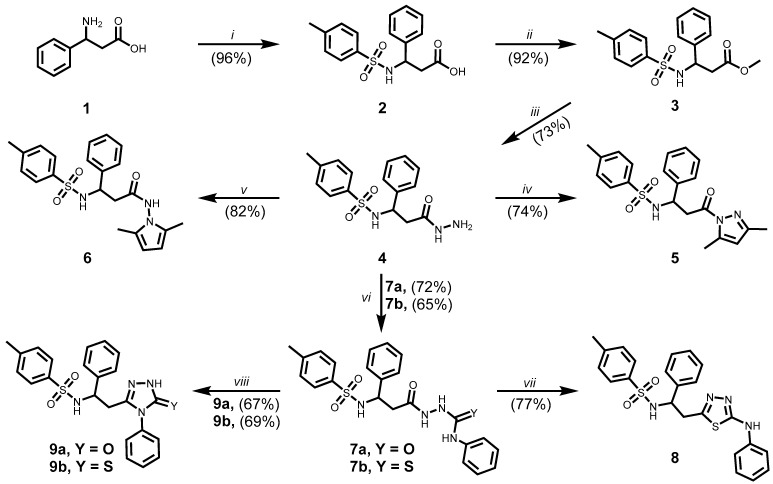
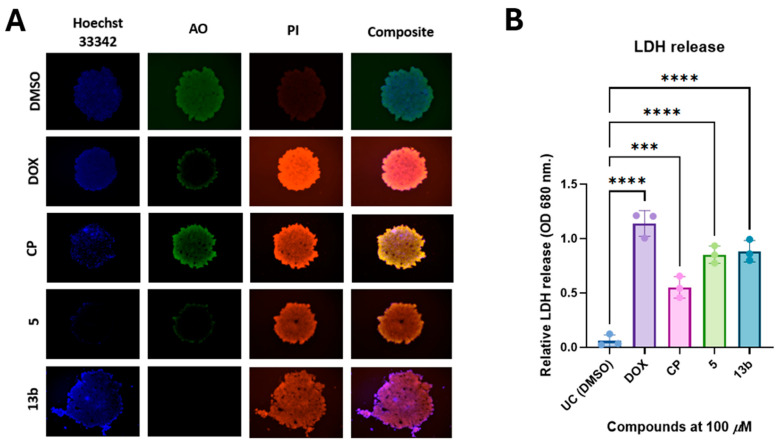
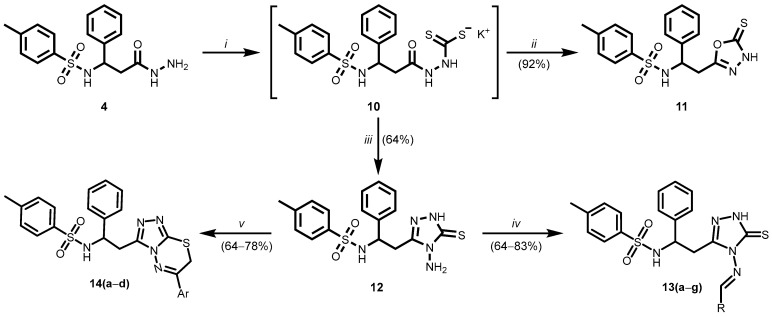
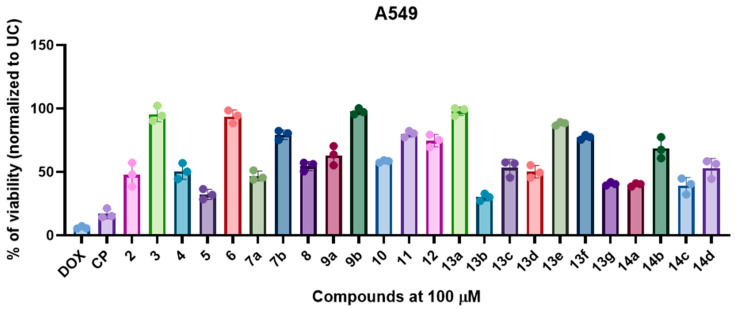
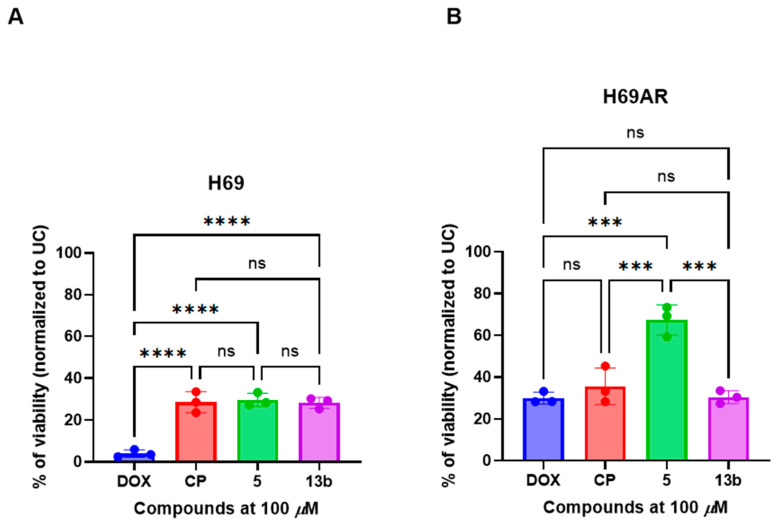
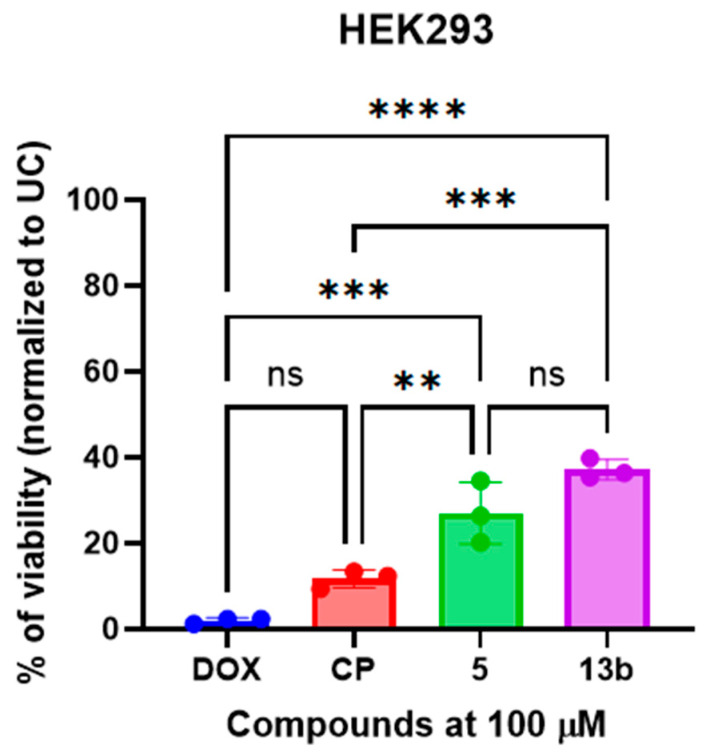
In this study, a series of novel -phenylalanine derivatives were synthesised and evaluated for their anticancer activity. The 3-(4-methylbenzene-1-sulfonamido)-3-phenylpropanoic acid () was prepared using -phenylalanine as a core scaffold. The -amino acid derivative was converted to the corresponding hydrazide , which enabled the development of structurally diverse heterocyclic derivatives including pyrrole , pyrazole , thiadiazole , oxadiazole , triazoles and with Schiff base analogues and series1,2,4-triazolo [3,4-][1,3,4]thiadiazines . These modifications were designed to enhance chemical stability, solubility, and biological activity. All compounds were initially screened for cytotoxicity against the A549 human lung adenocarcinoma cell line, identifying -[3-(3,5-dimethyl-1-pyrazol-1-yl)-3-oxo-1-phenylpropyl]-4-methylbenzenesulfonamide () and ()--{2-[4-[(4-chlorobenzylidene)amino]-5-thioxo-4,5-dihydro-1-1,2,4-triazol-3-yl]-1-phenylethyl}-4-methylbenzenesulfonamide () as the most active. The two lead candidates were further evaluated in H69 and H69AR small cell lung cancer lines to assess activity in drug-sensitive and multidrug-resistant models. Schiff base containing a 4-chlorophenyl moiety, retained potent antiproliferative activity in both H69 and H69AR cells, comparable to cisplatin, while compound lost efficacy in the resistant phenotype. These findings suggest Schiff base derivative may overcome drug resistance mechanisms, a limitation commonly encountered with standard chemotherapeutics such as doxorubicin. These results demonstrate the potential role of -phenylalanine derivatives, azole-containing sulphonamides, as promising scaffolds for the development of novel anticancer agents, particularly in the context of lung cancer and drug-resistant tumours.
在本研究中,合成了一系列新型苯丙氨酸衍生物,并对其抗癌活性进行了评估。以苯丙氨酸为核心骨架制备了3-(4-甲基苯-1-磺酰胺基)-3-苯基丙酸()。氨基酸衍生物被转化为相应的酰肼,从而能够开发出结构多样的杂环衍生物,包括吡咯()、吡唑()、噻二唑()、恶二唑()、三唑()和,以及席夫碱类似物和1,2,4-三唑并[3,4-][1,3,4]噻二嗪系列。这些修饰旨在提高化学稳定性、溶解度和生物活性。所有化合物最初都针对A549人肺腺癌细胞系进行了细胞毒性筛选,确定-[3-(3,5-二甲基-1-吡唑-1-基)-3-氧代-1-苯基丙基]-4-甲基苯磺酰胺()和()--{2-[4-[(4-氯亚苄基)氨基]-5-硫代-4,5-二氢-1,2,4-三唑-3-基]-1-苯乙基}-4-甲基苯磺酰胺()为活性最强的化合物。这两种先导候选物在H69和H69AR小细胞肺癌细胞系中进一步评估,以评估其在药物敏感和多药耐药模型中的活性。含有4-氯苯基部分的席夫碱在H69和H69AR细胞中均保留了较强的抗增殖活性,与顺铂相当,而化合物在耐药表型中失去了疗效。这些发现表明席夫碱衍生物可能克服耐药机制,这是多柔比星等标准化疗药物常见 limitations。这些结果证明了苯丙氨酸衍生物、含唑磺酰胺作为新型抗癌药物开发的有前景的骨架的潜在作用,特别是在肺癌和耐药肿瘤方面。