Banaszek Sebastian, Szota Michał
Institute of Geodesy and Cartography, 27 Modzelewski Street, 02-679 Warsaw, Poland.
Fire Academy, 52/54 Slowackiego Street, 01-629 Warsaw, Poland.
Sensors (Basel). 2025 Jul 31;25(15):4734. doi: 10.3390/s25154734.
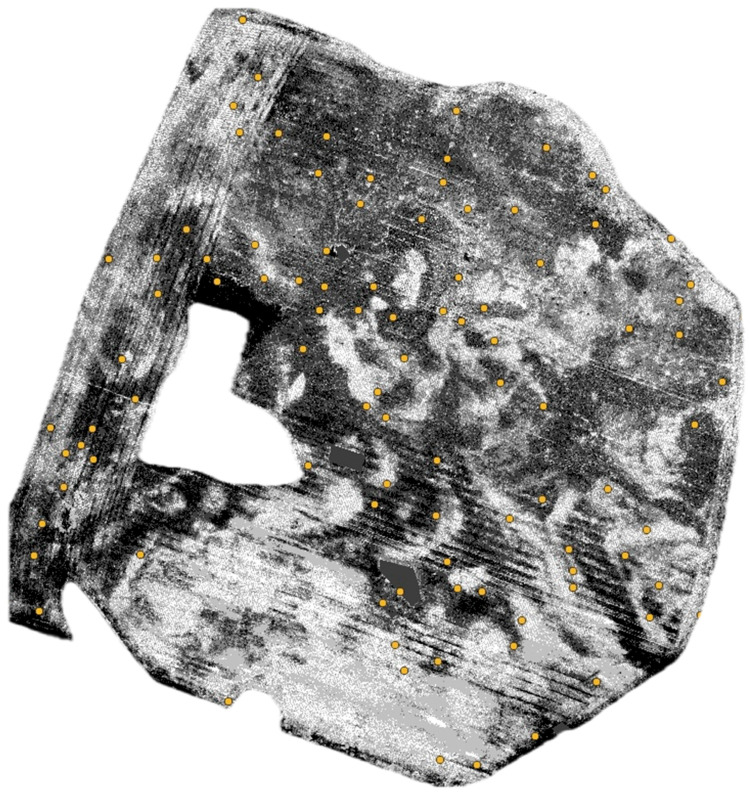
Monitoring crop damage caused by wildlife remains a significant challenge in agricultural management, particularly in the case of large-scale monocultures such as maize. The given study presents a semi-automated process for detecting wildlife-induced damage using RGB imagery acquired from unmanned aerial vehicles (UAVs). The method is designed for non-specialist users and is fully integrated within the QGIS platform. The proposed approach involves calculating three vegetation indices-Excess Green (ExG), Green Leaf Index (GLI), and Modified Green-Red Vegetation Index (MGRVI)-based on a standardized orthomosaic generated from RGB images collected via UAV. Subsequently, an unsupervised k-means clustering algorithm was applied to divide the field into five vegetation vigor classes. Within each class, 25% of the pixels with the lowest average index values were preliminarily classified as damaged. A dedicated QGIS plugin enables drone data analysts (Drone Data Analysts-DDAs) to adjust index thresholds, based on visual interpretation, interactively. The method was validated on a 50-hectare maize field, where 7 hectares of damage (15% of the area) were identified. The results indicate a high level of agreement between the automated and manual classifications, with an overall accuracy of 81%. The highest concentration of damage occurred in the "moderate" and "low" vigor zones. Final products included vigor classification maps, binary damage masks, and summary reports in HTML and DOCX formats with visualizations and statistical data. The results confirm the effectiveness and scalability of the proposed RGB-based procedure for crop damage assessment. The method offers a repeatable, cost-effective, and field-operable alternative to multispectral or AI-based approaches, making it suitable for integration with precision agriculture practices and wildlife population management.
监测野生动物对农作物造成的损害仍然是农业管理中的一项重大挑战,尤其是在玉米等大规模单一作物种植的情况下。本研究提出了一种半自动流程,用于使用从无人机(UAV)获取的RGB图像检测野生动物造成的损害。该方法是为非专业用户设计的,并完全集成在QGIS平台内。所提出的方法包括基于通过无人机收集的RGB图像生成的标准化正射镶嵌图计算三个植被指数——过量绿色指数(ExG)、绿叶指数(GLI)和修正的绿红植被指数(MGRVI)。随后,应用无监督k均值聚类算法将田地划分为五个植被活力等级。在每个等级中,平均指数值最低的25%的像素被初步分类为受损像素。一个专门的QGIS插件使无人机数据分析人员(Drone Data Analysts-DDAs)能够根据视觉解释交互式地调整指数阈值。该方法在一个50公顷的玉米田上进行了验证,在该玉米田中识别出了7公顷的受损区域(占总面积的15%)。结果表明,自动分类和人工分类之间具有高度一致性,总体准确率为81%。受损最集中的区域出现在“中等”和“低”活力区。最终产品包括活力分类图、二元损害掩码以及HTML和DOCX格式的总结报告,其中包含可视化和统计数据。结果证实了所提出的基于RGB的作物损害评估程序的有效性和可扩展性。该方法为多光谱或基于人工智能的方法提供了一种可重复、经济高效且可在田间操作的替代方案,使其适合与精准农业实践和野生动物种群管理相结合。