Wu Xiaoli, Yin Ting, Liu Wenyan, Wan Libo, Liao Yijun
School of Materials and Environmental Engineering, Chengdu Technological University, Chengdu 611730, China.
School of Humanities and Design, Chengdu Technological University, Chengdu 611730, China.
Polymers (Basel). 2025 Jul 27;17(15):2047. doi: 10.3390/polym17152047.
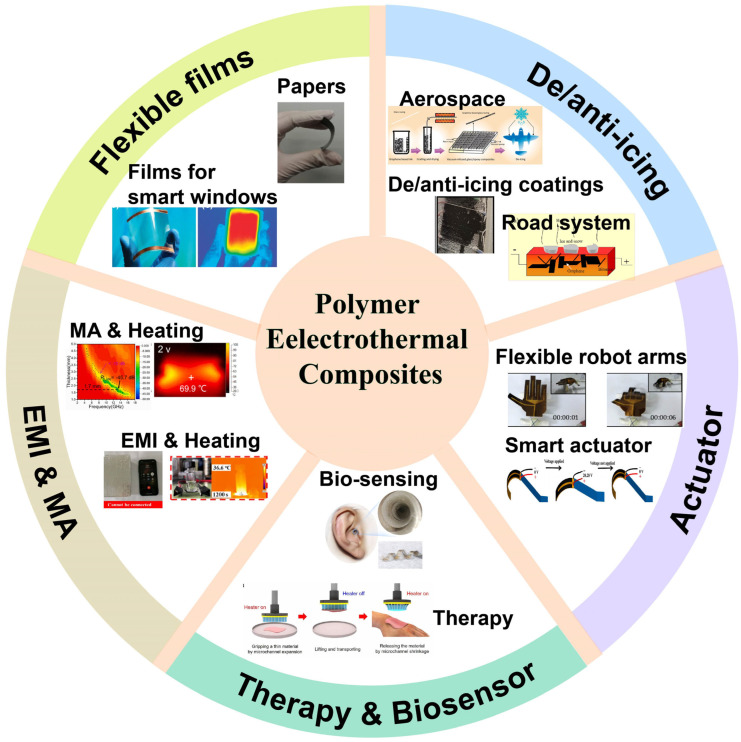
Polymer-based electrothermal composites (PECs) have been increasingly attracting attention in recent years owing to their flexibility, low density, and high electrothermal efficiency. However, although a large number of reviews have focused on flexible and transparent film heaters as well as polymer-based conductive composites, comprehensive reviews of polymer-based electrothermal composites remain limited. Herein, we provide a comprehensive review of recent advancements in polymer-based electrothermal materials. This review begins with an introduction to the electrothermal theoretical basis and the research progress of PECs incorporating various conductive fillers, such as graphene, carbon nanotubes (CNTs), carbon black (CB), MXenes, and metal nanowires. Furthermore, a critical discussion is provided to emphasize the factors influencing the electrothermal conversion efficiency of these composites. Meanwhile, the development of multi-functional electrothermal materials has been also summarized. Finally, the application progress, future prospects, limitations, and potential directions for PEC are discussed. This review aims to serve as a practical guide for engineers and researchers engaged in the development of polymer-based electrothermal composites.
近年来,基于聚合物的电热复合材料(PECs)因其柔韧性、低密度和高电热效率而越来越受到关注。然而,尽管大量综述聚焦于柔性透明薄膜加热器以及基于聚合物的导电复合材料,但对基于聚合物的电热复合材料的全面综述仍然有限。在此,我们对基于聚合物的电热材料的最新进展进行全面综述。本综述首先介绍电热理论基础以及包含各种导电填料(如石墨烯、碳纳米管(CNTs)、炭黑(CB)、MXenes和金属纳米线)的PECs的研究进展。此外,还进行了批判性讨论,以强调影响这些复合材料电热转换效率的因素。同时,也总结了多功能电热材料的发展情况。最后,讨论了PECs的应用进展、未来前景、局限性和潜在发展方向。本综述旨在为从事基于聚合物的电热复合材料开发的工程师和研究人员提供实用指南。